
Online Database of Chemicals from Around the World
| Sichuan Huamai Technology Co., Ltd. | China | |||
|---|---|---|---|---|
 | www.huamay.com | |||
 | +86 (28) 8012-5218 | |||
 | +86 (28) 8514-2568 | |||
 | wqkoa.newland@gmail.com | |||
| Chemical manufacturer since 2003 | ||||
| chemBlink Standard supplier since 2007 | ||||
| Opchem (Changzhou) Co., Ltd. | China | |||
|---|---|---|---|---|
| www.op-chem.com | |||
| +86 (519) 8328-8015 | |||
| info@op-chem.com | |||
| Chemical distributor since 2018 | ||||
| chemBlink Standard supplier since 2019 | ||||
| Beijing Scipromed Biotech Co.,ltd. | China | |||
|---|---|---|---|---|
| www.sciprotech.com | |||
| +86 13051765615 | |||
| support@sciprotech.com | |||
| Chemical manufacturer since 2023 | ||||
| chemBlink Standard supplier since 2024 | ||||
| Crescent Chemical Co. Inc. | USA | |||
|---|---|---|---|---|
| www.crescentchemical.com | |||
| +1 (631) 348-0333 | |||
| +1 (631) 348-0913 | |||
| crescent@creschem.com | |||
| Chemical distributor | ||||
| Classification | Biochemical >> Peptide |
|---|---|
| Name | Fibroblast Growth Factor |
| Synonyms | (2R)-N-[(2R)-1-[[(2R)-6-amino-1-[[(2R)-6-amino-1-[(2R)-2-(hydroxymethyl)pyrrolidin-1-yl]-1-oxohexan-2-yl]amino]-1-oxohexan-2-yl]amino]-3-(4-hydroxyphenyl)-1-oxopropan-2-yl]-2-[[2-[[(2R)-2-[[(2R)-1-[(2R)-2-[[(2R)-4-amino-2-[[(2R)-2-amino-3-phenylpropanoyl]amino]-4-oxobutanoyl]amino]-4-methylpentanoyl]pyrrolidine-2-carbonyl]amino]-4-methylpentanoyl]amino]acetyl]amino]butanediamide |
| Molecular Structure | 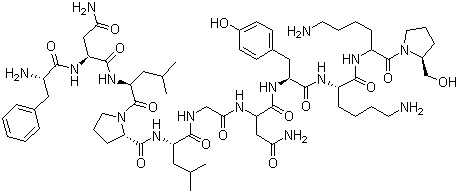 |
| Molecular Formula | C62H97N15O14 |
| Molecular Weight | 1276.53 |
| Protein Sequence | FNLPLGNYKKP |
| CAS Registry Number | 62031-54-3 |
| SMILES | CC(C)C[C@H](C(=O)NCC(=O)N[C@H](CC(=O)N)C(=O)N[C@H](CC1=CC=C(C=C1)O)C(=O)N[C@H](CCCCN)C(=O)N[C@H](CCCCN)C(=O)N2CCC[C@@H]2CO)NC(=O)[C@H]3CCCN3C(=O)[C@@H](CC(C)C)NC(=O)[C@@H](CC(=O)N)NC(=O)[C@@H](CC4=CC=CC=C4)N |
| SDS | Available |
|---|---|
 chemBlink Chemical Story
|
Fibroblast Growth Factor (FGF) is a significant protein involved in various biological processes, including cell growth, differentiation, and tissue repair. The discovery and characterization of FGF have provided profound insights into cellular signaling mechanisms and developmental biology. FGF was first identified in the early 20th century during studies aimed at understanding tissue regeneration and repair. The protein was initially discovered in extracts from brain tissue and was later recognized for its ability to stimulate fibroblast proliferation and tissue regeneration. Subsequent research revealed that FGF is not a single entity but rather a family of related proteins, each with distinct functions and receptors. One of the primary applications of FGF is in regenerative medicine and tissue engineering. FGF plays a crucial role in wound healing and tissue repair by promoting cell proliferation and migration. Its application in regenerative therapies includes the development of treatments for chronic wounds, burns, and surgical tissue repair. By stimulating fibroblast activity and tissue regeneration, FGF-based therapies aim to accelerate healing and improve recovery outcomes. In addition to its role in wound healing, FGF is employed in research related to cancer biology and developmental biology. The protein's involvement in cell signaling pathways makes it a valuable tool for studying cancer progression and metastasis. Abnormal FGF signaling has been implicated in various cancers, and understanding these pathways can lead to the development of targeted therapies and diagnostic tools. FGF is also used in developmental biology research to investigate embryonic development and organogenesis. The protein's role in regulating cell growth and differentiation is essential for understanding how tissues and organs form during development. By studying FGF signaling pathways, researchers can gain insights into congenital disorders and developmental abnormalities. Handling and using FGF in research and clinical applications require adherence to specific protocols to ensure its stability and efficacy. The protein is typically administered in a controlled environment to maintain its biological activity and avoid degradation. Proper storage and handling procedures are crucial to preserving the integrity of FGF preparations. Ongoing research continues to explore the full potential of FGF in various medical and scientific fields. Advances in biotechnology and molecular biology are expected to further elucidate the protein's functions and applications, leading to new therapeutic strategies and innovations. In summary, Fibroblast Growth Factor is a vital protein with significant roles in tissue repair, cancer research, and developmental biology. Its discovery and development have advanced our understanding of cellular signaling and provided valuable tools for medical and scientific research. References 1991. Growth factor-induced acceleration of tissue repair through direct and inductive activities in a rabbit dermal ulcer model. The Journal of clinical investigation, 87(2). DOI: 10.1172/jci115048 2024. Adipocyte FGF21 Signaling Defect Aggravated Adipoose Tissue Inflammation in Gestational Diabetes Mellitus. Nutrients, 16(22). DOI: 10.3390/nu16223826 1987. Mr 25,000 heparin-binding protein from guinea pig brain is a high molecular weight form of basic fibroblast growth factor. Proceedings of the National Academy of Sciences of the United States of America, 84(16). DOI: 10.1073/pnas.84.16.5778 |
| Market Analysis Reports |