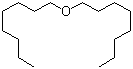
Dioctyl ether, CAS 629-82-3, is the symmetrical ether CH3(CH2)7-O-(CH2)7CH3, also called di-n-octyl ether, 1-octoxyoctane, or dicaprylyl ether. NIST and PubChem record the formula C16H34O and molecular weight 242.44. Its structure is dominated by two long hydrocarbon chains separated by a single ether oxygen.
That simple architecture gives the molecule a combination useful in personal-care formulations. The long C8 chains provide an oil-like, hydrophobic character, while the ether linkage is chemically resistant to hydrolysis compared with an ester. Under the INCI name Dicaprylyl Ether, it is used as a skin-conditioning emollient and solvent. BASF describes its commercial Cetiol OE grade as a fast-spreading emollient that gives a dry skin feel and notes the hydrolytic stability of the ether structure.
Spreading behavior is important to cosmetic sensory design. A formulation should often distribute quickly over skin or hair without feeling excessively greasy or heavy. Low-viscosity emollients can help carry pigments, UV filters or other oil-soluble ingredients while modifying slip and after-feel. Dicaprylyl ether is valued in this context because it spreads rapidly and can provide a comparatively light, dry sensory profile.
The ether bond distinguishes it from common fatty-acid esters. Esters can be cleaved by hydrolysis under sufficiently acidic, basic or enzymatic conditions; a simple dialkyl ether lacks the ester carbonyl and is generally more resistant. BASF specifically cites this property for deodorant/antiperspirant and hair-removal formulations, where hydrolytic stability can be advantageous.
Dioctyl ether is therefore an example of formulation chemistry in which a structurally uncomplicated molecule earns its role through physical behavior rather than dramatic chemical reactivity. Two hydrocarbon chains provide compatibility with oily ingredients, one oxygen adjusts molecular properties, and the result is a fast-spreading, hydrolysis-stable emollient and solvent.
References:
1. NIST Chemistry WebBook, Octane, 1,1'-oxybis-, CAS 629-82-3.
2. PubChem, Dicaprylyl Ether, CID 12399, CAS 629-82-3.
3. BASF, Cetiol OE, INCI Dicaprylyl Ether, CAS 629-82-3.
4. U.S. FDA GSRS, Dicaprylyl Ether, UNII 77JZM5516Z.
|




 GHS07 Warning Details
 chemBlink Chemical Story