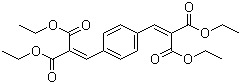
Tetraethyl 2,2'-(1,4-phenylenedimethylidyne)bismalonate is an organic compound with a complex structure that has attracted attention in various fields of chemical research. The compound consists of a central 1,4-phenylenedimethylidyne unit, which is linked to two malonate ester groups, each bound to an ethyl ester group. The structure imparts unique reactivity and electronic properties, making it an important molecule for synthesis and material science.
The discovery of tetraethyl 2,2'-(1,4-phenylenedimethylidyne)bismalonate can be traced to efforts in organic synthesis during the late 20th century, when researchers were exploring new ways to create compounds with intricate molecular architectures. The molecule was first synthesized as part of a series of compounds designed to explore the potential of aromatic systems in the formation of highly conjugated materials. The development of synthetic methods allowed chemists to connect functional groups to a central aromatic backbone, leading to the creation of this molecule.
The compound has been primarily studied for its application in organic synthesis and materials science. Due to the presence of the malonate groups, which are known for their nucleophilic reactivity, tetraethyl 2,2'-(1,4-phenylenedimethylidyne)bismalonate can undergo various chemical transformations. One important application of this compound is in the formation of polymers and copolymers. Its structure allows it to act as a monomer or building block for the preparation of polyesters and polycarbonates. The malonate ester groups provide a high degree of reactivity, making them useful in reactions with other monomers to form high-performance materials with tailored properties.
Another significant application of tetraethyl 2,2'-(1,4-phenylenedimethylidyne)bismalonate is in the development of molecular electronics. The conjugated nature of the phenylenedimethylidyne unit, combined with the reactivity of the malonate groups, makes it a candidate for use in the creation of organic semiconductors. Organic semiconductors are materials that can conduct electricity like traditional semiconductors but are made from organic molecules rather than inorganic materials like silicon. This feature makes tetraethyl 2,2'-(1,4-phenylenedimethylidyne)bismalonate an attractive compound for applications in organic light-emitting diodes (OLEDs), organic solar cells, and organic field-effect transistors (OFETs).
In addition to its use in organic electronics, tetraethyl 2,2'-(1,4-phenylenedimethylidyne)bismalonate has been studied for its role in the development of sensors and catalytic materials. The functional groups attached to the aromatic backbone allow for selective interactions with other molecules, making it useful in the design of molecular sensors for detecting specific ions or organic compounds. Additionally, the compound’s reactivity can be harnessed in catalytic processes, such as the catalysis of esterification reactions or the formation of complex organic structures.
Furthermore, tetraethyl 2,2'-(1,4-phenylenedimethylidyne)bismalonate’s structural features have made it a valuable tool in the study of molecular interactions and self-assembly. The malonate ester groups are capable of forming hydrogen bonds and interacting with other molecules, which is useful in the study of supramolecular chemistry. These interactions can be used to design new materials with specific properties or to develop more efficient catalysts for chemical reactions.
In conclusion, tetraethyl 2,2'-(1,4-phenylenedimethylidyne)bismalonate is a versatile and important compound with a range of applications in organic synthesis, material science, and molecular electronics. Its unique molecular structure and reactivity make it an important building block for the development of new materials and devices, including polymers, semiconductors, and catalytic systems. As research into its properties continues, it is likely to find further applications in advanced technologies.
|




 GHS07 Warning Details
 chemBlink Chemical Story