
Online Database of Chemicals from Around the World
| ABA Chemicals (Shanghai) Limited | China | |||
|---|---|---|---|---|
 | www.abachem.com | |||
 | +86 (21) 5115-9199 | |||
 | +86 (21) 5115-9188 | |||
 | rimondlong@abachem.com sales@abachem.com | |||
| Chemical manufacturer since 2006 | ||||
| chemBlink Standard supplier since 2009 | ||||
| BOC Sciences | USA | |||
|---|---|---|---|---|
| www.bocsci.com | |||
| +1 (631) 485-4226 | |||
| +1 (631) 614-7828 | |||
| info@bocsci.com | |||
| Chemical manufacturer | ||||
| chemBlink Standard supplier since 2010 | ||||
| Hangzhou Qichuang Chemical Co., Ltd. | China | |||
|---|---|---|---|---|
| www.qc-chemical.com | |||
| +86 (571) 8893-5129 | |||
| +86 (571) 8825-0182 | |||
| david@qc-chemical.com sales@qc-chemical.com davidw0828@gmail.com | |||
 | QQ Chat | |||
| Chemical distributor since 2009 | ||||
| chemBlink Standard supplier since 2013 | ||||
| Hangzhou Leap Chem Co., Ltd. | China | |||
|---|---|---|---|---|
| www.leapchem.com | |||
| +86 (571) 8771-1850 | |||
| market19@leapchem.com | |||
| QQ Chat | |||
| Chemical manufacturer since 2006 | ||||
| chemBlink Standard supplier since 2015 | ||||
| Cangzhou Enke Pharma-tech Co., Ltd. | China | |||
|---|---|---|---|---|
| www.enkepharma.com | |||
| +86 (317) 529-6180 510-6597 +86 15533709196 | |||
| +86 (317) 510-6596 | |||
| sale@enkepharma.com enkepharma@126.com | |||
| QQ Chat | |||
 | Skype Chat | |||
 | WeChat: ymzhao | |||
| Chemical manufacturer since 2011 | ||||
| chemBlink Standard supplier since 2016 | ||||
| Neostar United (Changzhou) Industrial Co., Ltd. | China | |||
|---|---|---|---|---|
| www.neostarunited.com | |||
| +86 (519) 8555-7386 +86 18015025600 | |||
| +86 (519) 8555-7389 | |||
| marketing1@neostarunited.com | |||
| Chemical distributor since 2014 | ||||
| chemBlink Standard supplier since 2020 | ||||
| Nanjing Qiangshan New Material Co., Ltd. | China | |||
|---|---|---|---|---|
| www.njqschem.com | |||
| +86 (25) 5702-7223 | |||
| dols80@163.com | |||
| Chemical distributor since 2011 | ||||
| chemBlink Standard supplier since 2020 | ||||
| Shanghai Edu Chemical Technology Co., Ltd. | China | |||
|---|---|---|---|---|
| www.chemido.com | |||
| +86 19301251526 | |||
| sales1@chemido.com | |||
| QQ Chat | |||
| Chemical manufacturer since 2011 | ||||
| chemBlink Standard supplier since 2025 | ||||
| Classification | Pharmaceutical intermediate >> API intermediate |
|---|---|
| Name | 2,3-Dimethyl-2H-indazol-6-amine hydrochloride |
| Synonyms | 2,3-Dimethyl-2H-indazol-6-amine monohydrochloride; 2,3-Dimethyl-6-amino-2H-indazole hydrochloride |
| Molecular Structure | 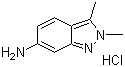 |
| Molecular Formula | C9H11N3.HCl |
| Molecular Weight | 197.67 |
| CAS Registry Number | 635702-60-2 |
| SMILES | CC1=C2C=CC(=CC2=NN1C)N.Cl |
| Hazard Symbols |  GHS07 Warning Details GHS07 Warning Details |
|---|---|
| Risk Statements | H302-H315-H319-H335 Details |
| Safety Statements | P261-P305+P351+P338 Details |
| SDS | Available |
 chemBlink Chemical Story
|
2,3-Dimethyl-2H-indazol-6-amine hydrochloride is a heteroaromatic compound derived from the indazole structural family, incorporating two methyl substituents at positions 2 and 3 on the bicyclic ring system, an amino group at position 6, and formulated as the corresponding hydrochloride salt. The molecular framework consists of a fused benzene and pyrazole ring, producing a rigid bicyclic system with defined electronic properties. The hydrochloride form enhances stability, crystallinity, and aqueous solubility by protonation of the amine, which is valuable for handling and storage in synthetic applications. The molecular formula of the free base is typically represented as C9H11N3, with the hydrochloride salt incorporating an additional equivalent of hydrogen chloride. Preparation of 2,3-dimethyl-2H-indazol-6-amine hydrochloride generally begins with construction of the indazole core through condensation of appropriately substituted hydrazines with ortho-functionalized aromatic precursors capable of intramolecular cyclization. Ring closure is enabled either thermally or through acid catalysis, forming the bicyclic indazole scaffold. Subsequent alkylation or directed methylation at positions 2 and 3 affords the required substitution pattern. Introduction of the amino group at position 6 is commonly achieved by nitration followed by reduction or, alternatively, by halogenation followed by nucleophilic aromatic substitution with ammonia. The final protonation step transforms the amine into its hydrochloride salt, yielding a solid product of improved chemical handling characteristics. Reaction parameters are selected to preserve the integrity of the heteroaromatic ring and to avoid overalkylation or oxidative degradation. The compound possesses reactivity associated with several functional positions. The primary amine at position 6 is nucleophilic and can undergo acylation, alkylation, sulfonylation, or coupling with carbonyl-containing reagents. The aromatic ring can participate in electrophilic substitution reactions at positions not sterically hindered by methyl groups, while the methyl substituents can be oxidized or halogenated under controlled conditions. The hydrochloride salt readily dissociates in aqueous media, generating the protonated amine and chloride anion, which enables pH-controlled transformations and facilitates purification by crystallization. From a physical standpoint, 2,3-dimethyl-2H-indazol-6-amine hydrochloride is typically obtained as a crystalline solid that is stable under ambient conditions when protected from moisture. The protonated form demonstrates significantly higher solubility in water and polar protic solvents compared with the neutral base, while showing compatibility with a wide range of organic solvents used in synthetic laboratories. It is stable under neutral and mildly acidic environments but may degrade upon prolonged exposure to strong oxidants, strong ultraviolet irradiation, or elevated temperatures, particularly in solution. In applied research settings, the compound is employed as a synthetic intermediate for the preparation of functionalized indazole derivatives. It serves as a precursor for heterocyclic scaffolds used in discovery chemistry, especially in the development of biologically active molecules, where structural modification of the indazole ring is used to tune molecular recognition and physicochemical properties. The amino functionality allows modular extension of the structure via amide bond formation, urea and carbamate construction, and heterocycle fusion, enabling systematic derivatization strategies. The two methyl substituents further influence conformational behavior, lipophilicity, and substituent orientation, which are evaluated during compound optimization campaigns. By combining a modifiable bicyclic core, a reactive primary amine, and structural features that enhance solubility and handling, 2,3-dimethyl-2H-indazol-6-amine hydrochloride provides a useful platform for the synthesis of diverse indazole-based derivatives in academic and industrial chemistry. References 2018. Substituted heteroaryl compounds and methods of use. US Patent 10059689-B2. Grant Date: 2018-08-28 |
| Market Analysis Reports |