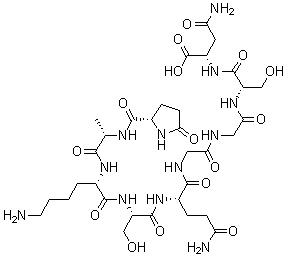
Nonathymulin is a nine-residue peptide associated with research on the serum thymic factor. Its identity is best understood by distinguishing the peptide from the complex it can form with zinc. The CAS entry specifies the peptide. In the original physiological literature, the name thymulin was proposed for the zinc-containing, biologically active form of the factor. The names may be used less precisely in other contexts, making the actual form important when comparing experiments.
A metal ion can change a peptide without changing its amino acid sequence. Interaction with the metal can alter the three-dimensional arrangement or the surface recognized by another molecule. This differs from modifying a residue by permanently attaching a new organic group. Whether a complex forms depends on the binding environment, and the presence of zinc somewhere in a preparation does not by itself tell how much of the peptide is complexed.
Early studies investigated whether activity measured in a biological assay depended on zinc. Subsequent binding experiments supported association of one zinc ion with the nonapeptide. The two findings are complementary. Binding measures formation of an association, whereas a biological assay asks whether the tested preparation produces a response. An investigator who measured only the amount of peptide would not necessarily know the amount of active complex in that assay.
This example is especially useful when considering how sample handling can affect the result of a biological measurement. A sample with an unchanged sequence may nonetheless differ in how much metal is bound. The chemical question is then not simply whether the peptide is present, but what form it is in. That distinction does not provide evidence that nonathymulin or zinc products treat immune conditions. It does explain why early thymic-factor research needed both a defined peptide and attention to its metal partner.
References:
1. PubChem. Nonathymulin, CID 3085284. https://pubchem.ncbi.nlm.nih.gov/compound/3085284
2. Dardenne M et al. Contribution of zinc and other metals to serum thymic factor activity. PNAS (1982). https://pubmed.ncbi.nlm.nih.gov/6957870/
3. Gastinel LN et al. Studies on the zinc binding site to the serum thymic factor. https://pubmed.ncbi.nlm.nih.gov/6538097/
|




 GHS07 Warning Details
 chemBlink Chemical Story