Online Database of Chemicals from Around the World

Chlortetracycline hydrochloride
[CAS# 64-72-2]

List of Suppliers
Hangzhou Verychem Science And Technology Co., Ltd. China Inquire
www.verychem.com
+86 (571) 8816-2785
+86 13606544505
+86 (571) 8816-2787
lucy@verychem.com
Chemical manufacturer since 2004
chemBlink Massive supplier since 2021
Epochem Co., Ltd. China Inquire
www.epochem.com
+86 (21) 6760-1595
6760-1597
+86 (21) 6760-1605
seth_wang@epochem.com
QQ Chat
Chemical manufacturer since 2006
chemBlink Standard supplier since 2005
Simagchem Corporation China Inquire
www.simagchem.com
+86 13806087780
+86 (592) 268-0237
sale@simagchem.com
Chemical manufacturer since 2002
chemBlink Standard supplier since 2008
Hefei TNJ Chemical Industry Co., Ltd. China Inquire
www.tnjchem.com
+86 (551) 6541-8684
+86 (551) 6541-8697
sales@tnjchem.com
Chemical manufacturer since 2001
chemBlink Standard supplier since 2010
BOC Sciences USA Inquire
www.bocsci.com
+1 (631) 485-4226
+1 (631) 614-7828
info@bocsci.com
Chemical manufacturer
chemBlink Standard supplier since 2010
Hangzhou Leap Chem Co., Ltd. China Inquire
www.leapchem.com
+86 (571) 8771-1850
market19@leapchem.com
QQ Chat
Chemical manufacturer since 2006
chemBlink Standard supplier since 2015
LKT Laboratories, Inc. USA Inquire
www.lktlabs.com
+1 (888) 558-5227
+1 (651) 644-8357
peacerli@mbolin-lktlabs.com
Chemical manufacturer
Shanghai Univic International Trading Corporation China Inquire
www.sh-univic.com
+86 (21) 5836-0151
5836-0152
+86 (21) 5836-0153
info@sh-univic.com
Chemical distributor
Ivy Fine Chemicals USA Inquire
www.ivychem.com
+1 (856) 465-8550
+1 (856) 616-1161
sales@ivychem.com
Chemical manufacturer
Chemos GmbH & Co. KG Germany Inquire
www.chemos.de
+49 871-966346-0
+49 871-966346-13
chemos@chemos.de
Chemical distributor
Toronto Research Chemicals Inc. Canada Inquire
www.trc-canada.com
+1 (416) 665-9696
+1 (416) 665-4439
info@trc-canada.com
Chemical manufacturer since 1982
AK Scientific, Inc USA Inquire
www.aksci.com
+1 (510) 429-8835
+1 (510) 429-8836
sales@aksci.com
Chemical manufacturer

Identification
ClassificationAPI >> Antibiotics >> Tetracycline
NameChlortetracycline hydrochloride
Synonyms[4S-(4alpha,4aalpha,5aalpha,6beta,12aalpha)]-7-Chloro-4-(dimethylamino)-1,4,4a,5,5a,6,11,12a-octahydro-3,6,10,12,12a-pentahydroxy-6-methyl-1,11-dioxo-2-naphthacenecarboxamide monohydrochloride
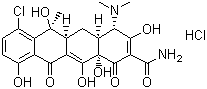
Molecular StructureCAS # 64-72-2, Chlortetracycline hydrochloride
Molecular FormulaC22H23ClN2O8.HCl
Molecular Weight515.35
CAS Registry Number64-72-2
EC Number200-591-7
SMILESCN(C)[C@@H]1C(O)=C(C(N)=O)C(=O)[C@@]2(O)C(O)=C3C(=O)c4c(O)ccc(Cl)c4[C@@](C)(O)[C@H]3C[C@@H]12.Cl
Properties
Solubilitywater: ~8.6 mg/mL (Expl.)
Safety Data
Hazard Symbolssymbol   GHS07 Warning  Details
Risk StatementsH315-H317-H319-H335  Details
Safety StatementsP261-P264-P264+P265-P271-P272-P280-P302+P352-P304+P340-P305+P351+P338-P319-P321-P332+P317-P333+P317-P337+P317-P362+P364-P403+P233-P405-P501  Details
Hazard Classification
up    Details
HazardClassCategory CodeHazard Statement
Eye irritationEye Irrit.2H319
Skin irritationSkin Irrit.2H315
Specific target organ toxicity - single exposureSTOT SE3H335
Skin sensitizationSkin Sens.1H317
Reproductive toxicityRepr.2H361
Acute toxicityAcute Tox.4H302
Flammable liquidsFlam. Liq.3H226
Serious eye damageEye Dam.1H318
Skin corrosionSkin Corr.1AH314
Aspiration hazardAsp. Tox.2H305
Reproductive toxicityLact.-H362
Acute toxicityAcute Tox.4H332
Acute toxicityAcute Tox.4H312
Acute hazardous to the aquatic environmentAquatic Acute1H400
Reproductive toxicityRepr.1BH360
SDSAvailable
up Discovery and Applications
Chlortetracycline hydrochloride is a semisynthetic salt form of chlortetracycline, one of the earliest members of the tetracycline class of antibiotics. It is a low-molecular-weight organic compound produced on an industrial scale and formulated primarily for pharmaceutical and veterinary use. Its chemical structure is based on the polycyclic tetracycline scaffold bearing a chlorine substituent, which contributes to its antibacterial spectrum.

The discovery of chlortetracycline dates to the late 1940s, during an intensive period of antibiotic screening focused on soil-derived microorganisms. The compound was first isolated from cultures of Streptomyces aureofaciens, a filamentous bacterium identified through systematic testing of fermentation broths for antimicrobial activity. Chlortetracycline was notable as the first tetracycline antibiotic to be discovered and was originally referred to as aureomycin. Its isolation represented a major advance in natural product chemistry and antibiotic research, as it demonstrated that a single compound could exhibit broad-spectrum activity against both Gram-positive and Gram-negative bacteria.

Following its discovery, chlortetracycline was rapidly developed for clinical use. Conversion to the hydrochloride salt improved its stability and handling properties, facilitating formulation for oral and parenteral administration. Early clinical studies confirmed its effectiveness against a wide range of bacterial infections, including respiratory tract infections, urinary tract infections, and certain zoonotic diseases. Its broad activity was attributed to inhibition of bacterial protein synthesis through binding to the 30S ribosomal subunit, a mechanism that later became characteristic of the entire tetracycline class.

In addition to human medicine, chlortetracycline hydrochloride found extensive application in veterinary medicine. It has been widely used for the treatment and prevention of infectious diseases in livestock and poultry, particularly those caused by susceptible bacteria such as Escherichia coli, Pasteurella, and Mycoplasma species. The compound has also been employed as a feed additive in certain regulatory environments, where it contributed to disease control and growth promotion, although such uses have been increasingly restricted due to concerns about antimicrobial resistance.

From a manufacturing perspective, chlortetracycline hydrochloride is produced by large-scale fermentation followed by multistep purification and salt formation. Advances in fermentation technology and downstream processing during the mid-twentieth century enabled reliable industrial production, making the compound widely accessible and economically viable. These developments also laid the groundwork for the subsequent discovery and modification of related tetracycline antibiotics, including oxytetracycline and tetracycline itself.

Although newer antibiotics with improved pharmacokinetic profiles have reduced the prominence of chlortetracycline in human medicine, it remains an important compound historically and practically. Its discovery established the tetracycline scaffold as a versatile and valuable platform in antibiotic chemistry, and its continued veterinary use underscores its enduring relevance. Chlortetracycline hydrochloride therefore occupies a significant place in the history of antimicrobial agents, bridging early natural product discovery and modern antibiotic development.

References

Chopra I, Roberts M (2001) Tetracycline antibiotics: mode of action, applications, molecular biology, and epidemiology of bacterial resistance. Microbiology and Molecular Biology Reviews 65 2 232–260 DOI: 10.1128/MMBR.65.2.232-260.2001

Nelson ML, Levy SB (2011) The history of the tetracyclines. Annals of the New York Academy of Sciences 1241 1 17–32 DOI: 10.1111/j.1749-6632.2011.06354.x
Market Analysis Reports
List of Reports Available for Chlortetracycline hydrochloride
Related Products
Chlorprothixene...  Chlorpyrifos D1...  Chlorpyrifos  Chlorpyrifos-me...  Chlorpyrifos-Me...  Chlorpyrifos-Ox...  Chlorquinaldol  Chlorsulfuron  Chlortalidone  Chlortetracycli...  Chlorthal  Chlorthalidone ...  Chlorthalidone ...  Chlorthal Monom...  Chlorthion  Chlorthiophos  Chlorthiophos  Chlorthiophos I  Chloryl fluorid...  Chlorzoxazone