
Online Database of Chemicals from Around the World
| Abosyn Chemicals Inc. | USA | |||
|---|---|---|---|---|
 | www.abosyn.com | |||
 | +1 (203) 683-8328 | |||
 | info@abosyn.com | |||
| Chemical manufacturer since 2014 | ||||
| chemBlink Standard supplier since 2025 | ||||
| Shanghai Worldyang Chemical Co., Ltd. | China | |||
|---|---|---|---|---|
| www.worldyachem.com | |||
| +86 13651600618 +86 (21) 5679-5779 | |||
 | +86 (21) 5679-5266 | |||
| sales7777@worldyachem.com | |||
 | QQ Chat | |||
 | WeChat: 13651600618 | |||
 | WhatsApp:+86 13651600618 | |||
| Chemical manufacturer since 2012 | ||||
| Classification | Organic raw materials >> Heterocyclic compound |
|---|---|
| Name | 5-Hydroxythalidomide |
| Molecular Structure | 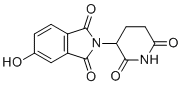 |
| Molecular Formula | C13H10N2O5 |
| Molecular Weight | 274.23 |
| CAS Registry Number | 64567-60-8 |
| EC Number | 965-879-3 |
| SMILES | C1CC(=O)NC(=O)C1N2C(=O)C3=C(C2=O)C=C(C=C3)O |
| Density | 1.6±0.1 g/cm3, Calc.* |
|---|---|
| Index of Refraction | 1.679, Calc.* |
| Boiling Point | 600.0±45.0 °C (760 mmHg), Calc.* |
| Flash Point | 316.7±28.7 °C, Calc.* |
| * | Calculated using Advanced Chemistry Development (ACD/Labs) Software. |
| Hazard Symbols |   GHS06;GHS08 Danger Details GHS06;GHS08 Danger Details | ||||||||||||||||
|---|---|---|---|---|---|---|---|---|---|---|---|---|---|---|---|---|---|
| Risk Statements | H301 Details | ||||||||||||||||
| Safety Statements | P264-P270-P301+P310+P330-P405-P501 Details | ||||||||||||||||
| Hazard Classification | |||||||||||||||||
| |||||||||||||||||
| SDS | Available | ||||||||||||||||
 chemBlink Chemical Story
|
Thalidomide was originally developed in the 1950s as a sedative and antiemetic, but its use during pregnancy caused severe birth defects, leading to its discontinuation in the early 1960s. Despite this, thalidomide exhibited significant immunomodulatory and anti-inflammatory properties, prompting further investigation of its mechanisms and metabolites. 5-Hydroxythalidomide was identified as a hydroxylated derivative of thalidomide in metabolic studies, revealing new insights into its pharmacodynamics. 5-Hydroxythalidomide retains the core phthalimide and glutarimide structure of thalidomide but has a hydroxyl group (-OH) at position 5 of the phthalimide ring. This structural modification enhances the compound's aqueous solubility and affects its interaction with biological targets, potentially altering its pharmacological effects compared to the parent molecule. The mechanism of action of 5-hydroxythalidomide involves its binding to and inhibition of inflammatory cytokines such as tumor necrosis factor-α (TNF-α). The hydroxyl group at the 5th position may alter the compound's ability to modulate the immune system, providing a unique therapeutic advantage. Additionally, it may contribute to the anti-angiogenic effects observed in thalidomide derivatives, which are critical for controlling abnormal blood vessel growth in diseases such as cancer. 5-Hydroxythalidomide has been studied for its role in treating multiple myeloma, a type of blood cancer. Its ability to modulate the immune system and inhibit TNF-α contributes to its effectiveness in combination therapy, reducing tumor growth and promoting apoptosis in cancer cells. The compound's anti-inflammatory properties make it a candidate for treating diseases such as rheumatoid arthritis and Crohn's disease. By inhibiting inflammatory pathways, 5-Hydroxythalidomide helps relieve symptoms and slow disease progression. 5-Hydroxythalidomide has the potential to inhibit angiogenesis (the formation of new blood vessels), making it useful in cancer treatment. Blocking the growth of blood vessels to tumors can starve cancer cells of nutrients and oxygen, thereby inhibiting their growth and spread. Research has also explored its use in treating eye diseases such as age-related macular degeneration, which causes abnormal blood vessel growth that can lead to impaired vision. Emerging research suggests that 5-hydroxythalidomide may have neuroprotective effects. Its ability to modulate the inflammatory response of the nervous system makes it a potential drug for the treatment of neurodegenerative diseases such as Alzheimer's disease and Parkinson's disease. Although 5-hydroxythalidomide has therapeutic effects, its safety needs to be carefully considered. As a thalidomide derivative, it may have some adverse effects, including peripheral neuropathy and teratogenicity risks. Therefore, its use is closely monitored and there are specific guidelines to mitigate potential side effects and ensure patient safety. References 2021. Thalidomide and its metabolite 5‐hydroxythalidomide induce teratogenicity via the cereblon neosubstrate PLZF. The EMBO Journal, 40(2). DOI: 10.15252/embj.2020105375 2021. Pharmacokinetics of primary metabolites 5-hydroxythalidomide and 5′-hydroxythalidomide formed after oral administration of thalidomide in the rabbit, a thalidomide-sensitive species. The Journal of Toxicological Sciences, 46(12). DOI: 10.2131/jts.46.553 2023. Structural rationalization of GSPT1 and IKZF1 degradation by thalidomide molecular glue derivatives. RSC Medicinal Chemistry, 14(5). DOI: 10.1039/d2md00347c |
| Market Analysis Reports |