
Online Database of Chemicals from Around the World
| Simagchem Corporation | China | |||
|---|---|---|---|---|
 | www.simagchem.com | |||
 | +86 13806087780 | |||
 | +86 (592) 268-0237 | |||
 | sale@simagchem.com | |||
| Chemical manufacturer since 2002 | ||||
| chemBlink Standard supplier since 2008 | ||||
| BOC Sciences | USA | |||
|---|---|---|---|---|
| www.bocsci.com | |||
| +1 (631) 485-4226 | |||
| +1 (631) 614-7828 | |||
| info@bocsci.com | |||
| Chemical manufacturer | ||||
| chemBlink Standard supplier since 2010 | ||||
| Shandong Chenghui Shuangda Pharmaceutical Co., Ltd. | China | |||
|---|---|---|---|---|
| www.chsdpharma.com | |||
| +86-531-58897029 | |||
| ericqiao@jnchsd.com | |||
 | QQ Chat | |||
 | WeChat: 15550412551 | |||
 | WhatsApp:15550412551 | |||
| Chemical manufacturer since 2014 | ||||
| chemBlink Standard supplier since 2025 | ||||
| AK Scientific, Inc | USA | |||
|---|---|---|---|---|
| www.aksci.com | |||
| +1 (510) 429-8835 | |||
| +1 (510) 429-8836 | |||
| sales@aksci.com | |||
| Chemical manufacturer | ||||
| AvaChem Scientific LLC | USA | |||
|---|---|---|---|---|
| www.avachem.com | |||
| +1 (210) 667-3815 | |||
| +1 (210) 592-6206 | |||
| chemsupply@avachem.com | |||
| Chemical manufacturer | ||||
| LKT Laboratories, Inc. | USA | |||
|---|---|---|---|---|
| www.lktlabs.com | |||
| +1 (888) 558-5227 | |||
| +1 (651) 644-8357 | |||
| peacerli@mbolin-lktlabs.com | |||
| Chemical manufacturer | ||||
| Santa Cruz Biotechnology, Inc. | USA | |||
|---|---|---|---|---|
| www.scbt.com | |||
| +1 (831) 457-3800 | |||
| +1 (831) 457-3801 | |||
| scbt@scbt.com | |||
| Chemical manufacturer | ||||
| Toronto Research Chemicals Inc. | Canada | |||
|---|---|---|---|---|
| www.trc-canada.com | |||
| +1 (416) 665-9696 | |||
| +1 (416) 665-4439 | |||
| info@trc-canada.com | |||
| Chemical manufacturer since 1982 | ||||
| MP Biomedicals LLC. | USA | |||
|---|---|---|---|---|
| www.mpbio.com | |||
| +1 (440) 337-1200 | |||
| +1 (440) 337-1180 | |||
| inside@mpbio.com | |||
| Chemical manufacturer | ||||
| Classification | API >> Circulatory system medication >> Prevention and treatment of angina pectoris |
|---|---|
| Name | Urapidil hydrochloride |
| Synonyms | 6-[[3-[4-(2-Methoxyphenyl)-1-piperazinyl]propyl]amino]-1,3-dimethyluracil hydrochloride |
| Molecular Structure | 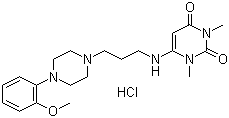 |
| Molecular Formula | C20H29N5O3.HCl |
| Molecular Weight | 423.94 |
| CAS Registry Number | 64887-14-5 |
| EC Number | 636-348-0 |
| SMILES | CN1C(=CC(=O)N(C1=O)C)NCCCN2CCN(CC2)C3=CC=CC=C3OC.Cl |
| Solubility | DMSO 24 mg/mL, Water 85 mg/mL (Expl.) |
|---|---|
| Hazard Symbols |  GHS07 Warning Details GHS07 Warning Details | ||||||||
|---|---|---|---|---|---|---|---|---|---|
| Risk Statements | H302-H315-H319-H335 Details | ||||||||
| Safety Statements | P261-P264-P264+P265-P270-P271-P280-P301+P317-P302+P352-P304+P340-P305+P351+P338-P319-P321-P330-P332+P317-P337+P317-P362+P364-P403+P233-P405-P501 Details | ||||||||
| Hazard Classification | |||||||||
| |||||||||
| SDS | Available | ||||||||
 chemBlink Chemical Story
|
Urapidil hydrochloride is a pharmaceutical agent primarily used as an antihypertensive medication. It functions mainly as an alpha-1 adrenergic receptor antagonist with additional activity on central serotonin (5-HT1A) receptors. Through these mechanisms, urapidil hydrochloride effectively reduces blood pressure by causing peripheral vasodilation and modulating central sympathetic tone. Urapidil was developed and introduced clinically in the late 20th century to provide an alternative treatment for hypertension, particularly in cases requiring rapid blood pressure control. Its unique dual action distinguishes it from other alpha-blockers by combining peripheral vascular relaxation with central nervous system effects that reduce sympathetic outflow. Pharmacodynamically, urapidil hydrochloride competitively blocks alpha-1 adrenergic receptors on vascular smooth muscle, leading to relaxation of arteries and veins, which decreases systemic vascular resistance and lowers blood pressure. Additionally, its agonist activity on 5-HT1A receptors in the central nervous system helps suppress sympathetic nervous system activity, further contributing to blood pressure reduction and limiting reflex tachycardia often seen with peripheral vasodilators. Urapidil hydrochloride is available in oral and intravenous formulations. The intravenous form is used in acute settings such as hypertensive emergencies or perioperative hypertension, providing rapid onset of action within minutes. The oral formulation is used for chronic management of hypertension with dosing adjusted according to blood pressure response. Pharmacokinetically, urapidil is well absorbed after oral administration, with bioavailability affected by first-pass metabolism in the liver. It is extensively metabolized hepatically to inactive metabolites that are eliminated primarily via the kidneys. The elimination half-life ranges approximately from 2 to 4 hours, supporting dosing regimens of one to three times daily depending on clinical context. Adverse effects of urapidil hydrochloride are generally related to its vasodilatory action and include dizziness, headache, hypotension, and occasional nausea. Unlike many other alpha-blockers, urapidil is less commonly associated with reflex tachycardia or orthostatic hypotension. Central nervous system effects such as fatigue or somnolence may occur due to its serotonergic activity. Urapidil hydrochloride has been used extensively in Europe and other regions as an effective antihypertensive agent, especially valued for its rapid blood pressure-lowering capability and a relatively favorable side effect profile. It is employed in managing essential hypertension, hypertensive crises, and situations where tight blood pressure control is necessary. In summary, urapidil hydrochloride is an alpha-1 adrenergic receptor antagonist with central 5-HT1A receptor agonist activity used to lower blood pressure. Its combined peripheral and central actions provide effective antihypertensive effects with a reduced incidence of reflex tachycardia. It is used both acutely and chronically to manage hypertension with an established safety and efficacy profile. References 2020. A rare long-term undetected pheochromocytoma leading to Takotsubo syndrome in an older male patient: a case report. BMC Endocrine Disorders, 20(1). DOI: 10.1186/s12902-020-00578-5 2023. Anesthesia for Outpatient Oral and Maxillofacial Surgery. Anesthesia for Oral and Maxillofacial Surgery, 10(1). DOI: 10.1007/978-981-19-7287-4_10 1990. Development and validation of an efficient HPLC method for quantification of voriconazole in plasma and microdialysate reflecting an important target site. Analytical and Bioanalytical Chemistry, 391(2). DOI: 10.1007/s00216-008-2286-3 |
| Market Analysis Reports |