
Online Database of Chemicals from Around the World
| SL Drugs and Pharmaceuticals Pvt. Ltd. | India | |||
|---|---|---|---|---|
 | www.sldrugs.com | |||
 | +91 (40) 6661-1133 | |||
 | +91 (40) 2375-1130 | |||
 | enquiry@sldrugs.com | |||
| Chemical distributor since 1999 | ||||
| chemBlink Standard supplier since 2010 | ||||
| Labseeker Inc | USA | |||
|---|---|---|---|---|
| www.labseeker.com | |||
| +1 (858) 750-1632 | |||
| +1 (858) 412-1220 | |||
| marketing@labseeker.com | |||
| Chemical manufacturer since 2002 | ||||
| chemBlink Standard supplier since 2015 | ||||
| Neostar United (Changzhou) Industrial Co., Ltd. | China | |||
|---|---|---|---|---|
| www.neostarunited.com | |||
| +86 (519) 8555-7386 +86 18015025600 | |||
| +86 (519) 8555-7389 | |||
| marketing1@neostarunited.com | |||
| Chemical distributor since 2014 | ||||
| chemBlink Standard supplier since 2020 | ||||
| Shijiazhuang C-element Biotech Co., Ltd. | China | |||
|---|---|---|---|---|
| www.c-elementbiotech.com | |||
| +86 18033710157 | |||
| Lisa@C-elementBiotech.com | |||
 | QQ Chat | |||
 | WeChat: 18033710157 | |||
| Chemical manufacturer since 2025 | ||||
| chemBlink Standard supplier since 2025 | ||||
| Achemica | Switzerland | |||
|---|---|---|---|---|
| www.achemica.com | |||
| +41 (24) 466-2929 | |||
| +41 (24) 466-2800 | |||
| contact@achemica.com | |||
| Chemical manufacturer since 2010 | ||||
| Laboratory of Technological Processes Faculty of Chemistry Warsaw University of Technology | Poland | |||
|---|---|---|---|---|
| lpt.ch.pw.edu.pl | |||
| +48 (22) 621-0138 | |||
| lpt@ch.pw.edu.pl | |||
| Chemical manufacturer | ||||
| Classification | Chemical reagent >> Organic reagent >> Fatty acid |
|---|---|
| Name | L-Dipivaloyltartaric acid |
| Synonyms | (2R,3R)-2,3-Bis(2,2-dimethyl-1-oxopropoxy)butanedioic acid |
| Molecular Structure | 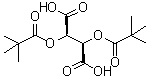 |
| Molecular Formula | C14H22O8 |
| Molecular Weight | 318.32 |
| CAS Registry Number | 65259-81-6 |
| SMILES | CC(C)(C)C(=O)O[C@H]([C@H](C(=O)O)OC(=O)C(C)(C)C)C(=O)O |
| Solubility | Very slightly soluble (0.8 g/L) (25 °C), Calc.* |
|---|---|
| Density | 1.240±0.06 g/cm3 (20 °C 760 Torr), Calc.* |
| Melting point | 127-132 °C (Expl.) |
| Index of Refraction | 1.484, Calc.* |
| Boiling Point | 436.6±45.0 °C (760 mmHg), Calc.* |
| Flash Point | 153.8±22.2 °C, Calc.* |
| * | Calculated using Advanced Chemistry Development (ACD/Labs) Software V11.02 (©1994-2014 ACD/Labs) |
| Hazard Symbols |  GHS07 Warning Details GHS07 Warning Details |
|---|---|
| Risk Statements | H302-H315-H319-H335 Details |
| Safety Statements | P261-P305+P351+P338 Details |
| SDS | Available |
 chemBlink Chemical Story
|
L-Dipivaloyltartaric acid, also known as L-DPTA, is a chemical compound derived from tartaric acid. It is a derivative where two pivaloyl groups (C5H9O2) are attached to the hydroxyl groups of the tartaric acid molecule. Tartaric acid itself is a naturally occurring organic acid found in many plants, particularly in grapes, and plays a role in wine production. The modification of tartaric acid by introducing pivaloyl groups to form L-DPTA has led to significant interest in its applications, particularly in the field of asymmetric synthesis and catalysis. The discovery and synthesis of L-DPTA can be traced back to efforts aimed at developing chiral ligands and catalysts for use in enantioselective reactions. In the early 1980s, the importance of tartaric acid derivatives in catalysis was recognized, especially due to the chiral nature of tartaric acid, which makes it useful in producing enantiomerically pure compounds. The modification of tartaric acid to create derivatives like L-DPTA allowed for the development of more efficient and selective catalytic processes, as pivaloyl groups can provide steric bulk and enhance the chiral recognition in various reactions. L-Dipivaloyltartaric acid finds its primary use in asymmetric synthesis, a branch of chemistry concerned with the selective production of one enantiomer over another in chiral molecules. In this context, L-DPTA is employed as a chiral auxiliary or ligand in catalysis, where its ability to form complexes with metal ions helps direct the formation of specific enantiomers in chemical reactions. This has made L-DPTA an important compound in the synthesis of pharmaceuticals, agrochemicals, and other fine chemicals where chirality is critical. The role of L-DPTA in catalysis is particularly evident in the development of asymmetric reactions, such as asymmetric hydrogenation and asymmetric oxidation. It is used as a ligand in the preparation of chiral metal complexes, which can catalyze reactions that yield enantiomerically pure products. These reactions are essential in the production of drugs and other biologically active compounds, where the presence of a specific enantiomer is often crucial for efficacy and safety. L-Dipivaloyltartaric acid has also been used in the synthesis of chiral polymers and materials. The use of L-DPTA as a chiral building block allows for the creation of materials with distinct optical properties, which can be applied in areas such as optoelectronics and material science. Additionally, its potential as a stabilizing agent in various chemical processes has made it a subject of ongoing research. In summary, L-Dipivaloyltartaric acid is a modified form of tartaric acid with two pivaloyl groups attached. It plays a significant role in asymmetric synthesis, particularly in catalysis, where it is used as a chiral auxiliary or ligand in the preparation of chiral metal complexes. Its applications are most notable in the production of enantiomerically pure compounds, which are essential in the pharmaceutical and chemical industries. The continued development and use of L-DPTA in synthetic chemistry contribute to advances in enantioselective processes and the synthesis of complex molecules. References 2022. Synthesis of P- and S-Stereogenic Compounds via Enantioselective C-H Functionalization. Synthesis, 54(14). DOI: 10.1055/a-1802-6793 2007. Asymmetric Protonation. Kalesse, M. Science of Synthesis, 25, 148. 2005. With a Chiral Proton Source. Plaquevent, J.-C.; Cahard, D.; Guillen, F. Science of Synthesis, 26, 502. |
| Market Analysis Reports |