
Online Database of Chemicals from Around the World
| Wuhan Kemi-works Chemical Co., Ltd. | China | |||
|---|---|---|---|---|
 | www.kemiworks.net | |||
 | +86 (27) 8573-6489 | |||
 | +86 (27) 8573-6485 | |||
 | info@kemiworks.net sales@kemiworks.com | |||
| Chemical manufacturer | ||||
| chemBlink Premium supplier since 2011 | ||||
| Classification | Chemical reagent >> Organic reagent >> Ester >> Acid ester compound |
|---|---|
| Name | 1,6-Hexanediol dimethacrylate |
| Synonyms | 6-(2-methylprop-2-enoyloxy)hexyl 2-methylprop-2-enoate |
| Molecular Structure | 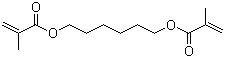 |
| Molecular Formula | C14H22O4 |
| Molecular Weight | 254.32 |
| CAS Registry Number | 6606-59-3 |
| EC Number | 229-551-7 |
| SMILES | CC(=C)C(=O)OCCCCCCOC(=O)C(=C)C |
| Density | 1.0±0.1 g/cm3 Calc.* |
|---|---|
| Boiling point | 334.2±25.0 °C 760 mmHg (Calc.)* |
| Flash point | 157.3±21.6 °C (Calc.)* |
| Index of refraction | 1.455 (Calc.)*, 1.458 (Expl.) |
| * | Calculated using Advanced Chemistry Development (ACD/Labs) Software. |
| Risk Statements | R36/37/38 Details | ||||||||||||||||||||||||||||
|---|---|---|---|---|---|---|---|---|---|---|---|---|---|---|---|---|---|---|---|---|---|---|---|---|---|---|---|---|---|
| Safety Statements | S26;S37/39 Details | ||||||||||||||||||||||||||||
| Hazard Classification | |||||||||||||||||||||||||||||
| |||||||||||||||||||||||||||||
| Transport Information | UN 3082 | ||||||||||||||||||||||||||||
| SDS | Available | ||||||||||||||||||||||||||||
 chemBlink Chemical Story
|
1,6-Hexanediol dimethacrylate (HDDMA) is a difunctional methacrylate ester widely utilized as a crosslinking agent in polymer and resin systems, particularly in ultraviolet (UV) and electron beam (EB) curable formulations. The compound consists of two methacrylate groups attached to a linear hexamethylene diol backbone, which gives it a combination of flexibility and high reactivity. HDDMA appears as a clear, low-viscosity liquid, and it is known for its excellent polymerization behavior and its ability to impart improved mechanical and chemical properties to cured materials. The development of HDDMA emerged from the broader evolution of methacrylate chemistry in the mid-to-late 20th century, during which time materials scientists were actively exploring new monomers and crosslinkers for advanced polymer systems. The dual methacrylate functionality of HDDMA allows it to participate in free-radical polymerization processes, forming covalent crosslinks between polymer chains. This characteristic makes it particularly valuable in the production of hard, durable coatings, adhesives, composites, and dental materials. One of the most common applications of HDDMA is in UV-curable coatings and inks. In these systems, HDDMA functions as a reactive diluent and crosslinker. It reduces the viscosity of formulations without introducing volatile organic compounds (VOCs), thereby improving flow and leveling during application. Upon exposure to UV light, HDDMA polymerizes rapidly to form a tough, abrasion-resistant film. Such coatings are widely used in the graphic arts, electronics, wood finishing, and automotive industries, where fast curing and high durability are required. In the realm of dental and biomedical materials, HDDMA is a key component in light-cured resins used for restorative fillings, sealants, and orthodontic adhesives. Its ability to produce low-shrinkage, high-strength polymers makes it suitable for precise dental applications where dimensional stability and wear resistance are essential. Additionally, HDDMA is used in the formulation of medical device adhesives and coatings, although its application in such contexts must meet strict biocompatibility and regulatory standards. HDDMA is also employed in 3D printing technologies, especially in stereolithography (SLA) and digital light processing (DLP) methods. In these systems, HDDMA serves as a crosslinker that contributes to the rigidity and strength of the printed structures. Its inclusion helps achieve high-resolution printing and excellent detail fidelity in complex geometries. Another significant use of HDDMA is in structural adhesives, where it enhances cohesive strength and thermal stability. In industrial bonding applications, it contributes to improved resistance against mechanical stress, moisture, and chemicals. HDDMA is often blended with other acrylate or methacrylate monomers to customize adhesive performance for specific substrates and environmental conditions. HDDMA is also involved in the production of reinforced composites and laminates, including those used in electronics, automotive, and aerospace sectors. Its ability to create tightly crosslinked polymer matrices contributes to the rigidity and dimensional stability of composite materials. These properties are especially valuable in applications requiring lightweight, high-performance structural components. From a chemical perspective, HDDMA is known for its relatively high reactivity in free-radical polymerization and its good compatibility with a wide variety of monomers and oligomers. The hexamethylene spacer in its structure imparts flexibility to the resulting polymer network, helping balance rigidity and toughness. This makes HDDMA a versatile crosslinker for tailoring the physical properties of cured resins. Despite its many advantages, HDDMA, like other methacrylates, can cause irritation to the skin, eyes, and respiratory system upon exposure. Industrial handling of HDDMA requires appropriate safety measures, including the use of gloves, goggles, and ventilation systems. Careful control of exposure levels is necessary to prevent sensitization or allergic reactions among workers. 1,6-Hexanediol dimethacrylate remains a widely used and well-characterized crosslinking agent in modern materials science. Its dual functionality, fast curing, and ability to impart mechanical robustness ensure its continued application in high-performance polymer systems, including coatings, adhesives, dental resins, and additive manufacturing. References 1973 Some Fundamental Aspects of the Polymerization of Vinyl Monomers with Electron Beams. Nonpolluting Coatings and Coating Processes. DOI: 10.1007/978-1-4684-0736-5_12 2016 Resin-Based Dental Composite Materials. Handbook of Bioceramics and Biocomposites. DOI: 10.1007/978-3-319-12460-5_22 2013 Preparation and evaluation of 1,6-hexanediol ethoxylate diacrylate-based alkyl methacrylate monolithic capillary column for separating small molecules. Journal of chromatography. A, 1295. DOI: https://pubmed.ncbi.nlm.nih.gov/23726078 |
| Market Analysis Reports |