
Online Database of Chemicals from Around the World
| Wuhan Kemi-works Chemical Co., Ltd. | China | |||
|---|---|---|---|---|
 | www.kemiworks.net | |||
 | +86 (27) 8573-6489 | |||
 | +86 (27) 8573-6485 | |||
 | info@kemiworks.net sales@kemiworks.com | |||
| Chemical manufacturer | ||||
| chemBlink Premium supplier since 2011 | ||||
| Classification | Chemical reagent >> Organic reagent >> Siloxane |
|---|---|
| Name | Vinyl terminated polydimethyl siloxane |
| Synonyms | Vinyl group-terminated di-Me siloxanes; Vinyl group-terminated di-Me siloxanes and silicones; Vinyl-terminated di-Me silicones; Vinyl-terminated di-Me siloxanes |
| Molecular Structure | 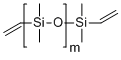 |
| Molecular Weight | ~25000 |
| CAS Registry Number | 68083-19-2 |
| EC Number | 614-275-5 |
| SMILES | C[Si](C)=O |
| Density | 0.965 g/mL (25 °C) |
|---|---|
| Index of Refraction | 1.4052 |
| Boiling point | >93 °C |
| Hazard Classification | |||||||||||||||||
|---|---|---|---|---|---|---|---|---|---|---|---|---|---|---|---|---|---|
| |||||||||||||||||
| SDS | Available | ||||||||||||||||
 chemBlink Chemical Story
|
Vinyl terminated polydimethyl siloxane (VT-PDMS) is a versatile class of organosilicon compounds widely used in various industrial applications. It is a type of polydimethylsiloxane (PDMS) that is terminated with vinyl groups at both ends of the polymer chain. The presence of these vinyl groups enhances the reactivity of the compound, making it highly useful in a range of chemical processes, including polymerization, crosslinking, and as a precursor in the synthesis of silicone-based materials. The discovery of polydimethylsiloxanes can be traced back to the early 20th century, with significant contributions from scientists such as Frederic Kipping, who synthesized the first siloxane compounds in the early 1900s. These initial discoveries paved the way for the development of various forms of silicones, including VT-PDMS, which emerged as a significant advancement in the polymer chemistry of silicones. The vinyl termination introduced into the PDMS backbone enabled improved properties such as enhanced crosslinking and reactivity, making it an essential material in numerous applications. VT-PDMS is particularly well known for its role in the production of high-performance sealants, adhesives, and coatings. In the construction industry, VT-PDMS is used as a base material in the formulation of silicone sealants. When crosslinked, these sealants exhibit excellent properties such as flexibility, weather resistance, and the ability to form strong bonds with a variety of substrates. This makes them ideal for use in applications requiring long-lasting, durable seals, such as in window installations, roofing, and caulking. In the automotive sector, VT-PDMS plays a crucial role in the formulation of gaskets, adhesives, and sealants that require high-temperature resistance and chemical stability. VT-PDMS-based sealants are used in critical applications such as engine components, where they provide reliable sealing even under extreme temperatures and harsh chemical environments. Furthermore, its low surface energy and excellent water-repellent properties make it an essential ingredient in manufacturing components that are resistant to corrosion. In addition to its application in sealants and adhesives, VT-PDMS is widely used in the electronics industry. It is commonly employed in the production of electronic encapsulants and coatings. When crosslinked, the polymer exhibits excellent dielectric properties, which makes it ideal for insulating electronic components. The ability to form flexible and durable coatings also makes VT-PDMS a valuable material for protecting sensitive electronic parts from moisture, dust, and other environmental contaminants. VT-PDMS is also integral to the production of silicone elastomers and foams. The vinyl groups present in the polymer backbone enable the material to undergo crosslinking reactions, which results in the formation of solid, highly elastic materials. These elastomers are used in a wide range of products, including medical devices, kitchenware, and automotive parts, where their flexibility, high temperature resistance, and biocompatibility are crucial properties. In the field of personal care, VT-PDMS is incorporated into formulations for hair and skin care products due to its smooth texture, ability to impart a shiny finish, and water-repellent properties. It enhances the feel and spreadability of creams, lotions, and hair serums, providing a pleasant sensory experience without greasiness. Despite its many advantages, there are ongoing research efforts to address the environmental impact of vinyl terminated polydimethyl siloxane, as concerns about the biodegradability of silicones persist. Research is focusing on developing more sustainable alternatives and methods for recycling and breaking down silicone-based materials. |
| Market Analysis Reports |