
Online Database of Chemicals from Around the World
| Hangzhou Verychem Science And Technology Co., Ltd. | China | |||
|---|---|---|---|---|
 | www.verychem.com | |||
 | +86 (571) 8816-2785 +86 13606544505 | |||
 | +86 (571) 8816-2787 | |||
 | lucy@verychem.com | |||
| Chemical manufacturer since 2004 | ||||
| chemBlink Massive supplier since 2021 | ||||
| Shanghai Nanxiang Reagent Co., Ltd. | China | |||
|---|---|---|---|---|
| www.nx-reagent.com | |||
| +86 (21) 3912-7448 +86 13512139665 | |||
| +86 (21) 3912-7431 | |||
| xumiao@nx-reagent.com | |||
 | QQ Chat | |||
| Chemical manufacturer since 1989 | ||||
| chemBlink Standard supplier since 2007 | ||||
| Simagchem Corporation | China | |||
|---|---|---|---|---|
| www.simagchem.com | |||
| +86 13806087780 | |||
| +86 (592) 268-0237 | |||
| sale@simagchem.com | |||
| Chemical manufacturer since 2002 | ||||
| chemBlink Standard supplier since 2008 | ||||
| Boron Molecular Inc. | USA | |||
|---|---|---|---|---|
| www.boronmolecular.com | |||
| +1 (919) 981-4441 | |||
| +1 (919) 981-4442 | |||
| sales@boronmolecular-usa.com | |||
| Chemical manufacturer since 2001 | ||||
| chemBlink Standard supplier since 2009 | ||||
| Reddy N Reddy Pharmaceuticals | India | |||
|---|---|---|---|---|
| www.reddynreddypharma.com | |||
| +91 (40) 2307-5686 +91 98480-96759 +91 98481-96759 | |||
| info@reddynreddypharma.com | |||
| Chemical manufacturer | ||||
| chemBlink Standard supplier since 2010 | ||||
| SL Drugs and Pharmaceuticals Pvt. Ltd. | India | |||
|---|---|---|---|---|
| www.sldrugs.com | |||
| +91 (40) 6661-1133 | |||
| +91 (40) 2375-1130 | |||
| enquiry@sldrugs.com | |||
| Chemical distributor since 1999 | ||||
| chemBlink Standard supplier since 2010 | ||||
| BOC Sciences | USA | |||
|---|---|---|---|---|
| www.bocsci.com | |||
| +1 (631) 485-4226 | |||
| +1 (631) 614-7828 | |||
| info@bocsci.com | |||
| Chemical manufacturer | ||||
| chemBlink Standard supplier since 2010 | ||||
| Haimen RuiYi Medical Tech Co., Ltd. | China | |||
|---|---|---|---|---|
| www.ruiyitech.cn | |||
| +86 (21) 5471-1706 | |||
| +86 (21) 5471-1707 | |||
| sales@ruiyitech.com zyj3625@msn.com | |||
| QQ Chat | |||
| Chemical manufacturer since 2009 | ||||
| chemBlink Standard supplier since 2012 | ||||
| Wonderchem Co., Limited | Hong Kong | |||
|---|---|---|---|---|
| www.wonder-chem.com | |||
| +852 8192-5218 | |||
| sales@wonder-chem.com | |||
| Chemical distributor since 2016 | ||||
| chemBlink Standard supplier since 2017 | ||||
| Suqian Nanxiang Chemicals Manufacturing Co., Ltd. | China | |||
|---|---|---|---|---|
| www.nanxiangchem.com | |||
| +86 (0527) 8483-6748 | |||
| sales@nanxiangchem.com | |||
| QQ Chat | |||
 | WeChat: 13512139665 | |||
| Chemical manufacturer since 2010 | ||||
| chemBlink Standard supplier since 2024 | ||||
| Strem Chemicals, Inc. | USA | |||
|---|---|---|---|---|
| www.strem.com | |||
| +1 (978) 499-1600 | |||
| +1 (978) 465-3104 | |||
| info@strem.com | |||
| Chemical manufacturer | ||||
| Gelest, Inc. | USA | |||
|---|---|---|---|---|
| www.gelest.com | |||
| +1 (215) 547-1015 | |||
| +1 (215) 547-2484 | |||
| info@gelest.com | |||
| Chemical manufacturer | ||||
| Anderson Development Company | USA | |||
|---|---|---|---|---|
| www.andersondevelopment.com | |||
| +1 (517) 438-5232 | |||
| +1 (517) 263-1000 | |||
| sales@anddev.com | |||
| Chemical manufacturer | ||||
| Classification | Chemical reagent >> Organic reagent >> Borate |
|---|---|
| Name | Tributyl borate |
| Synonyms | Tributoxyborane |
| Molecular Structure | 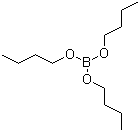 |
| Molecular Formula | C12H27BO3 |
| Molecular Weight | 230.15 |
| CAS Registry Number | 688-74-4 |
| EC Number | 211-706-5 |
| SMILES | B(OCCCC)(OCCCC)OCCCC |
| Density | 0.9±0.1 g/cm3, Calc.*, 0.853 g/mL |
|---|---|
| Melting point | -70 °C |
| Index of Refraction | 1.410, Calc.*, 10409 |
| Boiling Point | 230.6±8.0 °C (760 mmHg), Calc.*, 230-235 °C |
| Flash Point | 93.3±0.0 °C, Calc.*, 93 °C |
| Water solubility | decomposes |
| * | Calculated using Advanced Chemistry Development (ACD/Labs) Software. |
| Hazard Symbols |    GHS05;GHS07;GHS09 Danger Details GHS05;GHS07;GHS09 Danger Details | ||||||||||||||||||||||||||||||||
|---|---|---|---|---|---|---|---|---|---|---|---|---|---|---|---|---|---|---|---|---|---|---|---|---|---|---|---|---|---|---|---|---|---|
| Risk Statements | H302-H312-H315-H318-H319-H335-H360FD Details | ||||||||||||||||||||||||||||||||
| Safety Statements | P203-P261-P264-P264+P265-P270-P271-P280-P301+P317-P302+P352-P304+P340-P305+P351+P338-P305+P354+P338-P317-P318-P319-P321-P330-P332+P317-P337+P317-P362+P364-P403+P233-P405-P501 Details | ||||||||||||||||||||||||||||||||
| Hazard Classification | |||||||||||||||||||||||||||||||||
| |||||||||||||||||||||||||||||||||
| SDS | Available | ||||||||||||||||||||||||||||||||
 chemBlink Chemical Story
|
Tributyl borate (TBB) is an organoboron compound with the chemical formula C12H27BO4. It is classified as a trialkyl borate and is characterized by the presence of three butyl groups attached to a boron atom. TBB is a colorless, viscous liquid known for its solubility in organic solvents and its ability to form stable complexes with various substrates. The discovery of tributyl borate can be traced back to the early 20th century when researchers began exploring the chemical properties and applications of organoboron compounds. One of the pioneering works in this area was conducted by chemist Charles A. Coates in the 1940s, who studied various trialkyl borates, including tributyl borate. His research highlighted the potential of these compounds in organic synthesis, leading to further investigations into their reactivity and applications. Tributyl borate has gained recognition for its diverse applications in various fields, particularly in organic chemistry and materials science. One of its primary uses is as a reagent in organic synthesis, where it serves as a boron source in various chemical reactions. TBB is often employed in the synthesis of organoboron compounds, which are valuable intermediates in the production of pharmaceuticals, agrochemicals, and fine chemicals. Its ability to facilitate the formation of carbon-boron bonds has made it an essential tool for chemists working in synthetic organic chemistry. In addition to its role in organic synthesis, tributyl borate is utilized as a solvent and reaction medium in various chemical processes. Its high boiling point and low volatility make it suitable for use in high-temperature reactions and as a reaction solvent for polymerization processes. TBB is also employed in the preparation of boron-containing polymers, which exhibit unique properties such as improved thermal stability and chemical resistance. These materials have applications in coatings, adhesives, and other industrial products. Moreover, tributyl borate has found applications in the field of analytical chemistry. It is often used as a derivatizing agent for the analysis of alcohols and phenols, enhancing their detectability in chromatographic techniques such as gas chromatography (GC) and high-performance liquid chromatography (HPLC). The ability of TBB to form stable complexes with various analytes improves the sensitivity and selectivity of these analytical methods, making it a valuable reagent in chemical analysis. Another important application of tributyl borate is in the formulation of lubricants and plasticizers. Its compatibility with various polymer matrices allows it to enhance the performance of lubricants by providing excellent lubricating properties and reducing friction. Additionally, TBB serves as a plasticizer in polymer formulations, improving the flexibility and processability of materials used in packaging, automotive parts, and consumer products. Despite its many beneficial applications, safety considerations are crucial when handling tributyl borate. It is classified as a hazardous substance, and exposure may lead to skin and eye irritation. Therefore, appropriate safety measures, including the use of personal protective equipment and proper ventilation, should be implemented when working with this compound. In summary, tributyl borate is a versatile organoboron compound with a wide range of applications in organic synthesis, materials science, and analytical chemistry. Its discovery has paved the way for advancements in various chemical processes and products, contributing significantly to the fields of chemistry and industry. References 2020. Fabrication of B-Containing Glass and Glass-Ceramic Materials via Liquid Organic Phase Pyrolysis. Russian Journal of Inorganic Chemistry, 65(3). DOI: 10.1134/s0036023620030055 1959. Preparation of trialkylborines by the action of organometallic compounds on metaboric esters. Bulletin of the Academy of Sciences of the USSR, Division of chemical science, 8(6). DOI: 10.1007/bf00916686 2023. Effectively improving flame retardancy levels of finished cotton fabrics only by simple binary silicon-boron oxide sols. Journal of Polymer Research, 30(11). DOI: 10.1007/s10965-023-03812-5 |
| Market Analysis Reports |