
Online Database of Chemicals from Around the World
| Hangzhou Verychem Science And Technology Co., Ltd. | China | |||
|---|---|---|---|---|
 | www.verychem.com | |||
 | +86 (571) 8816-2785 +86 13606544505 | |||
 | +86 (571) 8816-2787 | |||
 | lucy@verychem.com | |||
| Chemical manufacturer since 2004 | ||||
| chemBlink Massive supplier since 2021 | ||||
| BOC Sciences | USA | |||
|---|---|---|---|---|
| www.bocsci.com | |||
| +1 (631) 485-4226 | |||
| +1 (631) 614-7828 | |||
| info@bocsci.com | |||
| Chemical manufacturer | ||||
| chemBlink Standard supplier since 2010 | ||||
| Hubei Tuoyuan Fine Chemical Co., Ltd. | China | |||
|---|---|---|---|---|
| www.chemty.com | |||
| +86 (027) 8470-0466 | |||
| +86 (027) 8470-0466 | |||
| 59741184@qq.com | |||
 | QQ Chat | |||
 | WeChat: 13260668040 | |||
| Chemical manufacturer since 2025 | ||||
| chemBlink Standard supplier since 2011 | ||||
| Wuhan Kemi-works Chemical Co., Ltd. | China | |||
|---|---|---|---|---|
| www.kemiworks.net | |||
| +86 (27) 8573-6489 | |||
| +86 (27) 8573-6485 | |||
| info@kemiworks.net sales@kemiworks.com | |||
| Chemical manufacturer | ||||
| chemBlink Standard supplier since 2011 | ||||
| Intatrade Chemicals GmbH | Germany | |||
|---|---|---|---|---|
| www.intatrade.de | |||
| +49 (3493) 605-465 | |||
| +49 (3493) 605-470 | |||
| sales@intatrade.de | |||
| Chemical distributor | ||||
| chemBlink Standard supplier since 2011 | ||||
| Carbosynth China Ltd. | China | |||
|---|---|---|---|---|
| www.carbosynth.cn | |||
| +86 (512) 6260-5585 | |||
| +86 (512) 6260-5576 | |||
| sales@carbosynth.com | |||
| QQ Chat | |||
| Chemical manufacturer since 2006 | ||||
| chemBlink Standard supplier since 2016 | ||||
| Shanghai Fuxin Pharmaceutical Co., Ltd. | China | |||
|---|---|---|---|---|
| www.fuxinpharm.com | |||
| +86 (21) 3130-0828 +86 18645121291 | |||
| +86 (21) 3130-0828 | |||
| contact@fuxinpharm.com | |||
| Chemical manufacturer since 2016 | ||||
| chemBlink Standard supplier since 2018 | ||||
| Frontier Scientific Services, Inc. | USA | |||
|---|---|---|---|---|
| www.frontierssi.com | |||
| +1 (302) 266-6891 (888) 577-2734 | |||
| +1 (302) 266-8296 | |||
| customerservice@frontierssi.com | |||
| Chemical manufacturer | ||||
| Classification | API >> Blood system medication >> Hemostatic drug |
|---|---|
| Name | Tranexamic acid |
| Synonyms | 4-(Aminomethyl)cyclohexanecarboxylic acid |
| Molecular Structure | 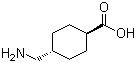 |
| Molecular Formula | C8H15NO2 |
| Molecular Weight | 157.21 |
| CAS Registry Number | 701-54-2 |
| EC Number | 622-133-9 |
| SMILES | C1CC(CCC1CN)C(=O)O |
| Solubility | Soluble (42 g/L) (25 °C), Calc.* |
|---|---|
| Density | 1.095±0.06 g/cm3 (20 °C 760 Torr), Calc.* |
| Melting point | 237-240 °C ** |
| Boiling point | 300.2±15.0 °C (760 Torr), Calc.* |
| Flash point | 135.4±20.4 °C, Calc.* |
| Index of refraction | 1.497 (Calc.)* |
| * | Calculated using Advanced Chemistry Development (ACD/Labs) Software V11.02 (©1994-2021 ACD/Labs) |
| ** | Levine, M. |
| Hazard Symbols |  GHS07 Warning Details GHS07 Warning Details | ||||||||
|---|---|---|---|---|---|---|---|---|---|
| Risk Statements | H315-H319-H335 Details | ||||||||
| Safety Statements | P261-P264-P264+P265-P271-P280-P302+P352-P304+P340-P305+P351+P338-P319-P321-P332+P317-P337+P317-P362+P364-P403+P233-P405-P501 Details | ||||||||
| Hazard Classification | |||||||||
| |||||||||
| SDS | Available | ||||||||
 chemBlink Chemical Story
|
Tranexamic acid is a synthetic derivative of the amino acid lysine and functions primarily as an antifibrinolytic agent. Its structure is based on a trans-4-(aminomethyl)cyclohexanecarboxylic acid backbone, where the amino group and carboxylic acid are attached to a stable cyclohexane ring in the trans configuration. This structural configuration is essential for its interaction with the lysine-binding sites on plasminogen and plasmin, which are key enzymes involved in the breakdown of fibrin clots. Tranexamic acid was first developed in the 1960s by Japanese researchers Shosuke and Utako Okamoto, who were investigating antifibrinolytic compounds that could inhibit excessive bleeding. Their goal was to find alternatives to epsilon-aminocaproic acid, which was effective but less potent. Tranexamic acid demonstrated stronger binding affinity for the lysine-binding sites on plasminogen and proved to be significantly more effective at inhibiting fibrinolysis. The principal mechanism of action of tranexamic acid involves the reversible blockade of lysine-binding sites on plasminogen. By doing so, it prevents the conversion of plasminogen to plasmin, the enzyme responsible for degrading fibrin clots. This action stabilizes fibrin matrices and reduces bleeding in conditions characterized by increased fibrinolysis. Tranexamic acid does not promote clot formation directly; instead, it preserves existing clots from premature breakdown. Since its introduction, tranexamic acid has found widespread medical use in the treatment and prevention of excessive bleeding. It is commonly administered during surgical procedures, particularly in cardiac, orthopedic, and dental surgeries, to reduce blood loss. It is also used in patients with congenital or acquired bleeding disorders, including hemophilia, heavy menstrual bleeding (menorrhagia), and hereditary angioedema. In trauma care, tranexamic acid gained prominence following large-scale clinical trials demonstrating its efficacy in reducing mortality when administered early in patients with major hemorrhage. The CRASH-2 trial, conducted internationally, played a pivotal role in establishing its use in trauma settings. The findings supported the drug’s ability to improve survival without increasing the risk of thromboembolic complications when given within the first three hours of injury. Oral formulations of tranexamic acid are frequently prescribed for chronic or recurrent bleeding conditions, such as menorrhagia, where it helps reduce menstrual blood loss significantly. It has also been explored for use in gastrointestinal bleeding, epistaxis (nosebleeds), and during prostate or bladder surgeries. Beyond systemic use, topical formulations have been developed for direct application to bleeding sites, especially in dental procedures or minor surgeries. Intravenous formulations are commonly used in acute care settings, while oral tablets are preferred for long-term or prophylactic use. In dermatology, tranexamic acid has gained attention for its off-label use in treating melasma and other hyperpigmentation disorders. It is believed to interfere with melanogenesis by modulating the interaction between keratinocytes and melanocytes, although this application is still under investigation and not approved in all countries. Pharmacokinetically, tranexamic acid is well absorbed orally and exhibits a high bioavailability. It is not significantly metabolized and is primarily excreted unchanged in the urine. The elimination half-life ranges between two to three hours, necessitating multiple daily doses for continuous therapeutic effect. Dose adjustments are required in patients with renal impairment due to its renal route of excretion. Tranexamic acid is generally well tolerated, with gastrointestinal disturbances being the most commonly reported adverse effects. Rare but serious side effects include visual disturbances and the potential for thromboembolic events, although the risk appears low when used appropriately. Its use is contraindicated in patients with a history of active thromboembolic disease without proper assessment. Tranexamic acid remains a cornerstone in managing bleeding disorders and controlling perioperative blood loss. Its affordability, effectiveness, and ease of administration contribute to its wide acceptance in both developed and resource-limited healthcare systems. Continuous research supports its expanding therapeutic potential, reinforcing its role in modern medicine. References 1986. Angioedema. Urticaria. DOI: 10.1007/978-3-642-70313-3_4 2013. Co-Drug Strategy for Promoting Skin Targeting and Minimizing the Transdermal Diffusion of Hydroquinone and Tranexamic Acid. Current Medicinal Chemistry, 20(32). DOI: 10.2174/15672050113109990202 2015. Effectiveness of tranexamic acid in reducing blood loss in spinal surgery: a meta-analysis. BMC Musculoskeletal Disorders, 15(1). DOI: 10.1186/1471-2474-15-448 |
| Market Analysis Reports |