
Online Database of Chemicals from Around the World
| Hangzhou Verychem Science And Technology Co., Ltd. | China | |||
|---|---|---|---|---|
 | www.verychem.com | |||
 | +86 (571) 8816-2785 +86 13606544505 | |||
 | +86 (571) 8816-2787 | |||
 | lucy@verychem.com | |||
| Chemical manufacturer since 2004 | ||||
| chemBlink Massive supplier since 2021 | ||||
| Tianjin Zhongxin Chem-tech Co., Ltd. | China | |||
|---|---|---|---|---|
| www.tjzxchem.com | |||
| +86 (22) 6688-0623 | |||
| +86 (22) 8988-0739 ex 8030 | |||
| sales@tjzxchem.com | |||
| Chemical manufacturer since 2007 | ||||
| chemBlink Standard supplier since 2009 | ||||
| Hangzhou Leap Chem Co., Ltd. | China | |||
|---|---|---|---|---|
| www.leapchem.com | |||
| +86 (571) 8771-1850 | |||
| market19@leapchem.com | |||
 | QQ Chat | |||
| Chemical manufacturer since 2006 | ||||
| chemBlink Standard supplier since 2015 | ||||
| Shanghai Fuxin Pharmaceutical Co., Ltd. | China | |||
|---|---|---|---|---|
| www.fuxinpharm.com | |||
| +86 (21) 3130-0828 +86 18645121291 | |||
| +86 (21) 3130-0828 | |||
| contact@fuxinpharm.com | |||
| Chemical manufacturer since 2016 | ||||
| chemBlink Standard supplier since 2018 | ||||
| Suzhou Laing Biological Technology Co., Ltd. | China | |||
|---|---|---|---|---|
| www.laingbiotec.com | |||
| +86 18100692919 | |||
| export@laingbiotec.com | |||
| Chemical manufacturer since 2013 | ||||
| chemBlink Standard supplier since 2019 | ||||
| Classification | Organic raw materials >> Ketone compound |
|---|---|
| Name | 2,6-Bis(1,1-dimethylethyl)-4-(phenylmethylene)-2,5-cyclohexadien-1-one |
| Synonyms | 4-benzylidene-2,6-ditert-butylcyclohexa-2,5-dien-1-one |
| Molecular Structure | 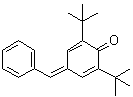 |
| Molecular Formula | C21H26O |
| Molecular Weight | 294.43 |
| CAS Registry Number | 7078-98-0 |
| EC Number | 429-460-4 |
| SMILES | CC(C)(C)C1=CC(=CC2=CC=CC=C2)C=C(C1=O)C(C)(C)C |
| Solubility | Insoluble (1.7E-3 g/L) (25 °C), Calc.* |
|---|---|
| Density | 1.030±0.06 g/cm3 (20 °C 760 Torr), Calc.* |
| Melting point | 74-75 °C** |
| Index of Refraction | 1.572, Calc.* |
| Boiling Point | 426.1±25.0 °C (760 mmHg), Calc.*, 186 °C (1 mmHg) |
| Flash Point | 183.0±18.1 °C, Calc.* |
| * | Calculated using Advanced Chemistry Development (ACD/Labs) Software V11.02 (©1994-2019 ACD/Labs) |
| ** | Ershov, V. V. |
| Hazard Symbols |  GHS07 Warning Details GHS07 Warning Details | ||||||||||||||||
|---|---|---|---|---|---|---|---|---|---|---|---|---|---|---|---|---|---|
| Risk Statements | H302-H315-H319-H335 Details | ||||||||||||||||
| Safety Statements | P261-P280-P301+P312-P302+P352-P305+P351+P338 Details | ||||||||||||||||
| Hazard Classification | |||||||||||||||||
| |||||||||||||||||
| SDS | Available | ||||||||||||||||
 chemBlink Chemical Story
|
2,6-Bis(1,1-dimethylethyl)-4-(phenylmethylene)-2,5-cyclohexadien-1-one, commonly referred to as a type of chalcone derivative, is a significant organic compound that has garnered attention due to its intriguing structure and diverse applications. This compound features a bicyclic structure containing both phenyl and cyclohexadiene moieties, characterized by two bulky tert-butyl groups at the 2 and 6 positions, and a phenylmethylene group at the 4 position. The synthesis of this compound can be traced back to research aimed at exploring the biological and chemical properties of chalcones and their derivatives, which are known for their potential in various applications including pharmaceuticals, agriculture, and material sciences. The discovery of 2,6-Bis(1,1-dimethylethyl)-4-(phenylmethylene)-2,5-cyclohexadien-1-one occurred as part of broader investigations into the reactivity and functionality of chalcone compounds. Chalcones, which are intermediates in the biosynthesis of flavonoids, were first isolated from natural sources in the late 19th century. Over the years, researchers have synthesized various chalcone derivatives to enhance their stability, solubility, and biological activity. The unique structure of 2,6-Bis(1,1-dimethylethyl)-4-(phenylmethylene)-2,5-cyclohexadien-1-one allows it to exhibit specific reactivity patterns, making it an interesting target for synthetic organic chemists. One of the primary applications of this compound lies in the field of pharmaceuticals. Studies have demonstrated that chalcone derivatives exhibit a range of biological activities, including antimicrobial, anti-inflammatory, and anticancer properties. The bulky tert-butyl groups in the structure of 2,6-Bis(1,1-dimethylethyl)-4-(phenylmethylene)-2,5-cyclohexadien-1-one may enhance its pharmacokinetic properties, potentially leading to improved bioavailability and efficacy in therapeutic applications. Research has indicated that derivatives of this compound can inhibit the growth of various cancer cell lines, suggesting a promising avenue for anticancer drug development. In addition to its pharmaceutical potential, this chalcone derivative finds applications in the agricultural sector as a bioactive compound. The antimicrobial properties of chalcones make them suitable candidates for the development of natural pesticides and fungicides. The structural characteristics of 2,6-Bis(1,1-dimethylethyl)-4-(phenylmethylene)-2,5-cyclohexadien-1-one may contribute to its effectiveness in protecting crops against pathogens, thereby enhancing agricultural productivity. Furthermore, the unique structural features of this compound enable its use in material science. Chalcones and their derivatives have been explored as precursors for the synthesis of polymers and other materials with specific optical and electronic properties. The incorporation of 2,6-Bis(1,1-dimethylethyl)-4-(phenylmethylene)-2,5-cyclohexadien-1-one into polymer matrices can impart desirable attributes such as UV stability and enhanced mechanical properties, making it a valuable additive in various industrial applications. In conclusion, 2,6-Bis(1,1-dimethylethyl)-4-(phenylmethylene)-2,5-cyclohexadien-1-one is a significant compound with a range of potential applications in pharmaceuticals, agriculture, and material science. Its discovery is part of the broader exploration of chalcone derivatives, which continue to be of interest due to their versatile properties and functionalities. Ongoing research aims to further elucidate the mechanisms of action of this compound and to develop novel applications that harness its unique structural attributes. References 2021. C-H Bond Functionalization of Amines: A Graphical Overview of Diverse Methods. SynOpen, 5(3). DOI: 10.1055/s-0040-1706051 2020. Base-Mediated 1,6-Aza-Michael Addition of Heterocyclic Amines and Amides to para-Quinone Methides Leading to Meclizine-, Hydroxyzine- and Cetirizine-like Architectures. Synthesis, 52(6). DOI: 10.1055/s-0039-1690677 2014. Improved synthesis of 4-benzylidene-2,6-di-tert-butylcyclohexa-2,5-dienone and its derivatives. Monatshefte fur Chemie - Chemical Monthly, 145(10). DOI: 10.1007/s00706-014-1266-x |
| Market Analysis Reports |