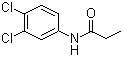
Propanil is a selective post-emergence herbicide primarily used in rice cultivation. It belongs to the chemical class of acetanilides and exhibits strong activity against a range of annual grasses and broadleaf weeds. Structurally, propanil is an acyl aniline compound, specifically 3',4'-dichloropropionanilide. The herbicidal action of propanil is based on its inhibition of photosynthesis, specifically targeting photosystem II within chloroplasts, resulting in the production of reactive oxygen species that cause rapid cell membrane degradation in susceptible plant species.
The discovery of propanil dates back to the 1960s, when it was developed as a safer alternative to earlier, more persistent herbicides. Its commercial introduction revolutionized weed management in flooded rice fields. One of the key advantages of propanil lies in its selectivity: rice plants possess the metabolic capacity to detoxify the compound through aryl acylamidase-mediated hydrolysis, whereas most weeds do not possess this capability. This metabolic distinction allows rice crops to tolerate propanil applications while nearby weeds are effectively controlled.
Propanil is typically applied as a foliar spray shortly after rice emergence and before the establishment of competing weed populations. It exhibits rapid absorption by the leaves and limited translocation, making timely application essential for optimal efficacy. Tank-mixing with other herbicides is common to broaden the spectrum of control and to manage resistance development in weed populations.
Over the years, propanil has been integrated into various weed management programs and has contributed to the increased productivity of rice farming, particularly in the southern United States and parts of Asia. Its use, however, must be carefully managed to avoid antagonism when mixed with certain herbicides or under specific environmental conditions, such as high temperatures, which can reduce crop selectivity and lead to phytotoxic effects.
Despite its effectiveness, propanil's environmental fate and toxicological profile have been subject to scrutiny. It degrades relatively quickly in the environment through microbial activity and hydrolysis, forming metabolites such as 3,4-dichloroaniline. This degradation product has raised concerns due to its potential persistence and toxicity. Consequently, regulatory agencies have imposed application restrictions to mitigate environmental impact and protect aquatic ecosystems.
Propanil has also played a role in the study of herbicide resistance. Repeated use over time in monoculture systems has led to the emergence of resistant weed species, particularly in Echinochloa crus-galli (barnyardgrass). This resistance is often due to enhanced metabolic detoxification or target-site insensitivity, prompting researchers to develop new strategies that incorporate herbicide rotation and integrated weed management practices.
Today, propanil remains a valuable tool in rice agriculture, though its usage is increasingly complemented by newer herbicides and mechanical practices to ensure long-term sustainability. Its discovery and adoption represent a significant milestone in the development of selective herbicides, showcasing the importance of understanding plant metabolism in achieving crop protection goals.
References
1971. Influence of herbicides on insecticide metabolism in leaf tissues. Journal of Agricultural and Food Chemistry, 19(6).
DOI: 10.1021/jf60178a047
1979. Changes in fatty acid and cholesterol synthesis in rat liver slices due to aromatic amines formed during the degradation of some herbicides. Bulletin of Environmental Contamination and Toxicology, 22(1).
DOI: 10.1007/bf01685513
2007. Effects of four rice herbicides on some metabolic and toxicology parameters of teleost fish (Leporinus obtusidens). Chemosphere, 68(8).
DOI: 10.1016/j.chemosphere.2007.03.006
|





 GHS07;GHS09 Warning Details
 chemBlink Chemical Story