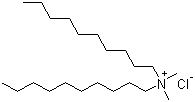
Didecyl dimethyl ammonium chloride is a quaternary ammonium compound (QAC) consisting of a nitrogen atom bonded to two decyl (C10) alkyl chains, two methyl groups, and a chloride counterion. This type of compound was developed in the mid-20th century as part of the broader class of QACs known for their antimicrobial and surface-active properties. The combination of long hydrophobic chains with a positively charged nitrogen center allows the molecule to adsorb onto microbial membranes, disrupt lipid bilayers, and cause cell lysis, providing broad-spectrum antimicrobial activity.
The primary application of didecyl dimethyl ammonium chloride is as a disinfectant and sanitizer. It is widely used in industrial, institutional, and household cleaning products, including surface disinfectants, floor cleaners, and sanitizing sprays. Its cationic nature enables strong interaction with negatively charged bacterial, fungal, and viral membranes, leading to rapid microbial inactivation. This makes it particularly useful in healthcare facilities, food processing environments, and public spaces where hygiene is critical.
In addition to its antimicrobial properties, didecyl dimethyl ammonium chloride serves as a cationic surfactant and conditioning agent in personal care and cosmetic products. It is incorporated into shampoos, conditioners, and skin care formulations to reduce static, improve hair combability, and enhance smoothness. The cationic headgroup adheres to negatively charged surfaces such as hair or skin, while the hydrophobic tails impart softness and improve spreadability. Its compatibility with other surfactants and emulsifiers allows its use in a wide range of formulations without compromising product stability.
Industrial applications of this compound include its use as a fabric softener, antistatic agent, and emulsifier. In textile processing, it improves fiber softness, reduces static buildup, and stabilizes emulsions. It also finds use in water treatment, pulp and paper processing, and other chemical applications where cationic surfactants facilitate flocculation, dispersion, or surface modification.
Safety and environmental considerations are important for didecyl dimethyl ammonium chloride. Like other QACs, it is toxic to aquatic organisms and may pose risks if released into the environment untreated. Direct contact with concentrated solutions can cause skin and eye irritation. Proper handling, concentration control, and wastewater treatment are essential to mitigate environmental and health risks. Its biodegradability is moderate, and formulations are designed to balance efficacy with environmental responsibility.
The development and use of didecyl dimethyl ammonium chloride highlight the versatility and effectiveness of quaternary ammonium chemistry. Its combination of antimicrobial efficacy, surface activity, and conditioning properties has ensured its widespread adoption across cleaning products, personal care formulations, textiles, and industrial processes. The compound continues to be an essential component in modern chemical applications, demonstrating the enduring value of medium-chain quaternary ammonium compounds.
References
2025. Unveiling the multifaceted mechanisms of action in nonionic and cationic biocide combinations against Gram-negative bacteria. Journal of Colloid and Interface Science.
DOI: 10.1016/j.jcis.2025.137891
2025. Topical corticosteroid and antimicrobial combinations: balancing efficacy and resistance risks. Drugs & Therapy Perspectives.
DOI: 10.1007/s40267-025-01170-4
2025. Intervention strategies for methicillin-resistant Staphylococcus aureus control in pig farming: a comprehensive review. Porcine Health Management.
DOI: 10.1186/s40813-025-00435-8
|





 GHS05;GHS07 Danger Details
 chemBlink Chemical Story