
Online Database of Chemicals from Around the World
| Hefei TNJ Chemical Industry Co., Ltd. | China | |||
|---|---|---|---|---|
 | www.tnjchem.com | |||
 | +86 (551) 6541-8684 | |||
 | +86 (551) 6541-8697 | |||
 | sales@tnjchem.com | |||
| Chemical manufacturer since 2001 | ||||
| chemBlink Standard supplier since 2010 | ||||
| BOC Sciences | USA | |||
|---|---|---|---|---|
| www.bocsci.com | |||
| +1 (631) 485-4226 | |||
| +1 (631) 614-7828 | |||
| info@bocsci.com | |||
| Chemical manufacturer | ||||
| chemBlink Standard supplier since 2010 | ||||
| Hangzhou Leap Chem Co., Ltd. | China | |||
|---|---|---|---|---|
| www.leapchem.com | |||
| +86 (571) 8771-1850 | |||
| market19@leapchem.com | |||
 | QQ Chat | |||
| Chemical manufacturer since 2006 | ||||
| chemBlink Standard supplier since 2015 | ||||
| Heraeus Ltd. | Hong Kong | |||
|---|---|---|---|---|
| www.heraeus.hk | |||
| +852 2675-1200 2773-1733 | |||
| +852 2773-1090 / 2682-3220 | |||
| cpd@heraeus.com.hk | |||
| Chemical manufacturer | ||||
| ChemPur GmbH | Germany | |||
|---|---|---|---|---|
| www.chempur.de | |||
| +49 (721) 933-840 | |||
| +49 (721) 47-2001 | |||
| info@chempur.de | |||
| Chemical manufacturer | ||||
| Shanghai Worldyang Chemical Co., Ltd. | China | |||
|---|---|---|---|---|
| www.worldyachem.com | |||
| +86 13651600618 +86 (21) 5679-5779 | |||
| +86 (21) 5679-5266 | |||
| sales7777@worldyachem.com | |||
| QQ Chat | |||
 | WeChat: 13651600618 | |||
 | WhatsApp:+86 13651600618 | |||
| Chemical manufacturer since 2012 | ||||
| Classification | Organic raw materials >> Carboxylic compounds and derivatives >> Acyclic carboxylic acid |
|---|---|
| Name | Ruthenium acetate |
| Synonyms | Ruthenium triacetate |
| Molecular Structure | 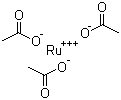 |
| Molecular Formula | C6H9O6Ru |
| Molecular Weight | 278.20 |
| CAS Registry Number | 72196-32-8 |
| EC Number | 638-755-9 |
| SMILES | CC(=O)[O-].CC(=O)[O-].CC(=O)[O-].[Ru+3] |
| Hazard Symbols |  GHS05 Danger Details GHS05 Danger Details | ||||||||||||||||
|---|---|---|---|---|---|---|---|---|---|---|---|---|---|---|---|---|---|
| Risk Statements | H314 Details | ||||||||||||||||
| Safety Statements | P280-P305+P351+P338+P310 Details | ||||||||||||||||
| Hazard Classification | |||||||||||||||||
| |||||||||||||||||
| Transport Information | UN 1759 | ||||||||||||||||
| SDS | Available | ||||||||||||||||
 chemBlink Chemical Story
|
Ruthenium acetate is the common name for a class of compounds in which ruthenium atoms are coordinated with acetate (CH3COO−) ligands. Among these, the best-characterized and most widely studied is the compound known as triruthenium acetate or basic ruthenium acetate, with the chemical formula [Ru3O(O2CCH3)6(H2O)3]+. This compound is a trinuclear oxo-centered complex, meaning it consists of three ruthenium atoms bridged by a central oxygen atom, with each ruthenium atom further coordinated to acetate ligands and water molecules. The synthesis of triruthenium acetate generally involves the reaction of ruthenium trichloride (RuCl3·xH2O) with an excess of acetic acid under heating. The process leads to the substitution of chloride ligands with acetate groups and the formation of the metal–metal bonded tri-ruthenium core. The resulting product is typically isolated as a salt with anions such as chloride, perchlorate, or nitrate depending on the reaction conditions and purification steps used. Structurally, [Ru3O(O2CCH3)6(H2O)3]+ features a triangular arrangement of ruthenium atoms with a μ3-oxo bridge at the center. Each ruthenium atom is six-coordinate, with four bridging acetate ligands contributing to the stability of the structure and one terminal water molecule at each metal center. The metal–metal bonding and oxo bridge are key contributors to the complex's stability and reactivity. Ruthenium acetate complexes have been widely studied for their redox properties and catalytic activity. They serve as models for understanding metal–metal interactions, and their well-defined structure makes them useful in probing the mechanisms of various redox reactions. These complexes can undergo multiple oxidation states, making them candidates for use in electron-transfer processes and oxidation catalysis. In catalysis, ruthenium acetate and related compounds have been investigated for their potential in promoting organic oxidations, including the oxidation of alcohols and olefins. Their redox versatility and the possibility of tuning their electronic properties through ligand modification make them suitable for homogeneous catalysis in both academic and industrial research. Ruthenium acetate complexes are also valuable in materials chemistry. They have been explored in the preparation of thin films and nanostructured materials where controlled deposition of ruthenium is required. Their solubility in organic solvents and defined nuclearity make them amenable to surface chemistry and advanced material processing techniques. Analytical techniques used to characterize ruthenium acetate complexes include X-ray crystallography, which provides detailed structural information, and nuclear magnetic resonance (NMR) spectroscopy, particularly 1H NMR for the acetate ligands. Infrared (IR) spectroscopy reveals the characteristic vibrations of carboxylate groups, while UV-visible spectroscopy and cyclic voltammetry are used to study their electronic transitions and redox behavior. Ruthenium acetate is typically handled as a solid or dissolved in polar solvents. It is sensitive to moisture and air under some conditions, depending on the specific salt and ligands present. Therefore, storage in airtight containers under inert atmosphere is often recommended. In summary, ruthenium acetate refers to a family of coordination compounds with ruthenium centers bonded to acetate ligands, most notably the trinuclear oxo-bridged [Ru3O(O2CCH3)6(H2O)3]+ complex. It plays an important role in coordination chemistry, redox studies, and homogeneous catalysis due to its stable structure, redox flexibility, and capacity for metal–metal interactions. |
| Market Analysis Reports |