
Online Database of Chemicals from Around the World
| Hangzhou Verychem Science And Technology Co., Ltd. | China | |||
|---|---|---|---|---|
 | www.verychem.com | |||
 | +86 (571) 8816-2785 +86 13606544505 | |||
 | +86 (571) 8816-2787 | |||
 | lucy@verychem.com | |||
| Chemical manufacturer since 2004 | ||||
| chemBlink Massive supplier since 2021 | ||||
| Simagchem Corporation | China | |||
|---|---|---|---|---|
| www.simagchem.com | |||
| +86 13806087780 | |||
| +86 (592) 268-0237 | |||
| sale@simagchem.com | |||
| Chemical manufacturer since 2002 | ||||
| chemBlink Standard supplier since 2008 | ||||
| Rising Pharmaceutical International Co., Ltd. | China | |||
|---|---|---|---|---|
| www.risingpharm.com | |||
| +86 (378) 229-5888 | |||
| +86 (378) 265-8355 | |||
| rising@risingpharm.com | |||
| Chemical manufacturer since 2000 | ||||
| chemBlink Standard supplier since 2008 | ||||
| Linhai Haixing Chemical Factory | China | |||
|---|---|---|---|---|
| www.lhhxchem.com | |||
| +86 (576) 8833-6807 | |||
| +86 (576) 8850-8156 | |||
| hxchemical@gmail.com | |||
| Chemical manufacturer since 1993 | ||||
| chemBlink Standard supplier since 2009 | ||||
| Taizhou Crene Biotechnology Co., Ltd. | China | |||
|---|---|---|---|---|
| www.pharm-intermediates.com | |||
| +86 (576) 8881-3233 8820-5808 +86 13396860566 | |||
| +86 (576) 8822-9589 | |||
| sales@pharm-intermediates.com | |||
 | QQ Chat | |||
| Chemical manufacturer since 2011 | ||||
| chemBlink Standard supplier since 2009 | ||||
| BOC Sciences | USA | |||
|---|---|---|---|---|
| www.bocsci.com | |||
| +1 (631) 485-4226 | |||
| +1 (631) 614-7828 | |||
| info@bocsci.com | |||
| Chemical manufacturer | ||||
| chemBlink Standard supplier since 2010 | ||||
| Creative Peptides | USA | |||
|---|---|---|---|---|
| www.creative-peptides.com | |||
| +1 (631) 624-4882 | |||
| +1 (631) 614-7828 | |||
| info@creative-peptides.com | |||
| Chemical manufacturer | ||||
| chemBlink Standard supplier since 2010 | ||||
| Alfa Chemistry | USA | |||
|---|---|---|---|---|
| www.alfa-chemistry.com | |||
| +1 (516) 734-6573 | |||
| +1 (516) 927-0118 | |||
| support@alfa-chemistry.com | |||
| Chemical manufacturer since 2005 | ||||
| chemBlink Standard supplier since 2012 | ||||
| Hangzhou Leap Chem Co., Ltd. | China | |||
|---|---|---|---|---|
| www.leapchem.com | |||
| +86 (571) 8771-1850 | |||
| market19@leapchem.com | |||
| QQ Chat | |||
| Chemical manufacturer since 2006 | ||||
| chemBlink Standard supplier since 2015 | ||||
| Health Biochem Technology Co., Ltd. | China | |||
|---|---|---|---|---|
| www.health-biochem.com | |||
| +86 (29) 6259-9512 | |||
| sales@health-biochem.com | |||
| Chemical manufacturer since 2015 | ||||
| chemBlink Standard supplier since 2018 | ||||
| Porton Corporation | China | |||
|---|---|---|---|---|
| www.porton.cn | |||
| +86 (23) 6763-5888 | |||
| +86 (23) 6703-8513 / 6763-5889 | |||
| porton@porton.cn | |||
| Chemical manufacturer since 2005 | ||||
| Zhejiang Jiangbei Pharmaceutical Co., Ltd. | China | |||
|---|---|---|---|---|
| www.jiangbei.com | |||
| +86 (415) 8878-6567 | |||
| +86 (415) 8878-6538 | |||
| trade@jiangbei.com | |||
| Chemical manufacturer since 1991 | ||||
| Hebei Xingang Pharmaceutical Co., Ltd. | China | |||
|---|---|---|---|---|
| www.xgpharm.cn | |||
| +86 (311) 8088-9704 8088-9705 +86 13837178289 | |||
| +86 (311) 8492-2430 | |||
| info@xgpharm.cn xgpharm@hotmail.com xgpharm@gmail.com | |||
 | WeChat: +86 13837178289 | |||
 | WhatsApp:+86 13837178289 | |||
| Chemical manufacturer since 1996 | ||||
| Taizhou Tianrui Chempharm Co., Ltd. | China | |||
|---|---|---|---|---|
| www.tianruipharm.com | |||
| +86 (576) 8860-3301 8860-3303 | |||
| +86 (576) 8860-3302 | |||
| sales@tianruipharm.com | |||
| Chemical manufacturer | ||||
| Classification | API >> Antibiotics >> Rifamycin |
|---|---|
| Name | Rifabutin |
| Synonyms | Collagen proline hydroxylase inhycobutin; (9S,12E,14S,15R,16S,17R,18R,19R,20S,21S,22E,24Z)-6,16,18,20-Tetrahydroxy-1'-isobutyl-14-methoxy-7,9,15,17,19,21,25-hepta-methyl-spiro[9,4-(epoxypentadeca[1,11,13]trienimino)-2H-furo-[2',3':7,8]-naphth[1,2-d]imidazol-2,4'-piperidin]-5,10,26-(3H,9H)-trione |
| Molecular Structure | 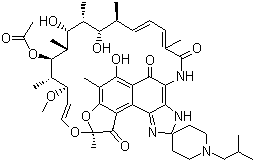 |
| Molecular Formula | C46H62N4O11 |
| Molecular Weight | 847.00 |
| CAS Registry Number | 72559-06-9 (76609-88-6) |
| EC Number | 615-780-3 |
| SMILES | C[C@H]1/C=CC=C(/C(=O)NC2=C(C3=C(C4=C(C(=C3O)C)O[C@@](C4=O)(OC=C[C@@H]([C@H]([C@H]([C@@H]([C@@H]([C@@H]([C@H]1O)C)O)C)OC(=O)C)C)OC)C)C5=NC6(CCN(CC6)CC(C)C)N=C25)O)C |
| Density | 1.3±0.1 g/cm3, Calc.* |
|---|---|
| Index of Refraction | 1.623, Calc.* |
| Boiling Point | 969.6±65.0 °C (760 mmHg), Calc.* |
| Flash Point | 540.2±34.3 °C, Calc.* |
| * | Calculated using Advanced Chemistry Development (ACD/Labs) Software. |
| Hazard Symbols |  GHS07 Warning Details GHS07 Warning Details |
|---|---|
| Risk Statements | H302-H315-H319-H335 Details |
| Safety Statements | P261-P305+P351+P338 Details |
| SDS | Available |
 chemBlink Chemical Story
|
Rifabutin is a synthetic antibiotic belonging to the rifamycin class of drugs. It is primarily used in the treatment of mycobacterial infections, particularly tuberculosis (TB), and is known for its effectiveness in treating infections caused by Mycobacterium avium complex (MAC) in individuals with HIV/AIDS. Rifabutin has a unique mechanism of action, inhibiting bacterial RNA synthesis, and it is often considered as an alternative to rifampin, particularly in cases where rifampin is contraindicated or less effective. The discovery of rifabutin can be traced back to the 1970s, when researchers sought to develop more effective antibiotics to combat the growing problem of antibiotic resistance, especially in the treatment of mycobacterial infections. Rifabutin was first developed by the pharmaceutical company Hoechst AG, and it was initially designed as a more potent derivative of rifamycin S, which had already shown promise in treating tuberculosis. After its discovery, rifabutin went through rigorous clinical trials to evaluate its safety and efficacy. Rifabutin works by binding to bacterial DNA-dependent RNA polymerase, a crucial enzyme for bacterial transcription. By inhibiting this enzyme, rifabutin prevents the synthesis of RNA, which is essential for bacterial growth and reproduction. This inhibition effectively halts the growth of the bacteria, allowing the body's immune system to clear the infection. Unlike rifampin, which is commonly used to treat TB, rifabutin is less likely to interact with other drugs, making it a better choice for patients undergoing complex antiretroviral therapy for HIV. Rifabutin's primary application is in the treatment of tuberculosis, particularly multi-drug-resistant TB (MDR-TB) and cases where rifampin is not suitable. It is also used in the prevention and treatment of infections caused by Mycobacterium avium complex, which is common among immunocompromised patients, especially those with HIV. In such patients, MAC infections can lead to severe complications, including fever, weight loss, and organ damage. Rifabutin is often used in combination with other antibiotics to increase its effectiveness and prevent the development of resistance. In addition to its use in tuberculosis and MAC infections, rifabutin is sometimes used in combination with other antibiotics for the treatment of certain bacterial infections, such as those caused by Staphylococcus species. Its broad-spectrum activity against various mycobacterial species and its lower risk of drug interactions make it an essential tool in the management of these infections. Rifabutin has also been the subject of research into its potential applications beyond tuberculosis and mycobacterial infections. Studies have explored its use in other bacterial infections, as well as its potential as an immunomodulatory agent. Some research has indicated that rifabutin may have anti-inflammatory properties, which could be beneficial in treating conditions characterized by excessive inflammation. However, further studies are required to fully understand these potential uses and to establish clear therapeutic guidelines. Despite its efficacy, rifabutin can have side effects, including gastrointestinal disturbances, liver enzyme elevation, and rash. Patients on rifabutin therapy must be closely monitored for these side effects, particularly when used in combination with other drugs. Drug interactions are a significant concern, as rifabutin can interact with antiretroviral medications, resulting in altered drug levels. This interaction can reduce the effectiveness of both rifabutin and antiretroviral drugs or increase the risk of adverse effects. Therefore, careful dosing and monitoring are essential in patients receiving combination therapy. Rifabutin’s discovery and development have provided an important tool in the fight against tuberculosis and mycobacterial infections, particularly in HIV-positive individuals who are at higher risk for these diseases. Its ability to target resistant mycobacterial strains and its relatively low potential for drug interactions have made it a critical medication in the treatment of these conditions. As research continues, it is likely that further applications for rifabutin will emerge, particularly in the management of other bacterial infections and inflammatory diseases. References 2022. Design and synthesis of water-soluble prodrugs of rifabutin for intraveneous administration. European Journal of Medicinal Chemistry, 238. DOI: 10.1016/j.ejmech.2022.114515 2019. Insights of synthetic analogues of anti-leprosy agents. Bioorganic & Medicinal Chemistry, 27(13). DOI: 10.1016/j.bmc.2019.04.032 2007. Synthesis and antibacterial evaluation of a novel series of rifabutin-like spirorifamycins. Bioorganic & Medicinal Chemistry Letters, 17(6). DOI: 10.1016/j.bmcl.2006.12.026 |
| Market Analysis Reports |