
Online Database of Chemicals from Around the World
| BOC Sciences | USA | |||
|---|---|---|---|---|
 | www.bocsci.com | |||
 | +1 (631) 485-4226 | |||
 | +1 (631) 614-7828 | |||
 | info@bocsci.com | |||
| Chemical manufacturer | ||||
| chemBlink Standard supplier since 2010 | ||||
| Creative Peptides | USA | |||
|---|---|---|---|---|
| www.creative-peptides.com | |||
| +1 (631) 624-4882 | |||
| +1 (631) 614-7828 | |||
| info@creative-peptides.com | |||
| Chemical manufacturer | ||||
| chemBlink Standard supplier since 2010 | ||||
| Intatrade Chemicals GmbH | Germany | |||
|---|---|---|---|---|
| www.intatrade.de | |||
| +49 (3493) 605-465 | |||
| +49 (3493) 605-470 | |||
| sales@intatrade.de | |||
| Chemical distributor | ||||
| chemBlink Standard supplier since 2011 | ||||
| Chengdu Youngshe Chemical Co., Ltd. | China | |||
|---|---|---|---|---|
| www.youngshechem.com | |||
| +86 (28) 6232-8193 +86 17380623303 | |||
| +86 (28) 6232-8193 | |||
| caroline@youngshechem.com | |||
 | QQ Chat | |||
 | Skype Chat | |||
| Chemical manufacturer since 2013 | ||||
| chemBlink Standard supplier since 2015 | ||||
| Nanjing Leon Biological Technology Co., Ltd. | China | |||
|---|---|---|---|---|
| www.njleonbiotech.com | |||
| +86 (25) 8452-3390 ex 127 | |||
| +86 (25) 8452-0790 | |||
| sales@njleonbiotech.com | |||
| Chemical manufacturer since 2014 | ||||
| chemBlink Standard supplier since 2015 | ||||
| Chengdu Biopurify Phytochemicals Ltd. | China | |||
|---|---|---|---|---|
| www.phytopurify.com | |||
| +86 (28) 8263-3860 8263-3987 | |||
| +86 (28) 8263-3165 | |||
| sales@biopurify.com biopurify@gmail.com | |||
| QQ Chat | |||
| Skype Chat | |||
| Chemical manufacturer | ||||
| chemBlink Standard supplier since 2017 | ||||
| Chengdu Jinglin Biotechnology Co., Ltd. | China | |||
|---|---|---|---|---|
| www.jinglinbio.com | |||
| +86 17380623303 | |||
| yunxicaroline@gmail.com | |||
| QQ Chat | |||
| Chemical distributor since 2021 | ||||
| chemBlink Standard supplier since 2022 | ||||
| Shandong Binlaichem Pharmaceutical Co., Ltd. | China | |||
|---|---|---|---|---|
| www.binlaichem.com | |||
| +86 15963310191 | |||
| sales@binlaichem.com | |||
| QQ Chat | |||
| Chemical distributor since 2022 | ||||
| chemBlink Standard supplier since 2023 | ||||
| Guangzhou Amsper Biotechnology Ltd. | China | |||
|---|---|---|---|---|
| www.amsper.com | |||
| +8618565278009 | |||
| gifty@amsper.com | |||
| QQ Chat | |||
| Skype Chat | |||
 | WeChat: +8618565278009 | |||
 | WhatsApp:+8618565278009 | |||
| Chemical distributor since 2018 | ||||
| chemBlink Standard supplier since 2025 | ||||
| Peptides International, Inc. | USA | |||
|---|---|---|---|---|
| www.pepnet.com | |||
| +1 (502) 266-8787 (800) 777-4779 | |||
| +1 (502) 267-1329 | |||
| peptides@pepnet.com | |||
| Chemical manufacturer since 1983 | ||||
| FutureChem Co., Ltd. | South Korea | |||
|---|---|---|---|---|
| www.futurechem.co.kr | |||
| +82 (2) 3010-8515 (70) 8255-8908 | |||
| +82 (2) 3010-8516 | |||
| webmaster@futurechem.co.kr | |||
| Chemical manufacturer | ||||
| Classification | Flavors and spices >> Synthetic spice >> Carboxylic acid and ester perfume >> Aromatic carboxylic acid ester |
|---|---|
| Name | N2-(N-Glycyl-L-histidyl)-L-lysine monoacetate |
| Synonyms | Gly-His-Lys acetate salt |
| Molecular Structure | 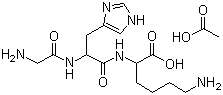 |
| Molecular Formula | C14H24N6O4.C2H4O2 |
| Molecular Weight | 400.43 |
| Protein Sequence | GHK |
| CAS Registry Number | 72957-37-0 |
| EC Number | 277-125-4 |
| SMILES | CC(=O)O.C1=C(NC=N1)C[C@@H](C(=O)N[C@@H](CCCCN)C(=O)O)NC(=O)CN |
| Hazard Symbols |  GHS07 Warning Details GHS07 Warning Details |
|---|---|
| Risk Statements | H302-H315-H319-H335 Details |
| Safety Statements | P261-P280-P301+P312-P302+P352-P305+P351+P338 Details |
| SDS | Available |
 chemBlink Chemical Story
|
N2-(N-Glycyl-L-histidyl)-L-lysine monoacetate is a synthetic tripeptide derivative that has been studied primarily in the context of peptide-based bioactive compounds. Its development is rooted in advances in peptide chemistry and solid-phase peptide synthesis, which became widely adopted after the pioneering work of Robert Bruce Merrifield in the 1960s. This methodology allowed for the stepwise assembly of peptides with precise control over sequence and stereochemistry, making it possible to produce complex tripeptides such as N2-(N-Glycyl-L-histidyl)-L-lysine monoacetate in a reproducible and scalable manner. The compound contains three amino acid residues: glycine at the N-terminus, histidine in the central position, and lysine at the C-terminus. The lysine residue is modified at the N2 position to form a peptide bond with the histidyl-glycine dipeptide, creating a linear tripeptide structure. The monoacetate form indicates that the molecule is isolated as the acetate salt, which improves its stability and handling. Histidine in the middle position provides an imidazole side chain, which is known to participate in metal coordination, proton transfer, and hydrogen bonding, giving the tripeptide potential biological activity. Lysine contributes a positively charged side chain at physiological pH, which can influence solubility, peptide–protein interactions, and cellular uptake. Glycine, as the simplest amino acid, provides flexibility to the peptide backbone, allowing for conformational adaptability. The discovery of N2-(N-Glycyl-L-histidyl)-L-lysine monoacetate was motivated by studies into short peptide sequences that mimic natural bioactive peptides or serve as ligands for biochemical targets. Tripeptides containing histidine and lysine residues have been explored for their ability to chelate metal ions, modulate enzyme activity, or act as signaling molecules. By synthesizing such tripeptides with precise sequences, researchers were able to investigate structure–activity relationships and the role of individual residues in biological function. The acetate salt form was introduced to enhance solubility and improve formulation characteristics for research or therapeutic applications. Applications of N2-(N-Glycyl-L-histidyl)-L-lysine monoacetate are primarily in biochemical and pharmaceutical research. The tripeptide is used as a model compound to study peptide–metal interactions, enzymatic cleavage, and cellular uptake mechanisms. Its sequence, containing both basic and imidazole-containing residues, allows it to interact with biological targets in ways that can mimic natural peptides involved in regulatory or catalytic processes. In addition, the compound has been investigated for its potential as a chelating agent, given the coordination properties of the histidine residue, which could be relevant for research into metalloproteins or metal ion delivery systems. The synthesis and study of N2-(N-Glycyl-L-histidyl)-L-lysine monoacetate exemplify the utility of short peptides in understanding molecular interactions and designing bioactive molecules. By leveraging solid-phase peptide synthesis and careful selection of residues, researchers can produce tripeptides with defined chemical and biological properties, providing tools for both fundamental research and potential therapeutic applications. The compound demonstrates how synthetic peptide chemistry can be used to create small, well-characterized molecules that serve as intermediates in the study of peptide function, structure, and activity. References 2024. Self-Assembled Peptide-Gold Nanoparticle 1D Nanohybrids Functionalized with GHK Tripeptide for Enhanced Wound-Healing and Photothermal Therapy. ACS Applied Materials & Interfaces, 17(8). DOI: 10.1021/acsami.4c21924 2024. The glycyl-l-histidyl-l-lysine-Cu2+ tripeptide complex attenuates lung inflammation and fibrosis in silicosis by targeting peroxiredoxin 6. Redox Biology, 75. DOI: 10.1016/j.redox.2024.103237 2020. Hydrogels based on low-methoxyl amidated citrus pectin and flaxseed gum formulated with tripeptide glycyl-l-histidyl-l-lysine improve the healing of experimental cutting wounds in rats. International Journal of Biological Macromolecules, 165(Pt B). DOI: 10.1016/j.ijbiomac.2020.09.251 |
| Market Analysis Reports |