
Online Database of Chemicals from Around the World
| Hubei Innerse Biotechnology Co., Ltd. | China | |||
|---|---|---|---|---|
 | www.innersebio.com | |||
 | +86 (027) 8818-9299 | |||
 | sales@innersebio.com | |||
 | QQ Chat | |||
| Chemical manufacturer since 2020 | ||||
| chemBlink Standard supplier since 2025 | ||||
| Shanghai Worldyang Chemical Co., Ltd. | China | |||
|---|---|---|---|---|
| www.worldyachem.com | |||
| +86 13651600618 +86 (21) 5679-5779 | |||
 | +86 (21) 5679-5266 | |||
| sales7777@worldyachem.com | |||
| QQ Chat | |||
 | WeChat: 13651600618 | |||
 | WhatsApp:+86 13651600618 | |||
| Chemical manufacturer since 2012 | ||||
| Name | Cy5 dic18 |
|---|---|
| Synonyms | (2E)-2-[(2E,4E)-5-(3,3-dimethyl-1-octadecylindol-1-ium-2-yl)penta-2,4-dienylidene]-3,3-dimethyl-1-octadecylindole iodide |
| Molecular Structure | 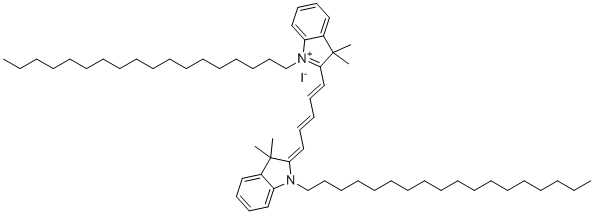 |
| Molecular Formula | C61H99IN2 |
| Molecular Weight | 987.36 |
| CAS Registry Number | 75539-51-4 |
| SMILES | CCCCCCCCCCCCCCCCCCN1C2=CC=CC=C2C(/C1=CC=CC=CC3=[N+](C4=CC=CC=C4C3(C)C)CCCCCCCCCCCCCCCCCC)(C)C.[I-] |
| Hazard Symbols |  GHS07 Warning Details GHS07 Warning Details |
|---|---|
| Risk Statements | H315-H319 Details |
| Safety Statements | P264-P280-P302+P352-P337+P313-P305+P351+P338-P362+P364-P332+P313 Details |
| SDS | Available |
 chemBlink Chemical Story
|
Cy5 dic18, formally known as 1,1'-dioctadecyl-3,3,3',3'-tetramethylindodicarbocyanine perchlorate, is a synthetic fluorescent dye in the cyanine family. Cyanine dyes, including Cy5, were originally developed in the mid-19th century for their bright colors in the textile industry. Over time, their chemical properties, especially their fluorescent properties, have attracted interest from the scientific community. Cy5 dic18 is specifically designed with an octadecyl (C18) chain to enhance its affinity for lipid membranes, making it an ideal tool for studying cellular structure and function. Cy5 dic18 is characterized by its extended conjugated system, which contributes to its bright fluorescence and long-wavelength emission. Cy5 dic18 incorporates into lipid bilayers due to its hydrophobic octadecyl chain. When excited by light of a specific wavelength, it fluoresces, allowing visualization of cell membranes and lipid-rich structures. Its long-wavelength emission minimizes background interference and autofluorescence, thereby improving imaging clarity. Cy5 dic18 is widely used to label and visualize cell membranes in both living and fixed cells. Its ability to embed into lipid bilayers enables detailed imaging of cell morphology and membrane dynamics. The lipophilicity of the dye makes it suitable for labeling lipid-rich organelles and vesicles, thus facilitating the study of their formation, movement, and intracellular interactions. In flow cytometry, Cy5 dic18 labels cells for the analysis of surface markers, enabling the identification and classification of cell populations based on their fluorescence signatures. It is used in fluorescent immunoassays to detect and quantify antigens or antibodies, providing a sensitive method for diagnostics and research. In live cell imaging, Cy5 dic18 allows the monitoring of dynamic processes such as cell migration, endocytosis, and exocytosis. Its stable fluorescence supports long-term observation of living cells without significant photobleaching. Researchers use it to study the fluidity and organization of cell membranes, gaining insights into membrane-related processes and cellular responses to external stimuli. Cy5 dic18 aids the development of lipid-based drug delivery systems by tracking the distribution and uptake of lipid nanoparticles in cells and tissues. It is also used to study the interaction between cancer cells and their microenvironment, especially how cancer cells interact with surrounding tissues and metastasize. Advantages of Cy5 dic18 are: bright fluorescence provides high-contrast images; long-wavelength emission reduces interference from autofluorescence; photostability enables long-term imaging without significant signal loss; lipophilicity ensures effective membrane labeling. Cy5 dic18 also has limitations: due to its hydrophobicity, it needs to be handled carefully to ensure proper solubility in biological studies; although it is generally safe, high concentrations may affect cell viability, so labeling conditions need to be optimized. |
| Market Analysis Reports |