
Online Database of Chemicals from Around the World
| BOC Sciences | USA | |||
|---|---|---|---|---|
 | www.bocsci.com | |||
 | +1 (631) 485-4226 | |||
 | +1 (631) 614-7828 | |||
 | info@bocsci.com | |||
| Chemical manufacturer | ||||
| chemBlink Standard supplier since 2010 | ||||
| Shanghai Edu Chemical Technology Co., Ltd. | China | |||
|---|---|---|---|---|
| www.chemido.com | |||
| +86 19301251526 | |||
| sales1@chemido.com | |||
 | QQ Chat | |||
| Chemical manufacturer since 2011 | ||||
| chemBlink Standard supplier since 2025 | ||||
| Classification | Flavors and spices >> Synthetic spice >> Aromatic cinnamic acid, esters and derivatives |
|---|---|
| Name | Methyl 4-formylcinnamate |
| Synonyms | 3-(4-Formylphenyl)acrylic acid methyl ester; Methyl 3-(4-formylphenyl)acrylate; Methyl p-formylcinnamate |
| Molecular Structure | 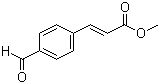 |
| Molecular Formula | C11H10O3 |
| Molecular Weight | 190.20 |
| CAS Registry Number | 7560-50-1 |
| SMILES | COC(=O)C=CC1=CC=C(C=C1)C=O |
| Density | 1.2±0.1 g/cm3 Calc.* |
|---|---|
| Melting point | 86-91 °C (Expl.) |
| Boiling point | 334.1±25.0 °C 760 mmHg (Calc.)* |
| Flash point | 148.7±23.2 °C (Calc.)* |
| Index of refraction | 1.598 (Calc.)* |
| * | Calculated using Advanced Chemistry Development (ACD/Labs) Software. |
| Hazard Symbols |  GHS07 Warning Details GHS07 Warning Details |
|---|---|
| Risk Statements | H302-H315-H319-H335 Details |
| Safety Statements | P261-P305+P351+P338 Details |
| SDS | Available |
 chemBlink Chemical Story
|
Methyl 4-formylcinnamate is an α,β-unsaturated ester containing a formyl group at the para position of the aromatic ring. Structurally, it combines a conjugated double bond system with an aromatic aldehyde and an ester functionality, which provides multiple reactive sites for chemical transformations. The compound belongs to the cinnamate family, which has been widely studied due to its applications in organic synthesis, materials chemistry, and as a precursor for biologically active molecules. Its preparation and use have attracted attention because the combination of aldehyde and α,β-unsaturation allows selective reactions such as condensation, reduction, and cyclization. The synthesis of methyl 4-formylcinnamate is typically achieved through the esterification of 4-formylcinnamic acid with methanol under acidic or catalytic conditions, or by condensation reactions such as the Knoevenagel reaction using 4-formylbenzaldehyde and a suitable malonate ester. The resulting ester is usually obtained as a pale yellow crystalline solid and can be purified by standard recrystallization or chromatography techniques. Reaction conditions are adjusted to prevent side reactions such as polymerization of the α,β-unsaturated system or oxidation of the aldehyde, ensuring high yield and structural integrity. The compound is widely used as a building block in organic synthesis, particularly for the preparation of substituted cinnamates, chalcones, and heterocyclic compounds. The aldehyde group allows formation of imines, oximes, and hydrazones, while the α,β-unsaturated ester can undergo Michael addition, conjugate reduction, or cycloaddition reactions. These versatile transformations make methyl 4-formylcinnamate suitable for constructing more complex molecular architectures, including natural product analogues, bioactive small molecules, and functionalized materials. Its reactivity has made it a convenient intermediate for laboratory-scale synthesis of compounds requiring precise functional group placement. In medicinal chemistry research, derivatives of methyl 4-formylcinnamate have been explored as potential enzyme inhibitors, anti-inflammatory agents, and anticancer compounds. The conjugated system contributes to molecular rigidity and planarity, which can enhance interactions with biological targets, while the aldehyde functionality permits structural diversification through selective reactions. Fluorinated or other substituted analogues of cinnamate esters have been prepared using this compound as a precursor, allowing systematic studies of structure–activity relationships and the influence of electron-withdrawing or electron-donating groups on biological properties. Beyond pharmaceutical applications, methyl 4-formylcinnamate has been employed in the preparation of polymers, liquid crystals, and other materials where conjugated systems provide electronic or optical properties. The aldehyde group allows covalent attachment to other building blocks, facilitating the design of extended conjugated networks. Researchers have also used it to synthesize chromophores, dyes, and fluorescent probes, exploiting the combination of aromatic, α,β-unsaturated, and ester functionalities to tune absorption and emission characteristics. Physically, methyl 4-formylcinnamate is typically a stable solid under standard laboratory conditions. It is moderately soluble in polar organic solvents such as ethanol, methanol, and dichloromethane. Care must be taken to store it away from strong oxidizing agents and excessive light to prevent degradation or polymerization. Its stability and multifunctional reactivity make it a versatile intermediate for multistep synthetic sequences. Overall, methyl 4-formylcinnamate is a valuable α,β-unsaturated aromatic ester used extensively as an intermediate in organic synthesis. Its dual functionality as an aldehyde and conjugated ester allows selective chemical transformations, making it a key building block for the preparation of diverse bioactive compounds, functional materials, and structurally complex molecules. References 2021. A kind of preparation method of panobinostat. CN Patent, 113387866. 2018. A kind of panobinostat intermediate and its synthesis and application. CN Patent, 108794375. 2018. Dual inhibitor of prolyl hydroxylase and histone deacetylase and preparation method and application thereof. CN Patent, 109232541. |
| Market Analysis Reports |