
Online Database of Chemicals from Around the World
| Simagchem Corporation | China | |||
|---|---|---|---|---|
 | www.simagchem.com | |||
 | +86 13806087780 | |||
 | +86 (592) 268-0237 | |||
 | sale@simagchem.com | |||
| Chemical manufacturer since 2002 | ||||
| chemBlink Standard supplier since 2008 | ||||
| Hefei TNJ Chemical Industry Co., Ltd. | China | |||
|---|---|---|---|---|
| www.tnjchem.com | |||
| +86 (551) 6541-8684 | |||
| +86 (551) 6541-8697 | |||
| sales@tnjchem.com | |||
| Chemical manufacturer since 2001 | ||||
| chemBlink Standard supplier since 2010 | ||||
| BOC Sciences | USA | |||
|---|---|---|---|---|
| www.bocsci.com | |||
| +1 (631) 485-4226 | |||
| +1 (631) 614-7828 | |||
| info@bocsci.com | |||
| Chemical manufacturer | ||||
| chemBlink Standard supplier since 2010 | ||||
| Hangzhou Leap Chem Co., Ltd. | China | |||
|---|---|---|---|---|
| www.leapchem.com | |||
| +86 (571) 8771-1850 | |||
| market19@leapchem.com | |||
 | QQ Chat | |||
| Chemical manufacturer since 2006 | ||||
| chemBlink Standard supplier since 2015 | ||||
| Riverland Trading LLC. | USA | |||
|---|---|---|---|---|
| www.riverlandtrading.com | |||
| +1 (336).944-2293 | |||
| bens@riverlandtrading.com | |||
| Chemical distributor | ||||
| chemBlink Standard supplier since 2023 | ||||
| Bruc Chemicals Co., Ltd. | China | |||
|---|---|---|---|---|
| www.brucchem.com | |||
| +86 15820039489 | |||
| brucneochem@outlook.com | |||
| Chemical manufacturer since 2010 | ||||
| chemBlink Standard supplier since 2026 | ||||
| Scientific Polymer Products, Inc. | USA | |||
|---|---|---|---|---|
| www.scientificpolymer.com | |||
| +1 (585) 265-0413 | |||
| +1 (585) 265-1390 | |||
| custserv@scipoly.com | |||
| Chemical manufacturer | ||||
| Jiangsu Tianyin Chemical Industry Co., Ltd. | China | |||
|---|---|---|---|---|
| www.chinatianyin.com | |||
| +86 (510) 8755-1178 | |||
| +86 (510) 8755-1428 | |||
| tianyin@chinatianyin.com | |||
| Chemical manufacturer | ||||
| Dynamic International Enterprises Limited | China | |||
|---|---|---|---|---|
| www.dynai.com | |||
| +86 (21) 6231-2607 (510) 8755-1178 8755-4400 | |||
| +86 (21) 6231-3801 / (510) 8755-1428 | |||
| china@dynai.com | |||
| Chemical manufacturer | ||||
| Changzhou Suntton Co., Ltd. | USA | |||
|---|---|---|---|---|
| www.suntton.com | |||
| +1 (914) 965-2077 +86 (519) 8513-6089 | |||
| +1 (914) 375-2093 / +86 (519) 8513-6133 | |||
| luke.verdet@suntton.com lily.chen@suntton.com | |||
| Chemical manufacturer | ||||
| Yangzhou Baosheng Bio-Chemical Co., Ltd. | China | |||
|---|---|---|---|---|
| www.ybsbiochem.com | |||
| +86 (514) 8422-1897 +86 15161417788 +86 15252517788 | |||
| +86 (514) 8422-5897 | |||
| export@ybsbiochem.com | |||
| Chemical manufacturer since 1997 | ||||
| Classification | Organic raw materials >> Carboxylic compounds and derivatives >> Carboxylic esters and their derivatives |
|---|---|
| Name | Tributyl citrate |
| Synonyms | Tri-n-butyl citrate |
| Molecular Structure | 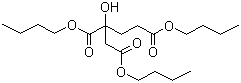 |
| Molecular Formula | C18H32O7 |
| Molecular Weight | 360.45 |
| CAS Registry Number | 77-94-1 |
| EC Number | 201-071-2 |
| SMILES | CCCCOC(=O)CC(CC(=O)OCCCC)(C(=O)OCCCC)O |
| Density | 1.1±0.1 g/cm3 Calc.*, 1.042 g/mL (Expl.) |
|---|---|
| Melting point | -20 °C (Expl.) |
| Boiling point | 389.8±9.0 °C 760 mmHg (Calc.)*, 325 °C (Expl.) |
| Flash point | 120.7±12.2 °C (Calc.)*, 157 °C (Expl.) |
| Solubility | water: insoluble (Expl.) |
| Index of refraction | 1.465 (Calc.)*, 1.444 (Expl.) |
| * | Calculated using Advanced Chemistry Development (ACD/Labs) Software. |
| Hazard Symbols |  GHS05 Danger Details GHS05 Danger Details | ||||||||||||
|---|---|---|---|---|---|---|---|---|---|---|---|---|---|
| Risk Statements | H318 Details | ||||||||||||
| Safety Statements | P264+P265-P280-P305+P354+P338-P317 Details | ||||||||||||
| Hazard Classification | |||||||||||||
| |||||||||||||
| SDS | Available | ||||||||||||
 chemBlink Chemical Story
|
Tributyl citrate (TBC), CAS 77-94-1, is the tri-n-butyl ester of citric acid and an important member of the citrate family of plasticizers. Its history is closely connected with a recurring challenge in materials science: many useful polymers are naturally too rigid for the products manufacturers want to make. Plasticizers solve this problem by increasing molecular mobility within a polymer, and citrate esters became particularly interesting where formulators wanted alternatives to traditional phthalate plasticizers. The molecular origin of TBC is unusually familiar. Citric acid is the same tricarboxylic acid widely associated with citrus fruits and produced industrially on a large scale by fermentation. In tributyl citrate, its three carboxylic acid groups are esterified with n-butanol, producing a much more hydrophobic molecule with the formula C18H32O7. The transformation illustrates how esterification can completely change the practical behavior of a familiar starting material: a highly water-soluble organic acid becomes an oily organic ester suitable for modifying polymers. TBC functions primarily as an external plasticizer. When blended with a compatible polymer, its molecules occupy space among the macromolecular chains and reduce the intermolecular interactions that restrict chain movement. The polymer can consequently become softer and more flexible, and its glass-transition temperature may decrease. TBC has been used with PVC and its copolymers and has also attracted substantial attention as a plasticizer for other polymer systems. One particularly interesting example is poly(lactic acid), or PLA. PLA can be produced from biologically derived lactic acid and is an important biodegradable thermoplastic, but unmodified PLA is relatively stiff and brittle for some applications. Researchers have shown that tributyl citrate can substantially reduce the glass-transition temperature of PLA and increase molecular mobility, providing a route toward more flexible films. This creates an appealing materials concept: a polymer associated with renewable feedstocks can be combined with a citrate plasticizer whose citric-acid precursor is also produced industrially by fermentation. The relationship between plasticizer size, compatibility, and permanence remains important, however. A small plasticizer may be particularly effective at increasing chain mobility, but because an external plasticizer is not normally covalently bonded to the polymer, it can potentially migrate or separate during aging. Studies of citrate-plasticized PLA have therefore examined not only initial flexibility but also long-term phase behavior and plasticizer retention. Such work demonstrates why successful plasticization requires more than simply choosing a molecule that makes a polymer softer. TBC has also been studied as a plasticizer in pharmaceutical polymer films. Film coatings used on tablets and other dosage forms must combine flexibility, adhesion, water response, and processing characteristics. Research comparing tributyl citrate with other ester plasticizers has shown that plasticizer identity can influence glass-transition temperature, water absorption, adhesion, and permanence of acrylic pharmaceutical films. This is another example of how a seemingly minor formulation ingredient can influence the behavior of an entire finished product. Tributyl citrate should also be distinguished from acetyl tributyl citrate (ATBC), another widely encountered citrate plasticizer. The two compounds are closely related but have different CAS numbers and structures: TBC retains the hydroxyl group derived from citric acid, whereas ATBC carries an additional acetyl group at that position. Their properties and regulatory uses therefore should not be treated as interchangeable. In the United States, tributyl citrate appears in the FDA inventory of substances listed for specified food-contact applications, including adhesives under 21 CFR 175.105. Such regulatory listings are application-specific and do not mean that every possible use or exposure is automatically authorized. They nevertheless illustrate the longstanding interest in citrate esters for applications where material composition and potential exposure require careful consideration. Tributyl citrate ultimately represents a broader trend in polymer technology. The performance of a plastic material depends not only on the identity of its polymer chains, but also on the smaller molecules placed among them. By starting from citric acid and converting it into a compatible organic ester, chemists created a molecule capable of changing the flexibility and processing behavior of much larger macromolecular systems. Its story is therefore a useful reminder that materials are often designed at more than one scale. The polymer provides the framework, but small molecules can determine how that framework moves. Sometimes changing the behavior of a material weighing kilograms begins with controlling the interactions of molecules weighing only a few hundred daltons. References 1. Ljungberg, N.; Wesslen, B. (2003). "Tributyl citrate oligomers as plasticizers for poly(lactic acid): thermo-mechanical film properties and aging." Polymer, 44, 7679-7688. https://doi.org/10.1016/j.polymer.2003.09.055 2. Labrecque, L. V.; Kumar, R. A.; Dave, V.; Gross, R. A.; McCarthy, S. P. (1997). "Citrate esters as plasticizers for poly(lactic acid)." Journal of Applied Polymer Science, 66, 1507-1513. 3. Lin, S. Y.; Lee, C. J.; Lin, Y. Y. (2000). "The effect of plasticizers on compatibility, mechanical properties, and adhesion strength of drug-free Eudragit E films." Pharmaceutical Research. 4. U.S. Food and Drug Administration. Inventory of Food Contact Substances Listed in 21 CFR: Tributyl Citrate, CAS 77-94-1. FDA Food Contact Substance Inventory |
| Market Analysis Reports |