
Online Database of Chemicals from Around the World
| Hangzhou Verychem Science And Technology Co., Ltd. | China | |||
|---|---|---|---|---|
 | www.verychem.com | |||
 | +86 (571) 8816-2785 +86 13606544505 | |||
 | +86 (571) 8816-2787 | |||
 | lucy@verychem.com | |||
| Chemical manufacturer since 2004 | ||||
| chemBlink Massive supplier since 2021 | ||||
| Zhejiang Qianjiang Biochemical Co., Ltd. | China | |||
|---|---|---|---|---|
| www.qianjiangbioch.com | |||
| +86 (573) 8703-5289 8704-6039 8702-6183 | |||
| +86 (573) 8702-6402 / 8702-0637 / 8704-2055 | |||
| qjhgsc@126.com | |||
| Chemical manufacturer | ||||
| chemBlink Standard supplier since 2007 | ||||
| Simagchem Corporation | China | |||
|---|---|---|---|---|
| www.simagchem.com | |||
| +86 13806087780 | |||
| +86 (592) 268-0237 | |||
| sale@simagchem.com | |||
| Chemical manufacturer since 2002 | ||||
| chemBlink Standard supplier since 2008 | ||||
| Taizhou Crene Biotechnology Co., Ltd. | China | |||
|---|---|---|---|---|
| www.pharm-intermediates.com | |||
| +86 (576) 8881-3233 8820-5808 +86 13396860566 | |||
| +86 (576) 8822-9589 | |||
| sales@pharm-intermediates.com | |||
 | QQ Chat | |||
| Chemical manufacturer since 2011 | ||||
| chemBlink Standard supplier since 2009 | ||||
| Labseeker Inc | USA | |||
|---|---|---|---|---|
| www.labseeker.com | |||
| +1 (858) 750-1632 | |||
| +1 (858) 412-1220 | |||
| marketing@labseeker.com | |||
| Chemical manufacturer since 2002 | ||||
| chemBlink Standard supplier since 2015 | ||||
| Carbosynth China Ltd. | China | |||
|---|---|---|---|---|
| www.carbosynth.cn | |||
| +86 (512) 6260-5585 | |||
| +86 (512) 6260-5576 | |||
| sales@carbosynth.com | |||
| QQ Chat | |||
| Chemical manufacturer since 2006 | ||||
| chemBlink Standard supplier since 2016 | ||||
| Shanghai Finetech pharm Co., Ltd. | China | |||
|---|---|---|---|---|
| www.finetechpharm.cn | |||
| +86 18221039705 | |||
| ad@finetechpharm.cn | |||
| Chemical manufacturer since 2016 | ||||
| chemBlink Standard supplier since 2026 | ||||
| Classification | Biochemical >> Carbohydrate >> Monosaccharide |
|---|---|
| Name | Valiolamine |
| Synonyms | (1S,2S,3R,4S,5S)-5-Amino-1-hydroxymethylcyclohexane-1,2,3,4-tetranol |
| Molecular Structure | 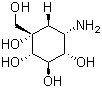 |
| Molecular Formula | C7H15NO5 |
| Molecular Weight | 193.20 |
| CAS Registry Number | 83465-22-9 |
| EC Number | 617-461-4 |
| SMILES | C1[C@@H]([C@@H]([C@H]([C@@H]([C@]1(CO)O)O)O)O)N |
| Density | 1.6±0.1 g/cm3 Calc.* |
|---|---|
| Boiling point | 368.6±42.0 °C 760 mmHg (Calc.)* |
| Flash point | 176.7±27.9 °C (Calc.)* |
| Index of refraction | 1.656 (Calc.)* |
| * | Calculated using Advanced Chemistry Development (ACD/Labs) Software. |
| Hazard Symbols |  GHS07 Warning Details GHS07 Warning Details |
|---|---|
| Risk Statements | H315-H319-H335 Details |
| Safety Statements | P261-P305+P351+P338 Details |
| SDS | Available |
 chemBlink Chemical Story
|
Valiolamine is a naturally derived aminocyclitol compound belonging to the class of sugar-like polyhydroxylated amines. It is structurally related to aminocyclitols found in microbial metabolites and is best known as a key intermediate in the biosynthesis and semisynthetic production of certain α-glucosidase inhibitors used for antidiabetic therapy. Structurally, valiolamine features a cyclohexane-type ring system heavily substituted with multiple hydroxyl groups and a primary amino group. This dense arrangement of functional groups gives the molecule a high degree of polarity and extensive hydrogen-bonding capability. Unlike typical sugars, however, it lacks a carbonyl group in its open-chain form and instead exists as a stable aminocyclitol framework. Valiolamine is closely related to the natural product valiolone, which is produced by certain Streptomyces species. In biosynthetic terms, valiolamine can be viewed as a reduced and aminated derivative within the valienamine/valiolone family of aminocyclitol compounds. These structures are characteristic of microbial secondary metabolites that often serve as enzyme inhibitors, particularly targeting carbohydrate-processing enzymes. One of the most important chemical features of valiolamine is its structural similarity to glucose. The arrangement of hydroxyl groups mimics the stereochemistry of hexose sugars, allowing valiolamine-derived compounds to bind effectively to carbohydrate-recognition sites in enzymes. This structural mimicry is the basis for its biological activity in glycosidase inhibition. Valiolamine itself is not typically the final pharmacologically active drug but serves as a crucial synthetic building block. It is used in the production of acarbose-related compounds and other α-glucosidase inhibitors, which are drugs that delay carbohydrate digestion in the small intestine. By inhibiting enzymes such as sucrase and maltase, these drugs reduce postprandial blood glucose spikes and are used in the management of type 2 diabetes. From a chemical perspective, the multiple hydroxyl groups on valiolamine make it highly hydrophilic and capable of forming extensive intramolecular and intermolecular hydrogen bonding networks. The amino group introduces basicity, allowing the compound to exist in protonated forms under physiological conditions. This amphoteric nature influences its solubility and interaction with biological targets. Stereochemistry plays a critical role in the biological function of valiolamine. The spatial arrangement of hydroxyl groups determines its ability to fit into the active sites of carbohydrate-processing enzymes. Even small changes in stereochemistry can significantly reduce binding affinity and biological activity, highlighting the importance of precise three-dimensional configuration. In terms of physicochemical properties, valiolamine is expected to be highly water-soluble due to its polyhydroxylated structure and protonatable amine group. It is typically not lipophilic and does not readily cross lipid membranes without transport mechanisms, which is consistent with many sugar-like metabolites. In synthetic chemistry, valiolamine and its derivatives are valuable scaffolds for designing glycosidase inhibitors. Chemical modification of its amino group allows attachment to other functional groups, leading to more complex molecules with enhanced pharmacological properties. Overall, valiolamine is a highly oxygenated aminocyclitol that mimics carbohydrate structures and serves as an important intermediate in the synthesis of α-glucosidase inhibitors. Its significance lies in its stereochemically defined polyol framework, biological sugar mimicry, and role in antidiabetic drug development. References 2026. The LOTUS Initiative for Open Natural Products Research: frozen dataset union wikidata (with metadata). . DOI: 10.5281/zenodo.5794106 2023. Structure-Based Design of Potent Iminosugar Inhibitors of Endoplasmic Reticulum α-Glucosidase I with Anti-SARS-CoV-2 Activity. Journal of Medicinal Chemistry. DOI: 10.1021/acs.jmedchem.2c01750 2021. N-Substituted Valiolamine Derivatives as Potent Inhibitors of Endoplasmic Reticulum α-Glucosidases I and II with Antiviral Activity. Journal of Medicinal Chemistry. DOI: 10.1021/acs.jmedchem.1c01377 |
| Market Analysis Reports |