
Online Database of Chemicals from Around the World
| Simagchem Corporation | China | |||
|---|---|---|---|---|
 | www.simagchem.com | |||
 | +86 13806087780 | |||
 | +86 (592) 268-0237 | |||
 | sale@simagchem.com | |||
| Chemical manufacturer since 2002 | ||||
| chemBlink Standard supplier since 2008 | ||||
| Hefei TNJ Chemical Industry Co., Ltd. | China | |||
|---|---|---|---|---|
| www.tnjchem.com | |||
| +86 (551) 6541-8684 | |||
| +86 (551) 6541-8697 | |||
| sales@tnjchem.com | |||
| Chemical manufacturer since 2001 | ||||
| chemBlink Standard supplier since 2010 | ||||
| BOC Sciences | USA | |||
|---|---|---|---|---|
| www.bocsci.com | |||
| +1 (631) 485-4226 | |||
| +1 (631) 614-7828 | |||
| info@bocsci.com | |||
| Chemical manufacturer | ||||
| chemBlink Standard supplier since 2010 | ||||
| Changzhou Comwin Fine Chemical Co., Ltd. | China | |||
|---|---|---|---|---|
| www.comwin-china.com | |||
| +86 (519) 8661-9955 | |||
| +86 (519) 8661-3190 | |||
| info@comwin-china.com | |||
| Chemical manufacturer since 1992 | ||||
| chemBlink Standard supplier since 2024 | ||||
| Chiron AS | Norway | |||
|---|---|---|---|---|
| www.chiron.no | |||
| +47 (73) 874-490 | |||
| +47 (73) 874-499 | |||
| chiron@chiron.no | |||
| Chemical manufacturer | ||||
| Scientific Polymer Products, Inc. | USA | |||
|---|---|---|---|---|
| www.scientificpolymer.com | |||
| +1 (585) 265-0413 | |||
| +1 (585) 265-1390 | |||
| custserv@scipoly.com | |||
| Chemical manufacturer | ||||
| Classification | Pharmaceutical intermediate >> Heterocyclic compound intermediate >> Pyridine compound >> Cyanopyridine |
|---|---|
| Name | Dicyclohexyl phthalate |
| Molecular Structure | 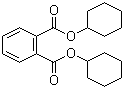 |
| Molecular Formula | C20H26O4 |
| Molecular Weight | 330.42 |
| CAS Registry Number | 84-61-7 |
| EC Number | 201-545-9 |
| SMILES | C1CCC(CC1)OC(=O)C2=CC=CC=C2C(=O)OC3CCCCC3 |
| Density | 1.2 |
|---|---|
| Melting point | 63-67 °C |
| Boiling point | 200-235 °C (4 mmHg) |
| Flash point | 107 °C |
| Water solubility | insoluble |
| Hazard Symbols |   GHS07;GHS08 Danger Details GHS07;GHS08 Danger Details | ||||||||||||||||||||||||||||||||||||||||
|---|---|---|---|---|---|---|---|---|---|---|---|---|---|---|---|---|---|---|---|---|---|---|---|---|---|---|---|---|---|---|---|---|---|---|---|---|---|---|---|---|---|
| Risk Statements | H315-H317-H319-H335-H360--H361-H412 Details | ||||||||||||||||||||||||||||||||||||||||
| Safety Statements | P203-P261-P264-P264+P265-P271-P272-P273-P280-P302+P352-P304+P340-P305+P351+P338-P318-P319-P321-P332+P317-P333+P317-P337+P317-P362+P364-P403+P233-P405-P501 Details | ||||||||||||||||||||||||||||||||||||||||
| Hazard Classification | |||||||||||||||||||||||||||||||||||||||||
| |||||||||||||||||||||||||||||||||||||||||
| SDS | Available | ||||||||||||||||||||||||||||||||||||||||
 chemBlink Chemical Story
|
Dicyclohexyl phthalate (DCHP) is a chemical compound that belongs to the family of phthalates, widely used as plasticizers in the production of flexible plastics. Phthalates like DCHP enhance the flexibility, durability, and longevity of plastic materials, making them essential in a range of industrial applications. Dicyclohexyl phthalate is specifically characterized by its two cyclohexyl groups attached to a phthalate backbone, imparting unique properties such as stability and low volatility compared to other phthalates. The discovery of phthalates, including DCHP, dates back to the early 20th century when scientists were exploring compounds that could improve the malleability of plastics. The development of DCHP occurred as part of ongoing efforts to find suitable plasticizers for various polymers, especially in applications requiring high stability and low migration. DCHP gained attention due to its superior performance in making polyvinyl chloride (PVC) and other polymers more flexible while maintaining heat and chemical resistance. Dicyclohexyl phthalate has found applications in several industries. It is commonly used in the manufacturing of flexible PVC, which is used in products such as cables, hoses, and plastic films. The use of DCHP in PVC allows the material to remain flexible over a wide temperature range without becoming brittle. This property is particularly valuable in electrical insulation and automotive parts, where stability and durability are critical. In addition to its use in PVC, DCHP has been applied in coatings, adhesives, and sealants. Its ability to provide plasticity and elasticity to materials makes it a versatile additive. DCHP is also used in the production of synthetic rubber and in certain elastomers, contributing to the resilience and toughness of the final products. However, like many phthalates, Dicyclohexyl phthalate has been scrutinized for potential environmental and health impacts. Phthalates, in general, have been associated with endocrine disruption in both humans and animals, raising concerns about their widespread use. Regulatory agencies have investigated the safety of DCHP, and its use has been restricted in certain applications, particularly in products that may come into contact with food or be used by children. Despite these concerns, DCHP continues to be used in applications where its physical properties offer significant advantages, and efforts have been made to ensure its safe handling and disposal. In research, Dicyclohexyl phthalate is studied for its behavior in environmental systems and its interaction with biological systems. This research has contributed to a deeper understanding of how phthalates like DCHP migrate from plastics and how they persist in the environment. Such studies are crucial for assessing the long-term impact of phthalates on ecosystems and human health. In summary, Dicyclohexyl phthalate is a key plasticizer with applications across multiple industries. Its discovery and development have contributed to advancements in flexible plastic materials, while ongoing research ensures that its use is balanced with safety considerations. DCHP remains an important component in the production of materials that require flexibility, durability, and resistance to environmental stresses. References 2023. Effects of the in-utero dicyclohexyl phthalate and di-n-hexyl phthalate administration on the oxidative stress-induced histopathological changes in the rat liver tissue correlated with serum biochemistry and hematological parameters. Frontiers in Endocrinology, 14. DOI: 10.3389/fendo.2023.1128202 2023. Occurrence and ecological risk assessment of 16 phthalates in surface water of the mainstream of the Yangtze River, China. Environmental science and pollution research international, 30(22). DOI: 10.1007/s11356-023-27203-x 2024. Assessment of phthalate esters migration in plastic products marketed in Turkey for food use. Journal of Food Measurement and Characterization, 18(8). DOI: 10.1007/s11694-024-02802-5 |
| Market Analysis Reports |