
Online Database of Chemicals from Around the World
| Sino Chemtech (Shanghai) Co., Ltd. | China | |||
|---|---|---|---|---|
 | www.shsinochem.com | |||
 | +86 (21) 5479-5335 +86 13917677577 | |||
 | +86 (21) 5479-5339 | |||
 | sales@shsinochem.com | |||
 | QQ Chat | |||
 | Skype Chat | |||
| Chemical manufacturer since 2007 | ||||
| chemBlink Standard supplier since 2007 | ||||
| Simagchem Corporation | China | |||
|---|---|---|---|---|
| www.simagchem.com | |||
| +86 13806087780 | |||
| +86 (592) 268-0237 | |||
| sale@simagchem.com | |||
| Chemical manufacturer since 2002 | ||||
| chemBlink Standard supplier since 2008 | ||||
| Nanjing Hope International Trade Co., Ltd. | China | |||
|---|---|---|---|---|
| www.nanjinghope.com | |||
| +86 (25) 6601-6088 | |||
| +86 (25) 8369-6629 | |||
| vip@nanjinghope.com | |||
| Chemical distributor | ||||
| chemBlink Standard supplier since 2012 | ||||
| Labseeker Inc | USA | |||
|---|---|---|---|---|
| www.labseeker.com | |||
| +1 (858) 750-1632 | |||
| +1 (858) 412-1220 | |||
| marketing@labseeker.com | |||
| Chemical manufacturer since 2002 | ||||
| chemBlink Standard supplier since 2015 | ||||
| Bondchemistry Co., Ltd. | China | |||
|---|---|---|---|---|
| www.bondchemistry.com | |||
| +86 15858185835 | |||
| sales@bondchemistry.com | |||
| Chemical distributor | ||||
| chemBlink Standard supplier since 2020 | ||||
| Weifang Yuanye Biotechnology Co., Ltd. | China | |||
|---|---|---|---|---|
| www.wfyuanye.com | |||
| +86 (0536) 531-6600 | |||
| tina@yuanyechemical.com | |||
| QQ Chat | |||
| Skype Chat | |||
 | WeChat: 15053681231 | |||
 | WhatsApp:+86 15053681231 | |||
| Chemical manufacturer since 2006 | ||||
| chemBlink Standard supplier since 2023 | ||||
| Alchemie Shanghai Co., Ltd. | China | |||
|---|---|---|---|---|
| www.alcshanghai.com | |||
| +86 (021) 5072-0087 | |||
| assistant2@alchemie-shanghai.com | |||
| Chemical distributor since 2018 | ||||
| chemBlink Standard supplier since 2025 | ||||
| Jintan Jinlv Chemical Factory | China | |||
|---|---|---|---|---|
| www.jinlvchem.com | |||
| +86 (519) 8222-9885 +86 13861079985 +86 13861118999 | |||
| +86 (519) 8231-8588 | |||
| gyq@jinlvchem.com 1685170901@qq.com | |||
| Chemical manufacturer since 1985 | ||||
| Jiangsu Kuaida Agrochemical Co., Ltd. | China | |||
|---|---|---|---|---|
| www.kuaida-agrochem.com | |||
| +86 (513) 8441-5648 8441-5599 8441-5638 | |||
| +86 (513) 8454-2863 / 8454-8320 | |||
| sales@kuaida.cn | |||
| Chemical manufacturer | ||||
| AccuStandard Inc. | USA | |||
|---|---|---|---|---|
| www.accustandard.com | |||
| +1 (203) 786-5290 | |||
| +1 (203) 786-5287 | |||
| orders@accustandard.com | |||
| Chemical manufacturer since 1986 | ||||
| Hangzhou Dayoo Co., Ltd. | China | |||
|---|---|---|---|---|
| www.dayoochem.com | |||
| +86 (571) 8583-3303 | |||
| +86 (571) 8586-5553 | |||
| dayoochem@163.com | |||
| Chemical manufacturer | ||||
| Classification | Chemical pesticide >> Herbicide >> Benzene herbicide |
|---|---|
| Name | Quinclorac |
| Synonyms | 3,7-Dichloroquinoline-8-carboxylic acid; 3,7-Dichloro-8-quinolinecarboxylic acid; BAS-514-H; Facet 75 DF |
| Molecular Structure | 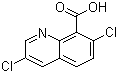 |
| Molecular Formula | C10H5Cl2NO2 |
| Molecular Weight | 242.06 |
| CAS Registry Number | 84087-01-4 |
| EC Number | 402-780-1 |
| SMILES | C1=CC(=C(C2=NC=C(C=C21)Cl)C(=O)O)Cl |
| Density | 1.6±0.1 g/cm3 Calc.* |
|---|---|
| Boiling point | 405.4±40.0 °C 760 mmHg (Calc.)* |
| Flash point | 199.0±27.3 °C (Calc.)* |
| Index of refraction | 1.695 (Calc.)* |
| * | Calculated using Advanced Chemistry Development (ACD/Labs) Software. |
| Hazard Symbols |  GHS07 Warning Details GHS07 Warning Details | ||||||||
|---|---|---|---|---|---|---|---|---|---|
| Risk Statements | H317 Details | ||||||||
| Safety Statements | P261-P272-P280-P302+P352-P321-P333+P317-P362+P364-P501 Details | ||||||||
| Hazard Classification | |||||||||
| |||||||||
| SDS | Available | ||||||||
 chemBlink Chemical Story
|
Quinclorac is a selective post-emergent herbicide primarily used to control grassy and certain broadleaf weeds, especially in turfgrass, rice, and various cereal crops. It belongs to the quinolinecarboxylic acid class of herbicides and has the molecular formula C10H5Cl2NO2. Its structure includes a chlorinated quinoline ring and a carboxylic acid functional group, which are responsible for its herbicidal properties. Quinclorac acts by mimicking natural auxins, a class of plant hormones that regulate growth. Specifically, it disrupts normal cell elongation and division in susceptible plants by inducing uncontrolled growth, leading to swelling, twisting, and ultimately death of targeted weeds. This auxin-mimic mechanism allows it to be particularly effective against annual grasses like barnyardgrass (*Echinochloa crus-galli*) and crabgrass (*Digitaria* spp.), as well as some broadleaf species such as clover and speedwell. The compound was introduced in the 1990s and has since become a key herbicide in rice cultivation, especially in Asia and the southern United States, where barnyardgrass poses a significant challenge. It is often applied in early post-emergence stages when weeds are still small and actively growing. Quinclorac is absorbed through both foliage and roots and translocated throughout the plant, ensuring systemic activity. In turf management, quinclorac is commonly used on established lawns, golf courses, and sports fields. It selectively controls weedy grasses without damaging desirable turf species like Kentucky bluegrass, perennial ryegrass, and tall fescue. Commercial turf formulations often include quinclorac in combination with other herbicides to enhance the weed control spectrum. Resistance management is an important aspect of quinclorac use. While its mode of action is distinct from many other herbicide classes, repeated use over time without rotation or integration with other control measures can lead to reduced efficacy or resistance in target weed populations. Therefore, integrated weed management strategies are recommended, including crop rotation, herbicide mixing, and cultural practices. Quinclorac is generally stable under environmental conditions and has moderate soil persistence. It binds moderately to soil particles and is not highly mobile, which helps reduce the risk of groundwater contamination. Its primary degradation pathway is microbial breakdown, and its half-life in soil varies depending on temperature, moisture, and microbial activity. Toxicological evaluations indicate that quinclorac has low acute toxicity in mammals, birds, and aquatic organisms. However, as with any pesticide, users must follow label instructions for safe handling, application, and personal protective equipment to minimize exposure and environmental impact. In summary, quinclorac is a systemic, selective herbicide used primarily to control grassy and broadleaf weeds in rice, turfgrass, and cereal crops. Its unique auxin-mimic mechanism and broad utility make it a valuable tool in both agricultural and turf weed management programs. References 2022. Multi-walled Carbon Nanotubes Remediate the Phytotoxicity of Quinclorac to Tomato. Bulletin of Environmental Contamination and Toxicology, 109(2). DOI: 10.1007/s00128-022-03582-8 2023. Fe3+-cysteine enhanced persulfate fenton-like process for quinclorac degradation: A wide pH tolerance and reaction mechanism. Environmental Research, 226. DOI: 10.1016/j.envres.2023.115447 2024. Biochar obtained from eucalyptus, rice hull, and native bamboo as an alternative to decrease mobility of hexazinone, metribuzin, and quinclorac in a tropical soil. Environmental Monitoring and Assessment, 196(5). DOI: 10.1007/s10661-024-12589-z |
| Market Analysis Reports |