
Online Database of Chemicals from Around the World
| Wuhan Kemi-works Chemical Co., Ltd. | China | |||
|---|---|---|---|---|
 | www.kemiworks.net | |||
 | +86 (27) 8573-6489 | |||
 | +86 (27) 8573-6485 | |||
 | info@kemiworks.net sales@kemiworks.com | |||
| Chemical manufacturer | ||||
| chemBlink Premium supplier since 2011 | ||||
| Classification | Organic raw materials >> Heterocyclic compound |
|---|---|
| Name | (9-Phenyl-9H-carbazol-3-yl)boronic acid |
| Synonyms | acridin-9-amine |
| Molecular Structure | 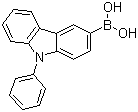 |
| Molecular Formula | C18H14BNO2 |
| Molecular Weight | 287.12 |
| CAS Registry Number | 854952-58-2 |
| EC Number | 691-972-0 |
| SMILES | B(C1=CC2=C(C=C1)N(C3=CC=CC=C32)C4=CC=CC=C4)(O)O |
| Density | 1.2±0.1 g/cm3, Calc.* |
|---|---|
| Index of Refraction | 1.638, Calc.* |
| Boiling Point | 466.0±51.0 °C (760 mmHg), Calc.* |
| Flash Point | 235.6±30.4 °C, Calc.* |
| * | Calculated using Advanced Chemistry Development (ACD/Labs) Software. |
| Hazard Symbols |  GHS07 Warning Details GHS07 Warning Details | ||||||||||||||||||||||||||||
|---|---|---|---|---|---|---|---|---|---|---|---|---|---|---|---|---|---|---|---|---|---|---|---|---|---|---|---|---|---|
| Risk Statements | H302-H312-H315-H319-H332-H335 Details | ||||||||||||||||||||||||||||
| Safety Statements | P261-P264-P264+P265-P270-P271-P280-P301+P317-P302+P352-P304+P340-P305+P351+P338-P317-P319-P321-P330-P332+P317-P337+P317-P362+P364-P403+P233-P405-P501 Details | ||||||||||||||||||||||||||||
| Hazard Classification | |||||||||||||||||||||||||||||
| |||||||||||||||||||||||||||||
| SDS | Available | ||||||||||||||||||||||||||||
 chemBlink Chemical Story
|
(9-Phenyl-9H-carbazol-3-yl)boronic acid is an organic boron compound that has gained significant attention in recent years due to its diverse applications in materials science, organic electronics, and medicinal chemistry. The substance consists of a carbazole ring system, which is a well-known heterocyclic structure, coupled with a phenyl group and a boronic acid group, making it a valuable building block for various chemical processes. The discovery of (9-phenyl-9H-carbazol-3-yl)boronic acid can be traced back to the growing interest in boronic acid derivatives in the late 20th century. Boronic acids are highly versatile compounds known for their ability to form reversible covalent bonds with diols, making them essential for a wide range of applications, particularly in catalysis and material science. Researchers soon recognized that integrating boronic acid functionality into aromatic systems like carbazole could lead to compounds with enhanced electronic properties, making them useful in the development of advanced materials and devices. The synthesis of (9-phenyl-9H-carbazol-3-yl)boronic acid typically involves the direct boronation of the carbazole derivative using a suitable boron source, such as bis(pinacolato)diboron, under specific reaction conditions. The resulting product contains a boronic acid group at the 3-position of the carbazole ring, which can participate in further chemical transformations or be utilized in various applications. One of the primary areas of application for (9-phenyl-9H-carbazol-3-yl)boronic acid is in the field of organic electronics, specifically in the development of organic light-emitting diodes (OLEDs) and organic semiconductors. The presence of the carbazole unit, which is known for its high electron-donating properties, combined with the boronic acid group, provides a unique balance of electron-accepting and electron-donating characteristics. This makes the compound suitable for use in organic materials that require efficient charge transport and emission properties. In OLEDs, the compound is often incorporated into the electron transport layer or as a dopant in the emissive layer, contributing to improved device efficiency and color purity. In addition to its use in organic electronics, (9-phenyl-9H-carbazol-3-yl)boronic acid is also utilized in organic photovoltaic (OPV) devices. OPVs are a type of solar cell that rely on organic materials to convert sunlight into electricity. The unique electronic properties of (9-phenyl-9H-carbazol-3-yl)boronic acid make it an ideal candidate for enhancing the charge transport and stability of these devices, which is critical for improving their performance and efficiency. In medicinal chemistry, boronic acids, including (9-phenyl-9H-carbazol-3-yl)boronic acid, have shown promise as inhibitors of proteasomes, enzymes that regulate the degradation of proteins within cells. By interacting with the proteasome, boronic acids can induce cell death, making them potential candidates for cancer therapy. The unique structure of (9-phenyl-9H-carbazol-3-yl)boronic acid allows it to selectively bind to proteasomes, providing a platform for the development of targeted cancer treatments. The compound's utility extends to catalysis as well. Boronic acids are frequently employed as catalysts or catalyst ligands in Suzuki coupling reactions, a key method for the formation of carbon-carbon bonds in organic synthesis. By incorporating (9-phenyl-9H-carbazol-3-yl)boronic acid into such reactions, researchers can create a wide variety of complex organic molecules, further demonstrating the compound's versatility. In conclusion, (9-phenyl-9H-carbazol-3-yl)boronic acid is a highly functionalized compound with a broad range of applications in materials science, electronics, and medicinal chemistry. Its unique chemical structure, combining a carbazole moiety with a boronic acid group, imparts valuable properties that make it an essential component in the development of next-generation organic devices, catalysts, and therapeutic agents. References 2024. Highly sensitive and specific detection of Ni2+ using a novel fluorometric probe in the DMSO-H2O system. Photochemical & Photobiological Sciences, 23(3). DOI: 10.1007/s43630-024-00537-2 2012. A highly efficient and aerobic protocol for the synthesis of N-heteroaryl substituted 9-arylcarbazolyl derivatives via a palladium-catalyzed ligand-free Suzuki reaction. Organic & Biomolecular Chemistry, 10(39). DOI: 10.1039/c2ob26119g 2006. Synthesis and Optical Properties of Starburst Carbazoles Based on 9-Phenylcarbazole Core. Synlett, 2006(16). DOI: 10.1055/s-2006-950266 |
| Market Analysis Reports |