
Online Database of Chemicals from Around the World
| CAS: 85893-37-4 Product: Fentanyl N-oxide No suppliers available. |
| Classification | Organic raw materials >> Heterocyclic compound >> Piperidines |
|---|---|
| Name | Fentanyl N-oxide |
| Synonyms | N-[1-oxido-1-(2-phenylethyl)piperidin-1-ium-4-yl]-N-phenylpropanamide |
| Molecular Structure | 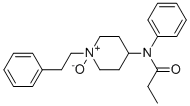 |
| Molecular Formula | C22H28N2O2 |
| Molecular Weight | 352.47 |
| CAS Registry Number | 85893-37-4 |
| EC Number | 642-158-9 |
| SMILES | CCC(=O)N(C1CC[N+](CC1)(CCC2=CC=CC=C2)[O-])C3=CC=CC=C3 |
| Hazard Symbols |  GHS06 Danger Details GHS06 Danger Details |
|---|---|
| Risk Statements | H301 Details |
| Safety Statements | P264-P270-P301+P316-P321-P330-P405-P501 Details |
 chemBlink Chemical Story
|
Fentanyl N-oxide is a phase I oxidative metabolite of fentanyl, a powerful synthetic opioid analgesic extensively used for managing severe pain and as an anesthetic adjunct. Structurally, fentanyl N-oxide results from the oxidation of the tertiary amine nitrogen in the fentanyl molecule, producing an N-oxide functional group. This transformation introduces a polar oxygen atom, increasing the compound’s hydrophilicity and reducing its affinity for the μ-opioid receptor, thereby diminishing its pharmacological activity. The formation of fentanyl N-oxide occurs primarily via the hepatic cytochrome P450 enzyme system, most notably CYP3A4, which is responsible for a majority of fentanyl’s metabolic transformations. The oxidation at the nitrogen atom is less common than other metabolic routes, such as N-dealkylation to norfentanyl, but it contributes to the full biotransformation profile of fentanyl in humans. The presence of fentanyl N-oxide, along with other metabolites, reflects the body’s detoxification processes and influences fentanyl’s overall pharmacokinetics. Pharmacologically, fentanyl N-oxide is considered inactive or minimally active. It exhibits significantly lower potency at opioid receptors compared to the parent compound, and in most studies, it is classified as a non-analgesic metabolite. Its formation serves primarily as a metabolic inactivation pathway rather than a contributor to fentanyl’s therapeutic or toxic effects. Due to its reduced receptor binding affinity and limited blood-brain barrier permeability, fentanyl N-oxide does not meaningfully participate in the central nervous system effects associated with fentanyl. The detection of fentanyl N-oxide is primarily of interest in forensic toxicology and drug monitoring contexts. It serves as an auxiliary biomarker of fentanyl exposure, especially in cases where direct fentanyl detection is difficult due to rapid metabolism and clearance. Its identification in biological specimens such as urine or plasma can support evidence of recent fentanyl use, particularly when combined with the detection of norfentanyl and other primary metabolites. Advanced analytical techniques, including liquid chromatography-tandem mass spectrometry (LC-MS/MS), are employed for the detection and quantification of fentanyl N-oxide. These techniques offer high sensitivity and specificity, allowing reliable identification even at low concentrations. Although fentanyl N-oxide is not as prevalent or abundant as norfentanyl in biological matrices, its detection can still provide valuable complementary data in comprehensive toxicological screens. Fentanyl N-oxide has no approved clinical use and is not considered an active pharmaceutical agent. Its role is entirely as a metabolic byproduct of fentanyl. However, its identification contributes to a more complete understanding of fentanyl metabolism, especially in studies of drug interaction, metabolic variability, and population pharmacokinetics. The formation of fentanyl N-oxide may be influenced by individual factors such as liver enzyme activity, genetic polymorphisms, and co-administered substances that modulate cytochrome P450 function. These factors can affect the relative proportions of various fentanyl metabolites, which in turn may impact the interpretation of drug levels in clinical or forensic assessments. In summary, fentanyl N-oxide represents a minor but distinct pathway in the metabolic fate of fentanyl. It holds little pharmacological relevance due to its lack of opioid activity but is important as a metabolic marker. Its identification supports efforts in drug testing, postmortem toxicology, and pharmacokinetic research aimed at improving the understanding of fentanyl metabolism and its implications for both therapeutic use and overdose investigations. References 2008. Harmonization of quality indicators of the domestic parent substance fentanyl. Pharmaceutical Chemistry Journal, 42(9). DOI: 10.1007/s11094-009-0166-6 |
| Market Analysis Reports |