
Online Database of Chemicals from Around the World
| Jinan Chenghui-Shuangda Chemical Co., Ltd. | China | |||
|---|---|---|---|---|
 | www.jnchsd.com | |||
 | +86 (531) 5889-7051 +86 15053146086 | |||
 | +86 (531) 5889-7093 | |||
 | jnchsd@qq.com | |||
 | QQ Chat | |||
| Chemical manufacturer since 2002 | ||||
| chemBlink Standard supplier since 2007 | ||||
| Simagchem Corporation | China | |||
|---|---|---|---|---|
| www.simagchem.com | |||
| +86 13806087780 | |||
| +86 (592) 268-0237 | |||
| sale@simagchem.com | |||
| Chemical manufacturer since 2002 | ||||
| chemBlink Standard supplier since 2008 | ||||
| Shandong Chengchuang Pharmaceutical Technology Development Co., Ltd. | China | |||
|---|---|---|---|---|
| www.ccmed.cn | |||
| +86 (531) 5889-7091 | |||
| +86 (531) 5889-7092 | |||
| ccyychem@163.com | |||
| Chemical manufacturer since 1999 | ||||
| chemBlink Standard supplier since 2010 | ||||
| BOC Sciences | USA | |||
|---|---|---|---|---|
| www.bocsci.com | |||
| +1 (631) 485-4226 | |||
| +1 (631) 614-7828 | |||
| info@bocsci.com | |||
| Chemical manufacturer | ||||
| chemBlink Standard supplier since 2010 | ||||
| Shanghai Hohance Chemical Co., Ltd. | China | |||
|---|---|---|---|---|
| www.hohance.com | |||
| +86 (21) 3111-5312 | |||
| +86 (21) 3111-5317 | |||
| info@hohance.com | |||
| Chemical manufacturer | ||||
| chemBlink Standard supplier since 2011 | ||||
| Hangzhou Leap Chem Co., Ltd. | China | |||
|---|---|---|---|---|
| www.leapchem.com | |||
| +86 (571) 8771-1850 | |||
| market19@leapchem.com | |||
| QQ Chat | |||
| Chemical manufacturer since 2006 | ||||
| chemBlink Standard supplier since 2015 | ||||
| Shanghai Yingrui Biopharm Co., Ltd. | China | |||
|---|---|---|---|---|
| www.shyrchem.com | |||
| +86 (21) 3358-5366 3466-6753 +86 13311639313 | |||
| +86 (21) 3497-9012 | |||
| sales02@shyrchem.com | |||
| QQ Chat | |||
 | Skype Chat | |||
| Chemical manufacturer since 2009 | ||||
| chemBlink Standard supplier since 2017 | ||||
| Shandong Chenghui Shuangda Pharmaceutical Co., Ltd. | China | |||
|---|---|---|---|---|
| www.chsdpharma.com | |||
| +86-531-58897029 | |||
| ericqiao@jnchsd.com | |||
| QQ Chat | |||
 | WeChat: 15550412551 | |||
 | WhatsApp:15550412551 | |||
| Chemical manufacturer since 2014 | ||||
| chemBlink Standard supplier since 2025 | ||||
| Classification | Biochemical >> Inhibitor >> Neuronal signaling >> Adrenergic receptor agonist |
|---|---|
| Name | Medetomidine hydrochloride |
| Synonyms | (R)-4-[1-(2,3-Dimethylphenyl)ethyl]-1H-imidazole hydrochloride |
| Molecular Structure | 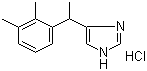 |
| Molecular Formula | C13H16N2.HCl |
| Molecular Weight | 236.74 |
| CAS Registry Number | 86347-15-1 |
| EC Number | 645-306-0 |
| SMILES | CC1=C(C(=CC=C1)C(C)C2=CN=CN2)C.Cl |
| Melting point | 168-172 °C (Expl.) |
|---|---|
| Solubility | DMF soluble, DMSO soluble, PBS soluble, ethanol soluble, water soluble (Expl.) |
| Hazard Symbols |    GHS06;GHS08;GHS09 Danger Details GHS06;GHS08;GHS09 Danger Details | ||||||||||||||||||||||||||||||||||||||||||||||||||||||||||||
|---|---|---|---|---|---|---|---|---|---|---|---|---|---|---|---|---|---|---|---|---|---|---|---|---|---|---|---|---|---|---|---|---|---|---|---|---|---|---|---|---|---|---|---|---|---|---|---|---|---|---|---|---|---|---|---|---|---|---|---|---|---|
| Risk Statements | H300+H330-H336-H370-H372-H410 Details | ||||||||||||||||||||||||||||||||||||||||||||||||||||||||||||
| Safety Statements | P260-P264-P271-P273-P284-P304+P340+P310 Details | ||||||||||||||||||||||||||||||||||||||||||||||||||||||||||||
| Hazard Classification | |||||||||||||||||||||||||||||||||||||||||||||||||||||||||||||
| |||||||||||||||||||||||||||||||||||||||||||||||||||||||||||||
| SDS | Available | ||||||||||||||||||||||||||||||||||||||||||||||||||||||||||||
 chemBlink Chemical Story
|
Medetomidine hydrochloride is a synthetic pharmaceutical compound primarily used as a sedative, analgesic, and anesthetic adjunct in veterinary medicine. It belongs to the class of alpha-2 adrenergic receptor agonists and was developed in the late 20th century to provide effective sedation and pain control in animals. Pharmacologically, medetomidine hydrochloride acts selectively on alpha-2 adrenergic receptors located in the central nervous system and peripheral tissues. Activation of these receptors inhibits the release of norepinephrine, leading to sedation, anxiolysis, analgesia, and muscle relaxation. The drug produces a dose-dependent sedative effect and is often used in combination with other agents to facilitate diagnostic, surgical, or therapeutic procedures in animals. Medetomidine hydrochloride is commonly used in various veterinary species, including dogs, cats, and horses. It can be administered via intravenous, intramuscular, or subcutaneous routes. The drug’s sedative and analgesic properties make it valuable for premedication before anesthesia, as well as for short procedures requiring restraint or pain relief. Pharmacokinetically, medetomidine hydrochloride is well absorbed following intramuscular or subcutaneous administration. It undergoes hepatic metabolism, primarily through glucuronidation and oxidation, and its metabolites are excreted via the kidneys. The elimination half-life varies by species but typically ranges between 1 to 3 hours, allowing for relatively short-duration sedation. Adverse effects of medetomidine hydrochloride include bradycardia, hypotension, respiratory depression, and transient hypertension. These effects are related to its action on the cardiovascular and respiratory systems mediated by alpha-2 receptor stimulation. Due to these potential side effects, careful dosing and monitoring are essential during its use. Reversal agents such as atipamezole, an alpha-2 adrenergic antagonist, are available and commonly used to quickly reverse medetomidine’s effects when necessary. Medetomidine hydrochloride has become a standard sedative and analgesic in veterinary practice due to its predictable effects, ease of administration, and the availability of a specific antagonist. It enhances the safety and comfort of animals undergoing procedures and improves the quality of anesthesia protocols. In summary, medetomidine hydrochloride is an alpha-2 adrenergic receptor agonist used extensively in veterinary medicine for sedation, analgesia, and anesthesia adjunct. Its pharmacological action provides effective CNS depression and pain relief, with a well-characterized safety profile and reversible effects through specific antagonists. References 1990. The clinical effectiveness of atipamezole as a medetomidine antagonist in the dog. Journal of Veterinary Pharmacology and Therapeutics, 13(2). DOI: 10.1111/j.1365-2885.1990.tb00769.x 2005. Influence of medetomidine on stress-related neurohormonal and metabolic effects caused by butorphanol, fentanyl, and ketamine administration in dogs. American Journal of Veterinary Research, 66(3). DOI: 10.2460/ajvr.2005.66.406 2007. Oxygenation in medetomidine-sedated dogs with and without 100% oxygen insufflation. Veterinary Therapeutics: Research in Applied Veterinary Medicine, 8(1). URL: https://pubmed.ncbi.nlm.nih.gov/17447225 |
| Market Analysis Reports |