
Online Database of Chemicals from Around the World
| Hangzhou Verychem Science And Technology Co., Ltd. | China | |||
|---|---|---|---|---|
 | www.verychem.com | |||
 | +86 (571) 8816-2785 +86 13606544505 | |||
 | +86 (571) 8816-2787 | |||
 | lucy@verychem.com | |||
| Chemical manufacturer since 2004 | ||||
| chemBlink Massive supplier since 2021 | ||||
| Beijing Ribio Biotech. Inc. | China | |||
|---|---|---|---|---|
| www.ribio.com.cn | |||
| +86 (10) 6266-4360 +86 13910960639 | |||
| +86 (10) 6266-4370 | |||
| sales@ribio.com.cn ribio@163.com | |||
 | QQ Chat | |||
| Chemical manufacturer since 2007 | ||||
| chemBlink Standard supplier since 2007 | ||||
| BOC Sciences | USA | |||
|---|---|---|---|---|
| www.bocsci.com | |||
| +1 (631) 485-4226 | |||
| +1 (631) 614-7828 | |||
| info@bocsci.com | |||
| Chemical manufacturer | ||||
| chemBlink Standard supplier since 2010 | ||||
| Creative Peptides | USA | |||
|---|---|---|---|---|
| www.creative-peptides.com | |||
| +1 (631) 624-4882 | |||
| +1 (631) 614-7828 | |||
| info@creative-peptides.com | |||
| Chemical manufacturer | ||||
| chemBlink Standard supplier since 2010 | ||||
| Win-Win Chemical Co., Ltd. | China | |||
|---|---|---|---|---|
| www.win-winchemical.com | |||
| +86 (577) 6449-8589 +86 15325081899 | |||
| +86 (577) 5699-4596 | |||
| sales@win-winchemical.com winwinchemical@gmail.com | |||
| QQ Chat | |||
 | Skype Chat | |||
| Chemical manufacturer since 2007 | ||||
| chemBlink Standard supplier since 2011 | ||||
| Glentham Life Sciences | UK | |||
|---|---|---|---|---|
| www.glenthamls.com | |||
| +44 (2033) 978-798 | |||
| +44 (2033) 978-909 | |||
| info@glenthamls.com | |||
| Chemical distributor since 2013 | ||||
| chemBlink Standard supplier since 2013 | ||||
| Biosynth AG. | Switzerland | |||
|---|---|---|---|---|
| www.biosynth.com | |||
| +41 (71) 858-2020 | |||
| +41 (71) 858-2030 | |||
| welcome@biosynth.ch | |||
| Chemical manufacturer | ||||
| chemBlink Standard supplier since 2014 | ||||
| Amadis Chemical Co., Ltd. | China | |||
|---|---|---|---|---|
| www.amadischem.com | |||
| +86 (571) 8992-5085 | |||
| +86 (571) 8992-5065 | |||
| sales@amadischem.com | |||
| Chemical manufacturer since 2010 | ||||
| chemBlink Standard supplier since 2015 | ||||
| W & J PharmaChem, Inc. | USA | |||
|---|---|---|---|---|
| www.wjpharmachem.com | |||
| +1 (301) 880-0624 | |||
| +1 (301) 434-9366 | |||
| info@wjpharmachem.com | |||
| Chemical manufacturer | ||||
| Classification | Biochemical >> Nucleoside drugs >> Deoxynucleotides and their analogues |
|---|---|
| Name | 7-Deaza-2'-deoxyguanosine |
| Synonyms | 2-Amino-7-(2-deoxy-beta-D-erythro-pentofuranosyl)-1,7-dihydro-4H-pyrrolo[2,3-d]pyrimidin-4-one |
| Molecular Structure | 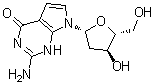 |
| Molecular Formula | C11H14N4O4 |
| Molecular Weight | 266.25 |
| Protein Sequence | N |
| CAS Registry Number | 86392-75-8 |
| SMILES | C1[C@@H]([C@H](O[C@H]1N2C=CC3=C2N=C(NC3=O)N)CO)O |
| Solubility | Very slightly soluble (0.17 g/L) (25 °C), Calc.* |
|---|---|
| Density | 1.90±0.1 g/cm3 (20 °C 760 Torr), Calc.* |
| Melting point | 262-265 °C** |
| Index of Refraction | 1.834, Calc.* |
| Boiling Point | 621.4±65.0 °C (760 mmHg), Calc.* |
| Flash Point | 329.6±34.3 °C, Calc.* |
| * | Calculated using Advanced Chemistry Development (ACD/Labs) Software V11.02 (©1994-2015 ACD/Labs) |
| ** | Seela, Frank |
| Hazard Symbols |  GHS07 Warning Details GHS07 Warning Details |
|---|---|
| Risk Statements | H302-H315-H319-H332-H335 Details |
| Safety Statements | P261-P280-P305+P351+P338 Details |
| SDS | Available |
 chemBlink Chemical Story
|
7-Deaza-2'-deoxyguanosine is a modified nucleoside analogue that has garnered attention in both antiviral research and the study of nucleic acid biochemistry. This compound is a structural analogue of 2'-deoxyguanosine, where the nitrogen atom at position 7 of the purine ring is replaced by a carbon atom. This modification alters the base-pairing properties and stability of the nucleoside, making it a valuable tool in molecular biology and antiviral drug design. The discovery of 7-deaza-2'-deoxyguanosine was part of ongoing research aimed at modifying nucleoside analogues to improve their efficacy and specificity in inhibiting DNA synthesis. It was initially synthesized in the 1990s as part of a broader effort to develop nucleoside analogues that could act as inhibitors of DNA polymerases, especially for retroviral and cellular DNA replication. The modification at position 7 of the guanine base was designed to reduce the compound's ability to form base pairs with cytosine, potentially disrupting DNA replication in a controlled manner. In terms of its biological application, 7-deaza-2'-deoxyguanosine has been primarily studied for its effects on nucleic acid replication processes. As a deoxyguanosine analogue, it can be incorporated into DNA strands during DNA synthesis, but it exhibits altered base-pairing properties due to the absence of the nitrogen at the 7-position. This modification can interfere with the normal replication and transcription processes, offering potential as an antiviral agent or as a tool in cancer therapy. One of the key areas where 7-deaza-2'-deoxyguanosine has been investigated is in the inhibition of retroviruses, particularly human immunodeficiency virus (HIV). Similar to other nucleoside analogues like zidovudine and lamivudine, 7-deaza-2'-deoxyguanosine can be incorporated into the viral DNA during reverse transcription, resulting in chain termination. However, unlike conventional guanosine analogues, the modified structure of 7-deaza-2'-deoxyguanosine makes it less likely to be recognized by the reverse transcriptase enzyme, potentially limiting its activity against retroviruses compared to other nucleoside reverse transcriptase inhibitors (NRTIs). In addition to its antiviral potential, 7-deaza-2'-deoxyguanosine has been explored for its ability to act as a research tool in the study of nucleic acid structure and function. Its incorporation into DNA allows for the investigation of how structural modifications at the purine ring affect DNA stability, replication, and repair. Researchers use 7-deaza-2'-deoxyguanosine to probe the effects of base-pairing alterations on the overall integrity of DNA molecules and to better understand the role of specific base interactions in the mechanics of DNA replication. 7-Deaza-2'-deoxyguanosine has also been considered for its potential in cancer therapy, particularly in the context of targeting cancer cells that are rapidly dividing. Nucleoside analogues like 7-deaza-2'-deoxyguanosine can inhibit DNA replication in cancer cells, which rely on rapid and unchecked DNA synthesis for growth and proliferation. By incorporating into DNA during replication, these compounds can induce replication errors or terminate the DNA chain, potentially leading to cell death or growth inhibition. However, clinical applications in cancer therapy remain limited, as other more potent nucleoside analogues have been prioritized. While 7-deaza-2'-deoxyguanosine shows promise in these applications, it is not without challenges. Its altered base-pairing properties may reduce its efficacy in certain contexts, especially in antiviral therapy, where the correct incorporation into the viral genome is essential for chain termination. Additionally, its potential toxicity and side effects, typical of many nucleoside analogues, need to be carefully managed in therapeutic contexts. In conclusion, 7-deaza-2'-deoxyguanosine is a modified nucleoside analogue that has applications in antiviral research, cancer therapy, and molecular biology. Its ability to interfere with DNA replication, particularly in retroviruses and cancer cells, makes it a valuable tool in drug development and scientific studies. While its use in clinical settings remains limited due to its reduced efficacy and potential side effects, its role as a research tool continues to be significant in the study of DNA replication and repair mechanisms. References 1986. Improvement of the dideoxy chain termination method of DNA sequencing by use of deoxy-7-deazaguanosine triphosphate in place of dGTP. Nucleic Acids Research, 14(3). DOI: 10.1093/nar/14.3.1319 2007. A study of 7-deaza-2′-deoxyguanosine-2′-deoxycytidine base pairing in DNA. Nucleic Acids Research, 35(18). DOI: 10.1093/nar/gkm670 2019. Deoxyinosine and 7-Deaza-2-Deoxyguanosine as Carriers of Genetic Information in the DNA of Campylobacter Viruses. Journal of Virology, 93(23). DOI: 10.1128/jvi.01111-19 |
| Market Analysis Reports |