Online Database of Chemicals from Around the World

Potassium citrate
[CAS# 866-84-2]

List of Suppliers
Fraken Biochem Co., Ltd. China Inquire
www.fraken.cn
+86 (532) 8389-9718
+86 (532) 8362-3236
fraken@fraken.cn
Chemical manufacturer
chemBlink Standard supplier since 2006
Simagchem Corporation China Inquire
www.simagchem.com
+86 13806087780
+86 (592) 268-0237
sale@simagchem.com
Chemical manufacturer since 2002
chemBlink Standard supplier since 2008
Sunwell Chemicals Co., Ltd. China Inquire
www.sunwell-chem.com
+86 (571) 8724-3911
+86 (571) 8724-3922
sales@sunwell-chem.com
Chemical manufacturer
chemBlink Standard supplier since 2009
Hefei TNJ Chemical Industry Co., Ltd. China Inquire
www.tnjchem.com
+86 (551) 6541-8684
+86 (551) 6541-8697
sales@tnjchem.com
Chemical manufacturer since 2001
chemBlink Standard supplier since 2010
Foodchem International China Inquire
www.foodchemadditives.com
+86 (21) 3126-7000
tjmwa7@gmail.com
Chemical manufacturer since 2006
chemBlink Standard supplier since 2014
Medilink Pharmachem India Inquire
www.medilinkpharma.com
+91 (79) 3007-0133
+91 (79) 4007-4175
exports@medilinkpharma.com
Chemical distributor since 1996
chemBlink Standard supplier since 2014
Hangzhou Leap Chem Co., Ltd. China Inquire
www.leapchem.com
+86 (571) 8771-1850
market19@leapchem.com
QQ Chat
Chemical manufacturer since 2006
chemBlink Standard supplier since 2015
Neostar United (Changzhou) Industrial Co., Ltd. China Inquire
www.neostarunited.com
+86 (519) 8555-7386
+86 18015025600
+86 (519) 8555-7389
marketing1@neostarunited.com
Chemical distributor since 2014
chemBlink Standard supplier since 2020
Riverland Trading LLC. USA Inquire
www.riverlandtrading.com
+1 (336).944-2293
bens@riverlandtrading.com
Chemical distributor
chemBlink Standard supplier since 2023
BLIT (Hefei) Chemical Co.,ltd China Inquire
www.blitchem.com
+86-551-62622640
info@blitchem.com
Chemical manufacturer since 2017
chemBlink Standard supplier since 2024
Springchem & Jadetextile Group Limited China Inquire
www.spring-chem.com
+86 (21) 5175-2788
5175-2786
+86 (21) 5175-2789
shachunyu@spring-chem.com
Chemical manufacturer
Santa Cruz Biotechnology, Inc. USA Inquire
www.scbt.com
+1 (831) 457-3800
+1 (831) 457-3801
scbt@scbt.com
Chemical manufacturer

Identification
ClassificationAPI >> Water, electrolyte and acid-base balance regulator >> Acid-base balance regulator
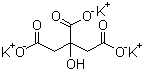
NamePotassium citrate
SynonymsTripotassium citrate; 2-Hydroxy-1,2,3-propanetricarboxylic acid tripotassium salt
Molecular StructureCAS # 866-84-2, Potassium citrate
Molecular FormulaC6H5K3O7
Molecular Weight306.37
CAS Registry Number866-84-2
EC Number212-755-5
SMILESC(C(=O)[O-])C(CC(=O)[O-])(C(=O)[O-])O.[K+].[K+].[K+]
Properties
Solubility148% w/w (water 20 °C)
Density1.98 g/mL (20 °C)
Melting point230 °C (decomp.)
Safety Data
Hazard Classification
up    Details
HazardClassCategory CodeHazard Statement
Specific target organ toxicity - single exposureSTOT SE3H335
Eye irritationEye Irrit.2H319
Skin irritationSkin Irrit.2H315
Skin corrosionSkin Corr.1AH314
Acute toxicityAcute Tox.4H302
SDSAvailable
up Discovery and Applications
Potassium citrate, with the chemical formula K3C6H5O7, is the potassium salt of citric acid. Its history is tied to citric acid, which was first isolated from lemon juice in 1784 by Swedish chemist Carl Wilhelm Scheele. Scheele's work laid the foundation for the discovery of citrates, including potassium citrate. Potassium citrate is usually produced by neutralizing citric acid with potassium hydroxide or carbonate. The reaction produces a colorless, odorless, slightly salty crystalline compound. Its solubility in water and ability to buffer pH make it a versatile substance in a variety of applications.

Potassium citrate is an alkalizing agent. After ingestion, it is metabolized to bicarbonate, which helps neutralize acidity in the body. This process is essential for diseases where controlling acid balance is key, such as treating kidney stones and metabolic acidosis. Its ability to keep pH balanced makes it important in both medical and nutritional settings.

Potassium citrate is most commonly used in the medical field to prevent and treat kidney stones. Its alkalinizing effect helps reduce the formation of uric acid and calcium oxalate stones by increasing the pH of the urine, making it less acidic. This change in urine composition prevents the crystallization process that leads to stone formation.

People with renal tubular acidosis or cystinuria also benefit from potassium citrate because it helps maintain a more alkaline urine pH, reducing the risk of stones and helping to manage these conditions. In addition, it can be used to treat hypokalemia (low potassium levels) and provide potassium supplementation when dietary intake is inadequate.

In the food industry, potassium citrate is used as an acidity regulator and stabilizer. Its ability to maintain pH is essential for products where acidity can affect flavor, texture, or shelf life. For example, it is often used in processed cheeses, beverages, and desserts to ensure consistency and prevent spoilage.

Potassium citrate can also enhance the buffering capacity of foods, helping to stabilize emulsions and improve the quality of sauces and dressings. In beverages, it can balance flavors by controlling acidity, making it a valuable ingredient in soft drinks and energy drinks.

In addition to its primary applications, potassium citrate is used in a variety of other industries. It functions in medicine as an ingredient in oral rehydration salts and effervescent tablets. In cosmetics, its buffering properties can be used in formulations to maintain the stability and efficacy of skin care products.

In agriculture, potassium citrate can be used as a fertilizer ingredient to provide plants with essential potassium and help balance soil pH. This diverse application highlights its versatility and importance in different fields.

References

2019. Nephrolithiasis in gout: prevalence and characteristics of Brazilian patients. Advances in rheumatology (London, England), 59.
DOI: 10.1186/s42358-019-0106-4

2018. Vision for the future on urolithiasis: research, management, education and training—some personal views. Urolithiasis, 47(1).
DOI: 10.1007/s00240-018-1086-2

2017. Dent disease in Poland: what we have learned so far?. International Urology and Nephrology, 49(11).
DOI: 10.1007/s11255-017-1676-x
Market Analysis Reports
List of Reports Available for Potassium citrate
Related Products
Potassium (4-ch...  Potassium chlor...  Potassium chlor...  Potassium [2-[[...  Potassium 2-Chl...  Potassium 4-Chl...  Potassium chrom...  Potassium Chrom...  Potassium cinna...  (+/-)-Potassium...  Potassium citra...  Potassium clavu...  Potassium Cobal...  Potassium Coco-...  Potassium cocoy...  Potassium cresy...  Potassium Croto...  Potassium Cumen...  Potassium cyana...  Potassium cyani...