
Online Database of Chemicals from Around the World
| Rensin Chemicals Limited | China | |||
|---|---|---|---|---|
 | www.rensin-chem.com | |||
 | +86 (25) 8770-2966 | |||
 | +86 (25) 8770-2968 | |||
 | aaron@rensin-chem.com aaron.bict@hotmail.com | |||
| Chemical manufacturer since 1998 | ||||
| chemBlink Standard supplier since 2010 | ||||
| Ningbo EST Chemical Co., Ltd. | China | |||
|---|---|---|---|---|
| www.estchemical.com | |||
| +86 18868651166 | |||
| +86 (574) 5670-2932 | |||
| sales@estchemical.com | |||
| Chemical manufacturer | ||||
| chemBlink Standard supplier since 2010 | ||||
| Sanxinyuan Food Industry Corp.Ltd. | China | |||
|---|---|---|---|---|
| www.sanxinyuanfood.com | |||
| +86 (534) 7126-6078 | |||
| +86 (534) 7126-6088 | |||
| export@sanxinyuanfood.com | |||
| Chemical manufacturer since 1997 | ||||
| chemBlink Standard supplier since 2010 | ||||
| BOC Sciences | USA | |||
|---|---|---|---|---|
| www.bocsci.com | |||
| +1 (631) 485-4226 | |||
| +1 (631) 614-7828 | |||
| info@bocsci.com | |||
| Chemical manufacturer | ||||
| chemBlink Standard supplier since 2010 | ||||
| Beckmann-Kenko GmbH | Germany | |||
|---|---|---|---|---|
| www.beckmann-kenko.com | |||
| +49 (4241) 930-888 | |||
| +49 (4241) 930-889 | |||
| info@beckmann-kenko.com | |||
| Chemical distributor | ||||
| chemBlink Standard supplier since 2011 | ||||
| Hangzhou Leap Chem Co., Ltd. | China | |||
|---|---|---|---|---|
| www.leapchem.com | |||
| +86 (571) 8771-1850 | |||
| market19@leapchem.com | |||
 | QQ Chat | |||
| Chemical manufacturer since 2006 | ||||
| chemBlink Standard supplier since 2015 | ||||
| Hebei Guanlang Biotechnology Co., LTD | China | |||
|---|---|---|---|---|
| www.guanlang-group.com | |||
| +86 19930503252 | |||
| mia@crovellbio.com | |||
| Chemical distributor since 2005 | ||||
| chemBlink Standard supplier since 2021 | ||||
| BLIT (Hefei) Chemical Co.,ltd | China | |||
|---|---|---|---|---|
| www.blitchem.com | |||
| +86-551-62622640 | |||
| info@blitchem.com | |||
| Chemical manufacturer since 2017 | ||||
| chemBlink Standard supplier since 2024 | ||||
| Yucheng Futian Pharmacy Co., Ltd. | China | |||
|---|---|---|---|---|
| www.futaste.com | |||
| +86 (534) 726-6358 | |||
| +86 (534) 212-5910 | |||
| sales@futaste.com | |||
| Chemical manufacturer | ||||
| Beijing Four Principles Technology Co., Ltd. | China | |||
|---|---|---|---|---|
| www.fourprinciple.cn | |||
| +86 (10) 8494-7198 | |||
| +86 (10) 8494-7198 | |||
| fourprinciple@gmail.com | |||
| Chemical manufacturer since 2004 | ||||
| Classification | Biochemical >> Carbohydrate >> Monosaccharide |
|---|---|
| Name | Mannitol |
| Molecular Structure | 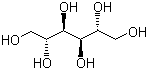 |
| Molecular Formula | C6H14O6 |
| Molecular Weight | 182.17 |
| CAS Registry Number | 87-78-5 |
| EC Number | 201-770-2 |
| SMILES | C([C@H]([C@H]([C@@H]([C@@H](CO)O)O)O)O)O |
| Hazard Symbols |  GHS07 Warning Details GHS07 Warning Details |
|---|---|
| Risk Statements | H302-H315-H319-H335 Details |
| Safety Statements | P261-P305+P351+P338 Details |
| SDS | Available |
 chemBlink Chemical Story
|
Mannitol was first discovered in the early 19th century. French chemist Joseph Louis Proust discovered it in 1806 in the exudate of the flowering ash tree (Fraxinus ornus), also known as manna ash. The compound was named after manna, a sweet substance mentioned in the Bible, reflecting its origin and sweet taste. Over time, mannitol has been isolated from various natural sources, including seaweed, mushrooms, and certain fruits, and modern production methods are hydrogenated fructose or glucose from starch. Mannitol (C6H14O6) is a white crystalline powder with a slightly sweet taste. It is a sugar alcohol, that is, a hydrogenated carbohydrate that provides fewer calories than sugar. Mannitol's properties include high water solubility, resistance to browning, and a cooling effect on the palate. It is non-hygroscopic, that is, it does not absorb moisture from the air, which makes it useful in a variety of formulations. Mannitol is widely used in medicine as a diuretic and osmotic agent. In clinical settings, it helps reduce intracranial pressure and treats cerebral edema by drawing fluid from tissues into the blood, promoting urine production. It is essential in the treatment of conditions such as traumatic brain injury, glaucoma, and in the assessment of renal function. Its use in renal function testing exploits its ability to be filtered by the kidneys without being reabsorbed, allowing for the assessment of glomerular filtration rate (GFR). Mannitol in urine helps assess renal function, providing key data for diagnosing and monitoring renal disease. Recent studies have also highlighted mannitol’s antioxidant properties. It scavenges free radicals and may offer protection in conditions associated with oxidative stress. Applications in this area are being explored in neuroprotection and other therapeutic areas. Mannitol is used as an excipient in pharmaceuticals, acting as a filler and stabilizer in tablets and capsules. Its non-hygroscopicity ensures stability, and its low reactivity makes it compatible with a wide range of active pharmaceutical ingredients (APIs). In the food industry, mannitol is considered a low-calorie sweetener. It provides approximately 1.6 calories per gram, less than half the calories of sucrose, making it suitable for sugar-free and low-calorie products. Its cooling effect also enhances the sensory experience of minty products, gum, and candies. Mannitol acts as a stabilizer and bulking agent in food formulations. Its stability at high temperatures and resistance to hygroscopicity help maintain the texture and quality of baked goods, confectionery, and powdered products. In addition, mannitol is non-cariogenic, meaning it does not contribute to tooth decay. This property makes it an ideal sweetener for oral care products, including toothpastes and mouthwashes, as well as tooth-friendly snacks and candies. Mannitol's non-hygroscopic nature makes it useful in industrial applications that require humidity control. It is used in dusting to prevent clumping and maintain the free-flowing properties of products such as pharmaceuticals, cosmetics, and certain chemicals. In biotechnology, mannitol is used as a cryoprotectant to protect cells and tissues during freezing. Its ability to stabilize proteins and prevent ice crystal formation is valuable in the preservation of biological samples and cryopreservation protocols. Mannitol is also used in the synthesis of biodegradable polymers and plastics. Its chemical structure provides the necessary hydroxyl groups for polymerization, which helps in the development of environmentally friendly materials for applications in packaging, agriculture, and other industries. References 2025. Effects of buffers on spray-freeze-dried/lyophilized high concentration protein formulations. International Journal of Pharmaceutics, 668(1). DOI: 10.1016/j.ijpharm.2024.124974 2024. Antibiotic tolerance due to restriction of cAMP-Crp regulation by mannitol, a non-glucose-family PTS carbon source. mSphere, 9(12). DOI: 10.1128/msphere.00772-24 2024. Preparation, characterization, and ex vivo evaluation of isoxanthohumol nanosuspension. International Journal of Pharmaceutics, 667(12). DOI: 10.1016/j.ijpharm.2024.124909 |
| Market Analysis Reports |