
Online Database of Chemicals from Around the World
| BOC Sciences | USA | |||
|---|---|---|---|---|
 | www.bocsci.com | |||
 | +1 (631) 485-4226 | |||
 | +1 (631) 614-7828 | |||
 | info@bocsci.com | |||
| Chemical manufacturer | ||||
| chemBlink Standard supplier since 2010 | ||||
| LOBA Feinchemie AG | Austria | |||
|---|---|---|---|---|
| www.loba.co.at | |||
| +43 (223) 277-391 | |||
| +43 (223) 276-677 | |||
| sales@loba.co.at | |||
| Chemical distributor | ||||
| chemBlink Standard supplier since 2012 | ||||
| Biosynth AG. | Switzerland | |||
|---|---|---|---|---|
| www.biosynth.com | |||
| +41 (71) 858-2020 | |||
| +41 (71) 858-2030 | |||
| welcome@biosynth.ch | |||
| Chemical manufacturer | ||||
| chemBlink Standard supplier since 2014 | ||||
| Jinyong Biotec | China | |||
|---|---|---|---|---|
| wanyuchemicals.com | |||
| +86 13754516765 | |||
| 54501485@qq.com | |||
 | QQ Chat | |||
| Chemical manufacturer since 2021 | ||||
| chemBlink Standard supplier since 2026 | ||||
| Classification | API >> Other chemicals |
|---|---|
| Name | Melarsomine dihydrochloride |
| Synonyms | Cymelarsan; Immiticide; Mel-Cy; Melarsenoxide cysteamine |
| Molecular Structure | 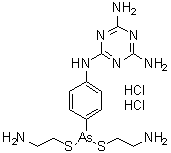 |
| Molecular Formula | C13H21AsN8S2.2(HCl) |
| Molecular Weight | 501.33 |
| CAS Registry Number | 89141-50-4 |
| EC Number | 696-065-3 |
| SMILES | C1=CC(=CC=C1NC2=NC(=NC(=N2)N)N)[As](SCCN)SCCN.Cl.Cl |
| Hazard Symbols |   GHS06;GHS07 Danger Details GHS06;GHS07 Danger Details | ||||||||||||||||||||
|---|---|---|---|---|---|---|---|---|---|---|---|---|---|---|---|---|---|---|---|---|---|
| Risk Statements | H301-H302-H319-H332 Details | ||||||||||||||||||||
| Safety Statements | P261-P264-P264+P265-P270-P271-P280-P301+P316-P301+P317-P304+P340-P305+P351+P338-P317-P321-P330-P337+P317-P405-P501 Details | ||||||||||||||||||||
| Hazard Classification | |||||||||||||||||||||
| |||||||||||||||||||||
| SDS | Available | ||||||||||||||||||||
 chemBlink Chemical Story
|
Melarsomine dihydrochloride is an arsenic-containing veterinary drug developed for one of the most difficult stages of canine heartworm disease: killing adult Dirofilaria immitis worms living in the pulmonary arteries and, in severe infections, the right side of the heart. Its use is striking because arsenic is usually discussed as a poison, yet medicinal chemistry has repeatedly exploited arsenic compounds when the therapeutic target is sufficiently vulnerable and dosing can be controlled. Heartworm disease begins when mosquitoes transmit larval parasites. Months later, mature worms occupy the cardiopulmonary circulation, where they cause vascular inflammation and can lead to pulmonary hypertension, heart failure, and other serious complications. Preventive macrocyclic lactones are highly effective against susceptible larval stages, but established adult infections require a different strategy. Melarsomine became the principal adulticide in dogs and is administered under veterinary supervision as a defined treatment protocol. The molecule belongs historically to organoarsenical antiparasitic chemistry. Arsenic drugs have a long and complicated medical history, including early treatments for trypanosomiasis and syphilis. Melarsomine is an arsenical designed for veterinary use rather than a general-purpose toxin. The dihydrochloride salt provides a defined pharmaceutical form, while the arsenic-containing pharmacophore is responsible for antiparasitic activity. Its exact molecular interactions in heartworms are less completely characterized than the mechanism of many modern enzyme-targeted drugs. Killing adult worms creates a second clinical problem: dead and dying parasites remain in the pulmonary vasculature and can trigger thromboembolic and inflammatory complications. For that reason, heartworm treatment is not simply "inject a worm-killing drug." Modern protocols include staging, exercise restriction, management of inflammation and associated Wolbachia bacteria, preventive therapy, and carefully timed melarsomine administration. The danger after treatment comes partly from the biology and location of the parasite itself. Melarsomine matters because it captures the difference between intrinsic hazard and controlled therapeutic use. An arsenic-containing molecule can be a dangerous substance and still have a favorable medical purpose in a narrowly defined veterinary setting. Its story also shows why antiparasitic therapy must consider what happens after the parasite dies. In heartworm disease, pharmacology, vascular pathology, parasite biology, and clinical management are inseparable. References: American Heartworm Society. Current Canine Guidelines for the Prevention, Diagnosis, and Management of Heartworm Infection. U.S. FDA veterinary drug information for melarsomine dihydrochloride (Immiticide). McCall JW et al. Advances in Parasitology. 2008;66:193-285. DOI: 10.1016/S0065-308X(08)00204-2. |
| Market Analysis Reports |