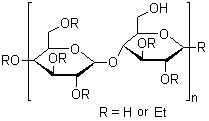
Ethyl cellulose is a cellulose derivative in which some of the hydroxyl groups of the anhydroglucose units in cellulose are replaced by ethyl ether groups (–OC2H5). It is chemically characterized as an ethyl ether of cellulose and is produced by treating alkali cellulose with ethyl chloride. Ethyl cellulose is hydrophobic, thermoplastic, and soluble in organic solvents, unlike unmodified cellulose, which is water-insoluble and only swells in water.
The development of ethyl cellulose dates to the early 20th century, during the expansion of industrial applications for chemically modified cellulose. Cellulose ethers, including methyl cellulose and ethyl cellulose, were synthesized to create materials with enhanced solubility, film-forming ability, and thermal stability. These properties made ethyl cellulose attractive for use in coatings, plastics, and pharmaceuticals. The earliest commercial applications emerged in the 1930s and 1940s, as ethyl cellulose was introduced as a non-toxic, film-forming agent and binder.
Ethyl cellulose is widely used in the pharmaceutical industry, especially as a coating agent for tablets and capsules. It is applied to control the release of active pharmaceutical ingredients by forming a semi-permeable membrane around dosage forms. Ethyl cellulose coatings can provide extended or sustained release profiles by limiting the diffusion of water into the core and the subsequent release of drug substances. It is also used as a matrix-forming agent in controlled-release tablets and as a binder in granulation processes.
In food technology, ethyl cellulose is permitted as a food additive in certain countries and is generally recognized as safe (GRAS) in the United States. It is used as a stabilizer, film-former, and thickening agent in food coatings and flavors, although its usage is less widespread than that of other cellulose derivatives. Its low permeability to oils and gases also makes it useful in packaging applications.
Ethyl cellulose is extensively employed in industrial coatings, inks, and lacquers due to its film-forming and adhesive properties. It serves as a binder in paints and printing inks, where it provides good flexibility, gloss, and resistance to water and chemicals. In electronics, it is used in the formulation of conductive pastes and dielectric coatings.
The degree of substitution (DS) and ethoxyl content significantly influence the physical properties of ethyl cellulose. Commercial ethyl cellulose products typically have a DS in the range of 2.2 to 2.6, meaning that approximately 2.2 to 2.6 of the three hydroxyl groups per anhydroglucose unit are substituted with ethyl groups. The polymer is available in various viscosity grades, which affect its performance in different formulations.
Ethyl cellulose is not soluble in water but dissolves in many organic solvents, including ethanol, methanol, toluene, and ethyl acetate. This property allows its use in non-aqueous systems and organic-solvent-based processes. When dissolved in appropriate solvents, ethyl cellulose forms clear, flexible, and tough films that are chemically and thermally stable.
In addition to its functional uses, ethyl cellulose is also used as a model material in research to study polymer behavior, drug release kinetics, and solvent interactions. It is often included in in vitro studies involving polymer-coated dosage forms or hydrophobic matrix systems.
In summary, ethyl cellulose is a chemically modified cellulose ether with hydrophobic and film-forming properties, widely used in pharmaceuticals, industrial coatings, inks, and packaging. Its stability, compatibility with organic solvents, and ability to form controlled-release drug delivery systems have made it a valuable material in both applied and research contexts.
References
2025. Chitosan/sodium alginate/ethyl cellulose-based multilayer film incorporated with l-ascorbic acid for improved barrier and antioxidant properties. International Journal of Biological Macromolecules, 287(3).
DOI: 10.1016/j.ijbiomac.2024.138169
2024. Mesalamine loaded ethyl cellulose nanoparticles: optimization and in vivo evaluation of antioxidant potential in ulcerative colitis. Biomedical Materials, 20(1).
DOI: 10.1088/1748-605x/ad920e
2024. Ethyl cellulose matrixed poly(sulfur-co-sorbic acid) composite films: Regulation of properties and application for food preservation. International Journal of Biological Macromolecules, 279(3).
DOI: 10.1016/j.ijbiomac.2024.135183
|




 GHS07 Warning Details
 chemBlink Chemical Story