
Online Database of Chemicals from Around the World
| Wuhan Kemi-works Chemical Co., Ltd. | China | |||
|---|---|---|---|---|
 | www.kemiworks.net | |||
 | +86 (27) 8573-6489 | |||
 | +86 (27) 8573-6485 | |||
 | info@kemiworks.net sales@kemiworks.com | |||
| Chemical manufacturer | ||||
| chemBlink Premium supplier since 2011 | ||||
| Classification | Catalysts and additives >> Polymer |
|---|---|
| Name | Polyalkylene glycol monobutyl ether |
| Synonyms | Poly(ethylene glycol-ran-propylene glycol) monobutyl ether |
| Molecular Structure | 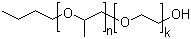 |
| Molecular Formula | CH3(CH2)3(OCH2CH2)n[OCH2CH(CH3)]kOH |
| Molecular Weight | ~3900 |
| CAS Registry Number | 9038-95-3 |
| EC Number | 618-542-7 |
| SMILES | OCCO.CCCCO.CC(O)CO |
| Density | 1.056 g/mL (25 °C) (Expl.) |
|---|---|
| Boiling point | >200 °C (Expl.) |
| Flash point | 113 °C - closed cup (Expl.) |
| Solubility | H2O: soluble (<40 °C) (Expl.) |
| Refraction index | 1.46 (Expl.) |
| Hazard Symbols |  GHS07 Warning Details GHS07 Warning Details | ||||||||||||||||||||||||||||||||||||||||
|---|---|---|---|---|---|---|---|---|---|---|---|---|---|---|---|---|---|---|---|---|---|---|---|---|---|---|---|---|---|---|---|---|---|---|---|---|---|---|---|---|---|
| Risk Statements | H302-H315-H319-H335 Details | ||||||||||||||||||||||||||||||||||||||||
| Safety Statements | P261-P264-P270-P271-P280-P301+P312-P302+P352-P304+P340-P305+P351+P338-P330-P332+P313-P337+P313-P362-P403+P233-P405-P501 Details | ||||||||||||||||||||||||||||||||||||||||
| Hazard Classification | |||||||||||||||||||||||||||||||||||||||||
| |||||||||||||||||||||||||||||||||||||||||
| SDS | Available | ||||||||||||||||||||||||||||||||||||||||
 chemBlink Chemical Story
|
Polyalkylene glycol monobutyl ether is a synthetic nonionic surfactant that has been developed through advances in polymer and surface chemistry. It belongs to the class of alkylene oxide-based compounds, where repeating ethylene oxide or propylene oxide units are polymerized and terminated with a butyl ether group. The molecular design provides a balance between hydrophilic polyalkylene glycol segments and the lipophilic butyl moiety, giving the compound amphiphilic properties that are essential for its wide range of applications. The discovery and development of polyalkylene glycol monobutyl ether can be traced to mid-20th century industrial research on polyalkylene glycols and their derivatives. These materials were initially produced by controlled polymerization of ethylene oxide or propylene oxide, and subsequent modification with various alcohols introduced end groups such as butyl ether. This modification not only imparted solubility control but also expanded the versatility of the resulting surfactants. The design strategy provided researchers with compounds that could act as solubilizers, dispersants, or wetting agents across multiple industrial sectors. One of the earliest significant applications of polyalkylene glycol monobutyl ether was as a component in cleaning and detergent formulations. Its nonionic nature allowed it to function effectively in both acidic and alkaline environments, and it showed compatibility with anionic, cationic, and amphoteric surfactants. Its excellent wetting ability and low foaming properties made it suitable for hard-surface cleaners and industrial cleaning solutions. The material also exhibited good stability against electrolytes, which enhanced its utility in complex formulations. In addition to cleaning applications, polyalkylene glycol monobutyl ether found use in paints and coatings as a coalescing agent and dispersant. Its ability to stabilize pigment particles and improve flow characteristics contributed to smoother and more uniform finishes. In metalworking fluids, the compound served as a lubricant and emulsifier, helping to reduce friction and wear while maintaining fluid stability under demanding conditions. Furthermore, it was adopted in textile processing, where its wetting and dispersing actions improved dye penetration and fabric treatment. The compound’s use also extended to the field of polymer processing and agricultural formulations. In polymerization reactions, polyalkylene glycol monobutyl ether was employed as a stabilizer or dispersant, aiding in the control of particle size and distribution. In agriculture, it was incorporated into pesticide and herbicide formulations to improve wetting and spreading on plant surfaces, thereby enhancing bioavailability and performance. The ongoing importance of polyalkylene glycol monobutyl ether lies in its adaptability and multifunctional properties. Its synthesis allows control over the ratio of alkylene oxide units, which can be tuned to achieve desired solubility and performance characteristics. This structural versatility has led to a broad spectrum of commercial grades tailored to specific applications, from low-viscosity wetting agents to higher molecular weight dispersants. The discovery and industrial development of polyalkylene glycol monobutyl ether illustrate how innovations in polyether chemistry have enabled the creation of functional surfactants with enduring value. Its combination of stability, compatibility, and performance has ensured continued use across cleaning, coatings, lubricants, textiles, and agriculture, making it an important example of applied polymer and surfactant chemistry. References 2012. Photoinactivation of Staphylococcus epidermidis biofilms and suspensions by the hydrophobic photosensitizer curcumin--effect of selected nanocarrier: studies on curcumin and curcuminoides XLVII. European Journal of Pharmaceutical Sciences, 47(1). DOI: 10.1016/j.ejps.2012.05.002 2012. Fractional crystallization of oil droplets in O/W emulsions dispersed by Synperonic F127. Journal of Colloid and Interface Science, 380(1). DOI: 10.1016/j.jcis.2012.05.038 2011. Multifunctional Pluronic P123/F127 mixed polymeric micelles loaded with paclitaxel for the treatment of multidrug resistant tumors. Biomaterials, 32(11). DOI: 10.1016/j.biomaterials.2010.12.018 |
| Market Analysis Reports |