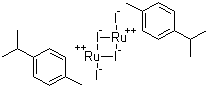
Diiodo(p-cymene)ruthenium(II) dimer is a significant compound in organometallic chemistry, known for its unique properties and applications in various chemical transformations. This complex features a ruthenium(II) center coordinated with p-cymene and two iodide ligands, forming a dimeric structure that exhibits interesting reactivity and utility in catalysis.
The discovery of Diiodo(p-cymene)ruthenium(II) dimer can be traced back to the broader exploration of ruthenium complexes as catalysts in organic synthesis. Ruthenium, a transition metal, is valued for its versatility and ability to facilitate a range of reactions. The development of this particular dimeric complex emerged from the need to enhance catalytic performance and to explore new avenues for metal-catalyzed reactions.
The synthesis of Diiodo(p-cymene)ruthenium(II) dimer involves the coordination of ruthenium with p-cymene, a common aromatic ligand, and two iodide ions. The resulting dimeric structure is notable for its stable and well-defined coordination environment, which plays a crucial role in its catalytic behavior. The p-cymene ligand stabilizes the ruthenium center, while the iodide ions contribute to the complex’s reactivity in various transformations.
One of the primary applications of Diiodo(p-cymene)ruthenium(II) dimer is in oxidative addition reactions. The iodide ligands are known to facilitate the oxidative addition of various substrates, making the complex valuable in the formation of new bonds. This property is particularly useful in cross-coupling reactions, where the introduction of new functional groups is required. The dimeric structure of the complex enhances its stability and allows for efficient catalysis under mild conditions.
Additionally, Diiodo(p-cymene)ruthenium(II) dimer has been explored for its role in olefin metathesis. In this process, the complex acts as a catalyst to enable the exchange of alkyl groups between olefins, leading to the formation of new olefinic products. The ability of the complex to facilitate this reaction is attributed to its unique electronic and steric properties, which provide an effective environment for the metathesis reaction to proceed.
The versatility of Diiodo(p-cymene)ruthenium(II) dimer extends beyond oxidative addition and olefin metathesis. The complex has also been investigated for its potential in other catalytic processes, including polymerization and hydrogenation reactions. Its stable coordination environment and reactivity profile make it a valuable tool for chemists seeking to develop new methodologies and improve reaction efficiencies.
In summary, Diiodo(p-cymene)ruthenium(II) dimer represents an important advancement in the field of organometallic chemistry. Its unique structure and properties enable it to serve as an effective catalyst in a range of chemical transformations, including oxidative addition and olefin metathesis. The continued study and application of this complex contribute to the broader understanding of ruthenium-based catalysts and their role in modern synthetic chemistry.
|




 GHS07 Warning Details
 chemBlink Chemical Story