
Online Database of Chemicals from Around the World
| Taizhou Crene Biotechnology Co., Ltd. | China | |||
|---|---|---|---|---|
 | www.pharm-intermediates.com | |||
 | +86 (576) 8881-3233 8820-5808 +86 13396860566 | |||
 | +86 (576) 8822-9589 | |||
 | sales@pharm-intermediates.com | |||
 | QQ Chat | |||
| Chemical manufacturer since 2011 | ||||
| chemBlink Standard supplier since 2009 | ||||
| BOC Sciences | USA | |||
|---|---|---|---|---|
| www.bocsci.com | |||
| +1 (631) 485-4226 | |||
| +1 (631) 614-7828 | |||
| info@bocsci.com | |||
| Chemical manufacturer | ||||
| chemBlink Standard supplier since 2010 | ||||
| Topscience Co. Ltd. | China | |||
|---|---|---|---|---|
| www.tsbiochem.com | |||
| +86 (400) 820-0310 | |||
| +86 (021) 3469-2979 | |||
| sales@tsbiochem.com | |||
| Chemical manufacturer since 2013 | ||||
| chemBlink Standard supplier since 2012 | ||||
| Hangzhou Leap Chem Co., Ltd. | China | |||
|---|---|---|---|---|
| www.leapchem.com | |||
| +86 (571) 8771-1850 | |||
| market19@leapchem.com | |||
| QQ Chat | |||
| Chemical manufacturer since 2006 | ||||
| chemBlink Standard supplier since 2015 | ||||
| Amadis Chemical Co., Ltd. | China | |||
|---|---|---|---|---|
| www.amadischem.com | |||
| +86 (571) 8992-5085 | |||
| +86 (571) 8992-5065 | |||
| sales@amadischem.com | |||
| Chemical manufacturer since 2010 | ||||
| chemBlink Standard supplier since 2015 | ||||
| Exclusive Chemistry Ltd. | Russia | |||
|---|---|---|---|---|
| www.exchemistry.com | |||
| +7 (903) 713-5556 | |||
| +7 (484) 396-4302 | |||
| info@exchemistry.com | |||
| Chemical manufacturer | ||||
| Santa Cruz Biotechnology, Inc. | USA | |||
|---|---|---|---|---|
| www.scbt.com | |||
| +1 (831) 457-3800 | |||
| +1 (831) 457-3801 | |||
| scbt@scbt.com | |||
| Chemical manufacturer | ||||
| AK Scientific, Inc | USA | |||
|---|---|---|---|---|
| www.aksci.com | |||
| +1 (510) 429-8835 | |||
| +1 (510) 429-8836 | |||
| sales@aksci.com | |||
| Chemical manufacturer | ||||
| Classification | API >> Antibiotics |
|---|---|
| Name | 3-(6-Methyl-2-pyridinyl)-N-phenyl-4-(4-quinolinyl)-1H-pyrazole-1-carbothioamide |
| Molecular Structure | 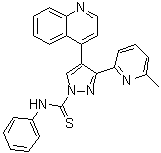 |
| Molecular Formula | C25H19N5S |
| Molecular Weight | 421.52 |
| CAS Registry Number | 909910-43-6 |
| EC Number | 635-614-3 |
| SMILES | CC1=NC(=CC=C1)C2=NN(C=C2C3=CC=NC4=CC=CC=C34)C(=S)NC5=CC=CC=C5 |
| Solubility | Insoluble water (3.2E-3 g/L) (25 °C), Calc.*, 50 mM in DMSO (Expl.) |
|---|---|
| Density | 1.27±0.1 g/cm3 (20 °C 760 Torr), Calc.* |
| Melting point | 111 °C** |
| Boiling point | 590.0±60.0 °C 760 mmHg (Calc.)* |
| Flash point | 310.6±32.9 °C (Calc.)* |
| Index of refraction | 1.707 (Calc.)* |
| * | Calculated using Advanced Chemistry Development (ACD/Labs) Software V11.02 (©1994-2014 ACD/Labs) |
| ** | Tojo, Masayoshi |
| Hazard Symbols |  GHS07 Warning Details GHS07 Warning Details | ||||||||||||||||||||||||
|---|---|---|---|---|---|---|---|---|---|---|---|---|---|---|---|---|---|---|---|---|---|---|---|---|---|
| Risk Statements | H302-H315-H319-H335 Details | ||||||||||||||||||||||||
| Safety Statements | P261-P264-P264+P265-P270-P271-P280-P301+P317-P302+P352-P304+P340-P305+P351+P338-P319-P321-P330-P332+P317-P337+P317-P362+P364-P403+P233-P405-P501 Details | ||||||||||||||||||||||||
| Hazard Classification | |||||||||||||||||||||||||
| |||||||||||||||||||||||||
| SDS | Available | ||||||||||||||||||||||||
 chemBlink Chemical Story
|
3-(6-Methyl-2-pyridinyl)-N-phenyl-4-(4-quinolinyl)-1H-pyrazole-1-carbothioamide is a synthetic heterocyclic compound that belongs to the broader class of thioamide-functionalized pyrazole derivatives. This molecule features a fused system of multiple aromatic and heteroaromatic rings, including a pyrazole core substituted at key positions by a quinoline group, a methylpyridine moiety, and a phenylcarbothioamide functional group. Its development is tied to efforts in medicinal and agrochemical chemistry, where multifunctional heterocyclic frameworks are investigated for a wide range of biological activities. The core structure of this compound, a pyrazole ring substituted with aromatic groups, is a recurring scaffold in the design of bioactive molecules. The incorporation of a quinoline ring at the 4-position and a 6-methylpyridinyl group at the 3-position imparts unique electronic and steric characteristics that influence its interaction with biological targets. The carbothioamide group linked to the nitrogen of the pyrazole ring introduces a thiocarbonyl functionality, which is known for its ability to coordinate with metal ions or form hydrogen bonds, making it a useful group in designing receptor ligands or enzyme inhibitors. The compound was initially synthesized as part of a broader effort to create selective inhibitors of protein kinases, particularly cyclin-dependent kinases (CDKs) and receptor tyrosine kinases. These enzymes play central roles in the regulation of cell cycle progression and signal transduction, and are frequently overactive or dysregulated in various cancers. Heteroaryl-substituted pyrazoles such as this one have been studied for their high binding affinity and selectivity profiles toward ATP-binding pockets of kinases. The quinoline and pyridine groups contribute to enhanced binding through π-π stacking interactions and hydrogen bonding with active site residues. In biochemical assays, compounds of this structural class have demonstrated potential in inhibiting kinase activity at micromolar or submicromolar concentrations. Their antiproliferative effects have been evaluated in cell-based models of cancer, where they reduce cellular viability by blocking cell cycle progression or inducing apoptosis. Although specific data on 3-(6-methyl-2-pyridinyl)-N-phenyl-4-(4-quinolinyl)-1H-pyrazole-1-carbothioamide may not be widely reported in publicly available pharmacological databases, structurally related analogues have shown promising bioactivity, validating the core structure as a lead scaffold for further optimization. Beyond oncology, thioamide-substituted heterocycles have also been studied for their potential antimicrobial, anti-inflammatory, and antiparasitic properties. The multiple nitrogen and sulfur donor atoms in the molecule may contribute to metal chelation, which could interfere with metalloenzymes in pathogens or modulate oxidative stress pathways. This broadens the potential application space for this compound and its derivatives in the search for new therapeutic agents. Synthesis of this compound typically involves the condensation of appropriately substituted hydrazines with 1,3-diketones or α,β-unsaturated ketones to form the pyrazole ring, followed by N-arylation and functionalization with quinoline and pyridine units. The carbothioamide functionality is usually introduced through reaction with thiophosgene or by conversion of an amide or amine precursor using Lawesson's reagent or similar thionation reagents. In conclusion, 3-(6-methyl-2-pyridinyl)-N-phenyl-4-(4-quinolinyl)-1H-pyrazole-1-carbothioamide exemplifies the design strategy of assembling multiple heteroaromatic systems into a single molecular entity to enhance biological activity and selectivity. While its detailed pharmacological profile may still be under study, its structural motifs align with those found in compounds of interest for kinase inhibition and other therapeutic targets. The continued exploration of such molecules contributes to the development of new drugs and agrochemicals with improved efficacy and specificity. References 2012. Accelerated generation of human induced pluripotent stem cells with retroviral transduction and chemical inhibitors under physiological hypoxia. Biochemical and Biophysical Research Communications, 417(2). DOI: 10.1016/j.bbrc.2011.11.111 2024. Involvement of extracellular vesicle microRNA clusters in developing healthy and Rett syndrome brain organoids. Cellular and Molecular Life Sciences, 81(1). DOI: 10.1007/s00018-024-05409-7 2024. NSDHL contributes to breast cancer stem-like cell maintenance and tumor-initiating capacity through TGF-β/Smad signaling pathway in MCF-7 tumor spheroid. BMC Cancer, 24(1). DOI: 10.1186/s12885-024-13143-3 |
| Market Analysis Reports |