
Online Database of Chemicals from Around the World
| Hangzhou Verychem Science And Technology Co., Ltd. | China | |||
|---|---|---|---|---|
 | www.verychem.com | |||
 | +86 (571) 8816-2785 +86 13606544505 | |||
 | +86 (571) 8816-2787 | |||
 | lucy@verychem.com | |||
| Chemical manufacturer since 2004 | ||||
| chemBlink Massive supplier since 2021 | ||||
| BOC Sciences | USA | |||
|---|---|---|---|---|
| www.bocsci.com | |||
| +1 (631) 485-4226 | |||
| +1 (631) 614-7828 | |||
| info@bocsci.com | |||
| Chemical manufacturer | ||||
| chemBlink Standard supplier since 2010 | ||||
| Alfa Chemistry | USA | |||
|---|---|---|---|---|
| www.alfa-chemistry.com | |||
| +1 (516) 734-6573 | |||
| +1 (516) 927-0118 | |||
| support@alfa-chemistry.com | |||
| Chemical manufacturer since 2005 | ||||
| chemBlink Standard supplier since 2012 | ||||
| Classification | Organic raw materials >> Carboxylic compounds and derivatives >> Carboxylic esters and their derivatives |
|---|---|
| Name | 2-Phenylphenoxyethyl acrylate |
| Synonyms | OPPEA; 2-Propenoic acid 2-([1,1'-biphenyl]-2-yloxy)ethyl ester |
| Molecular Structure | 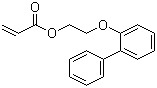 |
| Molecular Formula | C17H16O3 |
| Molecular Weight | 268.31 |
| CAS Registry Number | 91442-24-9 |
| EC Number | 500-247-9 |
| SMILES | C=CC(=O)OCCOC1=CC=CC=C1C2=CC=CC=C2 |
| Density | 1.1±0.1 g/cm3, Calc.* |
|---|---|
| Index of Refraction | 1.550, Calc.* |
| Boiling Point | 390.7±25.0 °C (760 mmHg), Calc.* |
| Flash Point | 164.7±17.8 °C, Calc.* |
| * | Calculated using Advanced Chemistry Development (ACD/Labs) Software. |
| Hazard Symbols |    GHS07;GHS08;GHS09 Warning Details GHS07;GHS08;GHS09 Warning Details | ||||||||||||||||||||
|---|---|---|---|---|---|---|---|---|---|---|---|---|---|---|---|---|---|---|---|---|---|
| Risk Statements | H317-H361-H361d-H410-H411 Details | ||||||||||||||||||||
| Safety Statements | P203-P261-P272-P273-P280-P302+P352-P318-P321-P333+P317-P362+P364-P391-P405-P501 Details | ||||||||||||||||||||
| Hazard Classification | |||||||||||||||||||||
| |||||||||||||||||||||
| SDS | Available | ||||||||||||||||||||
 chemBlink Chemical Story
|
The synthesis of 2-phenylphenoxyethyl acrylate stems from ongoing research in acrylate chemistry in the mid-20th century, specifically in the area of ??functional monomers that impart desirable properties to polymers. The monomer was designed to combine the reactivity of the acrylate group with the rigidity and stability provided by the phenylphenoxy moiety. The presence of the acrylate group allows for polymerization and crosslinking reactions, making it a versatile building block in polymer chemistry. The phenylphenoxy group adds rigidity and stability to the polymer structure, enhancing properties such as chemical resistance and thermal stability. 2-Phenylphenoxyethyl acrylate is used to formulate high-performance coatings and adhesives. Its ability to undergo free radical polymerization makes it suitable for creating durable, chemically resistant surfaces. Polymers derived from this monomer have excellent adhesion, flexibility, and resistance to environmental factors, making them ideal for protective coatings and industrial adhesives. 2-Phenylphenoxyethyl acrylate is used to synthesize specialty polymers that require a combination of flexibility, chemical resistance, and thermal stability. Applications for these polymers range from protective films to advanced composites. The phenylphenoxy group of this monomer increases the refractive index and optical clarity of the polymer, making it useful in optical coatings for lenses, displays, and light-emitting devices. It helps develop materials with improved optical properties, such as high transparency and low birefringence. It is also used to make electronic device materials that require stable dielectric properties and resistance to degradation. Its incorporation into polymers helps create materials suitable for printed circuit boards and other electronic components. The rigid phenylphenoxy structure imparts thermal stability to the polymer, making it suitable for high-temperature applications. This is critical in industries where materials are exposed to high temperatures and need to maintain their integrity and performance. Polymers containing 2-phenylphenoxyethyl acrylate have enhanced resistance to solvents, acids, and bases, making them ideal for use in harsh chemical environments. This property is particularly valuable for coatings and adhesives used in industrial environments. The acrylate group easily copolymerizes with other monomers, allowing for the design of customized polymer systems with specific properties. This versatility allows chemists to create customized materials that meet a variety of unique requirements, from flexible coatings to rigid structural parts. It can also be functionalized by adding chemical groups to further enhance or modify its properties. This adaptability is very useful in developing advanced materials with targeted properties. References 2016. Improvement in the anti-abrasion behavior of a highly refractive optical sheet through the use of modified urethane acrylates. Polymer Bulletin, 73(9). DOI: 10.1007/s00289-016-1622-6 2011. Preparation and properties of photocurable, high refractive, 2-naphthol epoxy-modified urethane acrylate. Polymer Bulletin, 68(5). DOI: 10.1007/s00289-011-0668-8 |
| Market Analysis Reports |