
Online Database of Chemicals from Around the World
| Ningbo Kilo Biotechnology Co., Ltd. | China | |||
|---|---|---|---|---|
 | www.kilobio.com | |||
 | +8613989352104 | |||
 | terry.zhang@kilobio.com | |||
 | QQ Chat | |||
 | WeChat: Wenzhou Medical University | |||
| Chemical distributor since 2023 | ||||
| chemBlink Standard supplier since 2023 | ||||
| Classification | Biochemical >> Peptide |
|---|---|
| Name | Tertomotide |
| Synonyms | (2S)-6-amino-2-[[(2S)-1-[(2S,3S)-2-[[(2S)-2-[[(2S)-2-[[(2S)-2-[[(2S)-2-[[(2S)-2-[[(2S,3R)-2-[[(2S)-2-[[(2S)-2-[[(2S)-2-[[(2S)-1-[(2S)-2-[[(2S)-2-[[(2S)-2-amino-4-carboxybutanoyl]amino]propanoyl]amino]-5-(diaminomethylideneamino)pentanoyl]pyrrolidine-2-carbonyl]amino]propanoyl]amino]-4-methylpentanoyl]amino]-4-methylpentanoyl]amino]-3-hydroxybutanoyl]amino]-3-hydroxypropanoyl]amino]-5-(diaminomethylideneamino)pentanoyl]amino]-4-methylpentanoyl]amino]-5-(diaminomethylideneamino)pentanoyl]amino]-3-phenylpropanoyl]amino]-3-methylpentanoyl]pyrrolidine-2-carbonyl]amino]hexanoic acid |
| Molecular Structure | 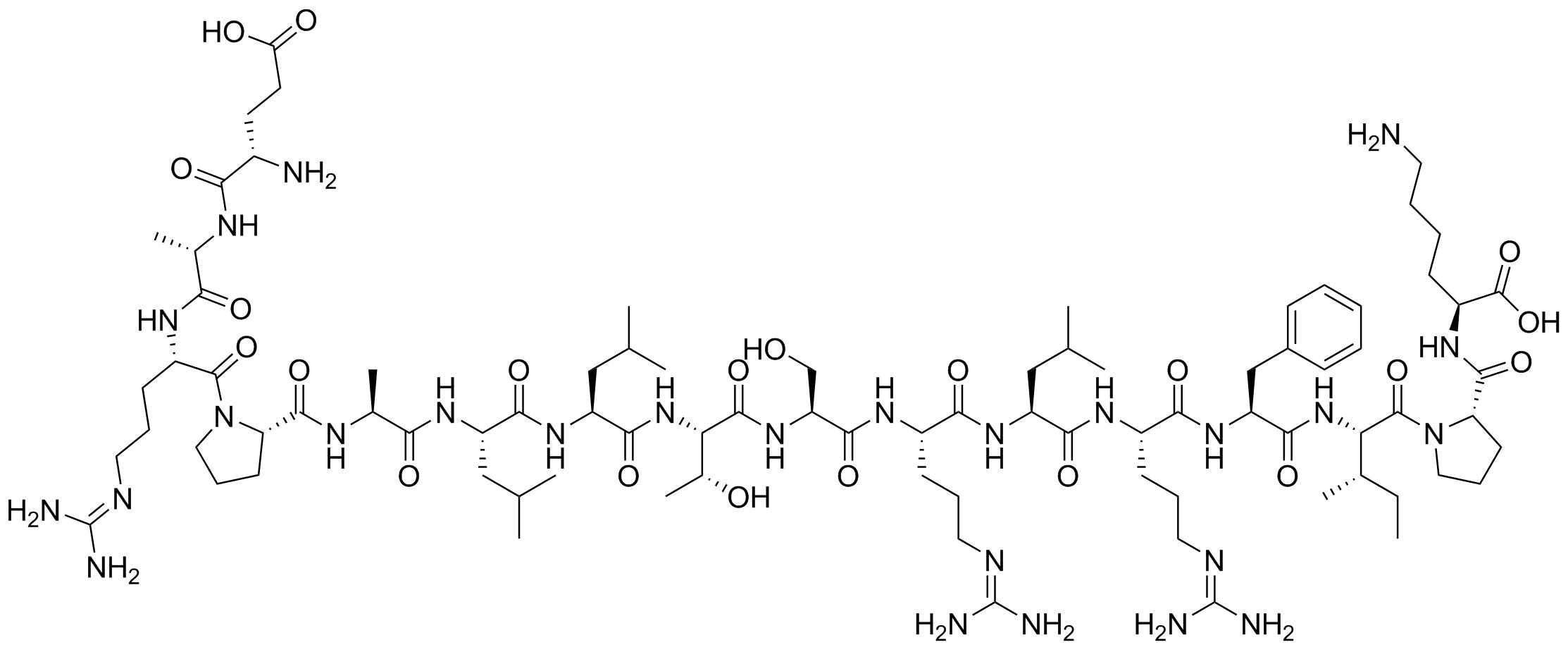 |
| Molecular Formula | C85H146N26O21 |
| Molecular Weight | 1868.23 |
| Protein Sequence | EARPALLTSRLRFIPK |
| CAS Registry Number | 915019-08-8 |
| SMILES | CC[C@H](C)[C@@H](C(=O)N1CCC[C@H]1C(=O)N[C@@H](CCCCN)C(=O)O)NC(=O)[C@H](CC2=CC=CC=C2)NC(=O)[C@H](CCCN=C(N)N)NC(=O)[C@H](CC(C)C)NC(=O)[C@H](CCCN=C(N)N)NC(=O)[C@H](CO)NC(=O)[C@H]([C@@H](C)O)NC(=O)[C@H](CC(C)C)NC(=O)[C@H](CC(C)C)NC(=O)[C@H](C)NC(=O)[C@@H]3CCCN3C(=O)[C@H](CCCN=C(N)N)NC(=O)[C@H](C)NC(=O)[C@H](CCC(=O)O)N |
| Density | 1.4±0.1 g/cm3 Calc.* |
|---|---|
| Index of refraction | 1.645 (Calc.)* |
 chemBlink Chemical Story
|
Tertomotide, also called GV1001, is a synthetic peptide representing sixteen residues of human telomerase reverse transcriptase. It is not a fragment selected for its ability to maintain telomeres. Instead, the idea was to present part of a protein as an antigen that the immune system could learn to recognize. The fragment's identity and the enzyme's activity are distinct. Telomerase is of interest in tumor biology because many cancers maintain telomeres while continuing to divide. In a vaccine strategy, however, targeting a telomerase fragment does not mean inhibiting the enzyme directly. The intended steps include antigen presentation, immune recognition, and a response able to reach the relevant cells. Each step can succeed or fail independently. An immune response to the peptide can therefore be measurable without producing a favorable clinical outcome. The TeloVac trial tested this distinction in patients with locally advanced or metastatic pancreatic cancer. The randomized phase 3 study compared chemotherapy alone with regimens that incorporated the peptide vaccine. The addition of GV1001 did not improve overall survival in the trial. That result constrains claims about the tested intervention in that setting; it should neither be omitted nor generalized to all possible uses of telomerase-derived antigens. The peptide is particularly useful for illustrating how a clinical comparison is framed. Because the trial evaluated combinations with chemotherapy, the question was whether adding the vaccine to that treatment strategy improved the measured outcome. It was not a comparison of an isolated peptide against all other cancer treatments. Reporting the comparator and the patient population is part of accurately reporting the result. The case illustrates why vaccine research needs a hierarchy of endpoints. A defined peptide sequence makes reproducible antigen selection possible. Immunological assays can test recognition. A controlled clinical trial can then ask whether a regimen improves an outcome meaningful to patients. Those questions are related, but the first two cannot answer the third. Tertomotide's development is instructive precisely because the rationale could be tested against a clinical endpoint rather than accepted on mechanistic plausibility alone. References: 1. FDA substance identity record. https://precision.fda.gov/uniisearch/srs/unii/55R7RG342O 2. Middleton G et al. TeloVac phase 3 trial. Lancet Oncol (2014). https://pubmed.ncbi.nlm.nih.gov/24954781/ |
| Market Analysis Reports |