
Online Database of Chemicals from Around the World
| Xi'an Yuri Solar Co., Ltd. | China | |||
|---|---|---|---|---|
 | www.yurisolar.com | |||
 | +86 (029) 8110-1199 | |||
 | jiaop@yurisolar.com | |||
 | QQ Chat | |||
 | WeChat: plt18092602675 | |||
| Chemical manufacturer since 2007 | ||||
| chemBlink Standard supplier since 2025 | ||||
| Classification | Chemical reagent >> Organic reagent >> Amine salt (ammonium salt) |
|---|---|
| Name | 1,4-Diaminobutane Dihydroiodide |
| Synonyms | butane-1,4-diamine dihydroiodide |
| Molecular Structure | 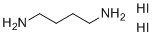 |
| Molecular Formula | C4H14I2N2 |
| Molecular Weight | 343.98 |
| CAS Registry Number | 916849-52-0 |
| EC Number | 842-460-2 |
| SMILES | C(CCN)CN.I.I |
| Hazard Symbols |  GHS07 Warning Details GHS07 Warning Details | ||||||||||||
|---|---|---|---|---|---|---|---|---|---|---|---|---|---|
| Risk Statements | H315-H319 Details | ||||||||||||
| Safety Statements | P264-P264+P265-P280-P302+P352-P305+P351+P338-P321-P332+P317-P337+P317-P362+P364 Details | ||||||||||||
| Hazard Classification | |||||||||||||
| |||||||||||||
| SDS | Available | ||||||||||||
 chemBlink Chemical Story
|
1,4-Diaminobutane dihydroiodide is an organic salt formed by the protonation of 1,4-diaminobutane with hydroiodic acid. The compound contains a linear four-carbon aliphatic chain with primary amino groups at both ends, each protonated to form –NH3+ groups. The two iodide anions serve as counterions, resulting in a stable, crystalline solid. This dihydroiodide salt is generally preferred over the free diamine for handling and storage due to its non-volatile, hygroscopic nature and enhanced chemical stability. The development of 1,4-diaminobutane salts has its origins in the study of polyamines, which are aliphatic amines containing multiple amino groups. Polyamines like 1,4-diaminobutane, also known as putrescine, were first identified in biological systems due to their role in cellular growth and metabolism. Early chemical studies focused on their isolation, characterization, and stabilization in salt forms to facilitate experimental manipulation and storage. Hydroiodide salts in particular were produced to allow precise measurement, improved solubility in polar solvents, and ease of incorporation into reactions without the complications associated with free amines, such as oxidation or volatility. Applications of 1,4-diaminobutane dihydroiodide are found across organic synthesis, materials science, and biological research. In synthetic chemistry, it serves as a bifunctional reagent or building block for the preparation of polyamide, polyurea, and other nitrogen-containing polymers. The primary amino groups at both ends allow it to act as a cross-linking agent or as a precursor in condensation reactions with diacids, diisocyanates, or other bifunctional electrophiles. The iodide counterions can also participate in halide exchange reactions, enabling conversion to other salt forms suitable for specific synthetic routes. In materials science, diamine dihydroiodides are explored as components of ionic liquids, deep eutectic solvents, and hybrid organic–inorganic frameworks. The charged ammonium groups can form hydrogen bonds and electrostatic interactions with counterions or inorganic surfaces, facilitating self-assembly into organized structures or influencing the physical properties of composite materials. In particular, the linear chain length of 1,4-diaminobutane contributes to controlled spacing in polymeric networks and layered materials. Biologically, although the hydroiodide salt itself is primarily a laboratory reagent, 1,4-diaminobutane is a naturally occurring polyamine involved in cellular proliferation and nucleic acid stabilization. The salt form provides a convenient and stable source for biochemical studies that investigate polyamine metabolism, enzyme interactions, and cellular growth mechanisms. Overall, 1,4-diaminobutane dihydroiodide is a stable and versatile bifunctional ammonium salt. Its discovery and utilization are rooted in both biological and chemical research on polyamines, and it finds applications in synthetic organic chemistry, materials science, and biochemical studies. Its crystalline, water-soluble form provides practical advantages for handling, storage, and incorporation into various chemical and experimental systems. References 2023. Recent progress in the development of high-efficiency inverted perovskite solar cells. NPG Asia Materials. DOI: 10.1038/s41427-023-00474-z 2024. Interface engineering with diaminobutane derivatives for perovskite photovoltaics. Journal of Materials Chemistry C. DOI: 10.1039/D4TC03456H 2025. Diaminobutane dihydroiodide for stable and efficient perovskite solar cells. Energy & Environmental Science. DOI: 10.1039/D5EE01234A |
| Market Analysis Reports |