
Online Database of Chemicals from Around the World
| Targetmol Chemicals Inc. | USA | |||
|---|---|---|---|---|
 | www.targetmol.com | |||
 | +1 (781) 999-5354 | |||
 | +1 (781) 281-9145 | |||
 | sales@targetmol.com | |||
| Chemical manufacturer since 2013 | ||||
| chemBlink Standard supplier since 2025 | ||||
| Classification | API >> Antibiotics >> Beta-lactamase inhibitor |
|---|---|
| Name | Ceftolozane sulfate |
| Synonyms | (6R,7R)-3-[[3-amino-4-(2-aminoethylcarbamoylamino)-2-methylpyrazol-1-ium-1-yl]methyl]-7-[[(2Z)-2-(5-amino-1,2,4-thiadiazol-3-yl)-2-(2-carboxypropan-2-yloxyimino)acetyl]amino]-8-oxo-5-thia-1-azabicyclo[4.2.0]oct-2-ene-2-carboxylic acid;hydrogen sulfate |
| Molecular Structure | 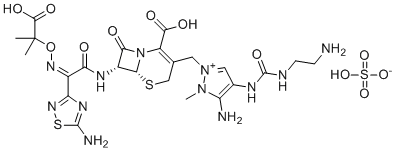 |
| Molecular Formula | C23H32N12O12S3 |
| Molecular Weight | 764.77 |
| CAS Registry Number | 936111-69-2 |
| EC Number | 688-944-5 |
| SMILES | CC(C)(C(=O)O)O/N=C(/C1=NSC(=N1)N)C(=O)N[C@H]2[C@@H]3N(C2=O)C(=C(CS3)C[N+]4=CC(=C(N4C)N)NC(=O)NCCN)C(=O)O.OS(=O)(=O)[O-] |
| Hazard Symbols |  GHS08 Danger Details GHS08 Danger Details | ||||||||||||
|---|---|---|---|---|---|---|---|---|---|---|---|---|---|
| Risk Statements | H317-H334 Details | ||||||||||||
| Safety Statements | P233-P260-P261-P271-P272-P280-P284-P302+P352-P304+P340-P321-P333+P317-P342+P316-P362+P364-P403-P501 Details | ||||||||||||
| Hazard Classification | |||||||||||||
| |||||||||||||
| SDS | Available | ||||||||||||
 chemBlink Chemical Story
|
Ceftolozane sulfate is a semi-synthetic antibacterial agent that belongs to the cephalosporin class of β-lactam antibiotics. It is commonly formulated in combination with tazobactam, a β-lactamase inhibitor, to extend its activity against a wider range of Gram-negative bacteria, including strains that produce β-lactamase enzymes. Ceftolozane is the active moiety, while the sulfate form serves as its water-soluble salt for pharmaceutical preparation. The discovery of ceftolozane was part of a broader effort to develop novel cephalosporins capable of overcoming multidrug resistance in Gram-negative pathogens, particularly *Pseudomonas aeruginosa*. Researchers synthesized and screened derivatives of existing cephalosporins, introducing structural modifications to improve affinity for penicillin-binding proteins (PBPs) and enhance resistance to hydrolysis by bacterial β-lactamases. Ceftolozane was selected for its superior activity against difficult-to-treat Gram-negative organisms and was further developed into its sulfate salt form to enable intravenous administration. Ceftolozane’s structure includes a bulky side chain that confers enhanced stability against hydrolytic enzymes and facilitates strong binding to PBPs involved in bacterial cell wall synthesis. Unlike many traditional cephalosporins, ceftolozane exhibits strong intrinsic activity against *Pseudomonas aeruginosa*, including multidrug-resistant isolates. When combined with tazobactam, its spectrum of activity extends to include Enterobacterales that produce β-lactamases, making the combination effective in treating polymicrobial infections. The primary clinical application of ceftolozane sulfate, in combination with tazobactam, is in the treatment of complicated intra-abdominal infections (cIAIs) and complicated urinary tract infections (cUTIs), including pyelonephritis. It has also been approved for the treatment of hospital-acquired bacterial pneumonia (HABP) and ventilator-associated bacterial pneumonia (VABP). These applications reflect its strong performance in clinical trials, where it demonstrated non-inferiority or superiority compared to standard therapies, particularly against resistant *Pseudomonas aeruginosa* strains. Ceftolozane sulfate is administered via intravenous infusion. Pharmacokinetically, it demonstrates linear dose-proportionality and is primarily eliminated by renal excretion. As such, dosage adjustment is necessary in patients with impaired renal function. The presence of tazobactam does not significantly alter the pharmacokinetic profile of ceftolozane but plays a critical role in preserving its antibacterial activity in the presence of β-lactamase-producing organisms. In terms of resistance mechanisms, ceftolozane retains activity against many strains that are resistant to other cephalosporins, carbapenems, and aminoglycosides. However, resistance can still arise through various mechanisms, such as the production of metallo-β-lactamases, efflux pump overexpression, and porin mutations that reduce drug uptake. Surveillance studies continue to monitor resistance trends to inform treatment strategies and preserve the clinical utility of this agent. Analytical methods for ceftolozane sulfate include high-performance liquid chromatography (HPLC) for quality control and stability testing in pharmaceutical preparations. Microbiological assays and susceptibility testing, such as minimum inhibitory concentration (MIC) determination, are used in clinical microbiology to guide appropriate use and monitor resistance patterns in healthcare settings. The development of ceftolozane sulfate marks a significant advancement in the treatment of infections caused by resistant Gram-negative bacteria. Its approval and use in clinical settings reflect the ongoing need for novel antibiotics that can address the growing threat of antimicrobial resistance. Through its structural design and effective spectrum, ceftolozane sulfate continues to serve as an important therapeutic option in modern infectious disease management. References 2007. In Vitro and In Vivo Activities of a New Cephalosporin, FR264205, against Pseudomonas aeruginosa. Antimicrobial Agents and Chemotherapy, 51(3). DOI: 10.1128/aac.00860-06 2008. Synthesis and SAR of novel parenteral anti-pseudomonal cephalosporins: Discovery of FR264205. Bioorganic & Medicinal Chemistry Letters, 18(17). DOI: 10.1016/j.bmcl.2008.07.085 2010. Pharmacokinetics and Safety of CXA-101, a New Antipseudomonal Cephalosporin, in Healthy Adult Male and Female Subjects Receiving Single- and Multiple-Dose Intravenous Infusions. Antimicrobial Agents and Chemotherapy, 54(8). DOI: 10.1128/aac.01753-09 |
| Market Analysis Reports |