
Online Database of Chemicals from Around the World
| Simagchem Corporation | China | |||
|---|---|---|---|---|
 | www.simagchem.com | |||
 | +86 13806087780 | |||
 | +86 (592) 268-0237 | |||
 | sale@simagchem.com | |||
| Chemical manufacturer since 2002 | ||||
| chemBlink Standard supplier since 2008 | ||||
| BOC Sciences | USA | |||
|---|---|---|---|---|
| www.bocsci.com | |||
| +1 (631) 485-4226 | |||
| +1 (631) 614-7828 | |||
| info@bocsci.com | |||
| Chemical manufacturer | ||||
| chemBlink Standard supplier since 2010 | ||||
| Medilink Pharmachem | India | |||
|---|---|---|---|---|
| www.medilinkpharma.com | |||
| +91 (79) 3007-0133 | |||
| +91 (79) 4007-4175 | |||
| exports@medilinkpharma.com | |||
| Chemical distributor since 1996 | ||||
| chemBlink Standard supplier since 2014 | ||||
| Infinium Pharmachem Pvt Ltd. | India | |||
|---|---|---|---|---|
| www.infiniumpharmachem.com | |||
| +91 (2692) 238-849 | |||
| exportbdm@infiniumpharmachem.com | |||
| Chemical manufacturer since 2003 | ||||
| chemBlink Standard supplier since 2018 | ||||
| City Chemical LLC | USA | |||
|---|---|---|---|---|
| www.citychemical.com | |||
| +1 (203) 932-2489 | |||
| +1 (203) 937-8400 | |||
| sales@citychemical.com | |||
| Chemical distributor | ||||
| Hubei Teyer Pharmaceutical Co., Ltd. | China | |||
|---|---|---|---|---|
| www.hubeiteyer.com | |||
| +86 (728) 533-2622 | |||
| info@hubeiteyer.com | |||
| Chemical manufacturer since 2002 | ||||
| AK Scientific, Inc | USA | |||
|---|---|---|---|---|
| www.aksci.com | |||
| +1 (510) 429-8835 | |||
| +1 (510) 429-8836 | |||
| sales@aksci.com | |||
| Chemical manufacturer | ||||
| Carbone Scientific Co., Ltd. | UK | |||
|---|---|---|---|---|
| www.carbonesci.com | |||
| +44 (870) 486-8629 | |||
| +44 (870) 288-7399 | |||
| sales@carbonesci.com | |||
| Chemical distributor | ||||
| Classification | API >> Special medicine >> Antidote |
|---|---|
| Name | Pralidoxime iodide |
| Synonyms | 2-[(Hydroxyimino)methyl]-1-methylpyridinium iodide; 2-Pyridinealdoxime methiodide |
| Molecular Structure | 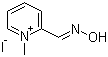 |
| Molecular Formula | C7H9N2O.I |
| Molecular Weight | 264.06 |
| CAS Registry Number | 94-63-3 |
| EC Number | 202-349-6 |
| SMILES | C[N+]1=CC=CC=C1/C=N/O.[I-] |
| Melting point | 220 °C (dec.) (Expl.) |
|---|---|
| Hazard Symbols |  GHS07 Warning Details GHS07 Warning Details | ||||||||
|---|---|---|---|---|---|---|---|---|---|
| Risk Statements | H302 Details | ||||||||
| Safety Statements | P264-P270-P301+P317-P330-P501 Details | ||||||||
| Hazard Classification | |||||||||
| |||||||||
| SDS | Available | ||||||||
 chemBlink Chemical Story
|
Pralidoxime iodide is a medication primarily used as an antidote for poisoning caused by organophosphates, which are commonly found in insecticides and nerve agents. It is a quaternary ammonium compound that works by reactivating acetylcholinesterase, an enzyme that is inhibited by organophosphates. When acetylcholinesterase is inhibited, acetylcholine accumulates at synaptic junctions, leading to overstimulation of the nervous system, which can result in symptoms such as muscle weakness, paralysis, respiratory failure, and potentially death. Organophosphate poisoning can occur in various settings, including agricultural environments where insecticides are used or in situations involving chemical warfare agents. The toxic effects of organophosphates are due to their ability to bind to and inhibit acetylcholinesterase, a critical enzyme responsible for breaking down acetylcholine in the nervous system. When acetylcholinesterase is inhibited, acetylcholine accumulates, leading to the overstimulation of muscarinic and nicotinic receptors, which causes symptoms such as salivation, lacrimation, urination, defecation, gastrointestinal distress, emesis, and bradycardia, as well as more severe effects like seizures and respiratory failure. Pralidoxime iodide works by binding to the organophosphate-enzyme complex and breaking the bond between the organophosphate and acetylcholinesterase, effectively reactivating the enzyme and restoring its normal function. This helps to reverse the toxic effects of acetylcholine accumulation. The effectiveness of pralidoxime iodide is greatest when administered early after exposure, as the bond between the organophosphate and acetylcholinesterase becomes more stable over time, reducing the chances of successful reactivation. Pralidoxime iodide is typically administered intravenously or intramuscularly, often in conjunction with atropine, another antidote used in the treatment of organophosphate poisoning. Atropine works by blocking the muscarinic effects of excess acetylcholine, which helps control symptoms such as excessive salivation, bronchorrhea, and bradycardia. The combination of pralidoxime iodide and atropine provides a more comprehensive approach to counteracting organophosphate toxicity. Although pralidoxime iodide is highly effective in treating organophosphate poisoning, its use is limited to cases involving cholinesterase inhibition. It is less effective for poisoning by other types of toxins that do not inhibit acetylcholinesterase. Additionally, its ability to reverse the effects of poisoning depends on the timing of administration, with earlier treatment leading to better outcomes. Delayed treatment or prolonged exposure to the toxic substance may result in irreversible binding and reduced efficacy of pralidoxime iodide. The compound is generally well tolerated, but side effects can occur, including headache, dizziness, and hypertension. In some cases, rapid infusion may cause tachycardia or other cardiovascular effects. Because of its quaternary ammonium structure, pralidoxime iodide has limited ability to cross the blood-brain barrier, which means it has minimal central nervous system effects but may be less effective against the neurological manifestations of poisoning in some cases. In addition to its use in organophosphate poisoning, pralidoxime iodide has been studied for potential use in other medical conditions, including certain types of poisoning involving neurotoxic substances, though its primary indication remains the treatment of organophosphate toxicity. In summary, pralidoxime iodide is an effective antidote for organophosphate poisoning, working by reactivating acetylcholinesterase and reversing the toxic effects of acetylcholine accumulation. It is typically administered in combination with atropine to improve outcomes. Its use is most beneficial when administered early after exposure to an organophosphate, and it remains a critical therapeutic tool in the management of poisoning in both clinical and emergency settings. References 1957. Pyridine-2-Aldoxime Methiodide and Poisoning by Anticholinesterases. Science (New York, N.Y.), 125(3251). DOI: 10.1126/science.125.3251.743 2024. Pralidoxime Is No Longer Fit for Purpose as an Antidote to Organophosphate Poisoning in the United Kingdom. Disaster Medicine and Public Health Preparedness, 18. DOI: 10.1017/dmp.2024.25 2024. Oxime-functionalized anti-insecticide fabric reduces insecticide exposure through dermal and nasal routes, and prevents insecticide-induced neuromuscular-dysfunction and mortality. Nature Communications, 15(1). DOI: 10.1038/s41467-024-49167-3 |
| Market Analysis Reports |