
Online Database of Chemicals from Around the World
| Hangzhou Verychem Science And Technology Co., Ltd. | China | |||
|---|---|---|---|---|
 | www.verychem.com | |||
 | +86 (571) 8816-2785 +86 13606544505 | |||
 | +86 (571) 8816-2787 | |||
 | lucy@verychem.com | |||
| Chemical manufacturer since 2004 | ||||
| chemBlink Massive supplier since 2021 | ||||
| Henan Haohai Industry Co., Ltd. | China | |||
|---|---|---|---|---|
| www.haohaichem.com | |||
| +86 (371) 6391-6105 | |||
| +86 (371) 6393-2448 | |||
| 3h@haohaichem.com | |||
| Chemical manufacturer | ||||
| chemBlink Standard supplier since 2006 | ||||
| Simagchem Corporation | China | |||
|---|---|---|---|---|
| www.simagchem.com | |||
| +86 13806087780 | |||
| +86 (592) 268-0237 | |||
| sale@simagchem.com | |||
| Chemical manufacturer since 2002 | ||||
| chemBlink Standard supplier since 2008 | ||||
| HBCChem, Inc. | USA | |||
|---|---|---|---|---|
| www.hbcchem-inc.com | |||
| +1 (510) 219-6317 | |||
| +1 (510) 675-0318 | |||
| sales@hbcchem-inc.com | |||
| Chemical manufacturer | ||||
| chemBlink Standard supplier since 2008 | ||||
| Hefei TNJ Chemical Industry Co., Ltd. | China | |||
|---|---|---|---|---|
| www.tnjchem.com | |||
| +86 (551) 6541-8684 | |||
| +86 (551) 6541-8697 | |||
| sales@tnjchem.com | |||
| Chemical manufacturer since 2001 | ||||
| chemBlink Standard supplier since 2010 | ||||
| BOC Sciences | USA | |||
|---|---|---|---|---|
| www.bocsci.com | |||
| +1 (631) 485-4226 | |||
| +1 (631) 614-7828 | |||
| info@bocsci.com | |||
| Chemical manufacturer | ||||
| chemBlink Standard supplier since 2010 | ||||
| LONGRE Pharmaceuticals Co., Ltd. | China | |||
|---|---|---|---|---|
| www.longrepharm.com | |||
| +86 (512) 6959-2836 +86 13306132836 | |||
| +86 (512) 6959-2835 | |||
| sales@longrepharm.com yuguojun1013@163.com | |||
| Chemical manufacturer since 2011 | ||||
| chemBlink Standard supplier since 2011 | ||||
| Shanghai Honovo Chemical Co., Ltd. | China | |||
|---|---|---|---|---|
| www.honovochem.com | |||
| +86 (21) 5892-6067 | |||
| +86 (21) 5892-6067 | |||
| sales@honovochem.com | |||
| Chemical distributor since 2015 | ||||
| chemBlink Standard supplier since 2015 | ||||
| Shanghai Witofly Chemical Co., Ltd. | China | |||
|---|---|---|---|---|
| www.witofly.com | |||
| +86 (21) 5063-0626 | |||
| +86 (21) 5056-3898 | |||
| sales@witofly.com | |||
 | QQ Chat | |||
| Chemical distributor since 2016 | ||||
| chemBlink Standard supplier since 2016 | ||||
| Shanghai 3s Technology Co., Ltd. | China | |||
|---|---|---|---|---|
| www.3s-tech.net | |||
| +86 (021) 5290-7809 | |||
| market@3s-tech.net | |||
| Chemical manufacturer since 2019 | ||||
| chemBlink Standard supplier since 2025 | ||||
| Kingchem Inc. | USA | |||
|---|---|---|---|---|
| www.kingchem.com | |||
| +1 (800) 211-4330 (201) 825-9988 | |||
| +1 (201) 825-9148 | |||
| customer-service@kingchem.com | |||
| Chemical manufacturer since 1994 | ||||
| Toronto Research Chemicals Inc. | Canada | |||
|---|---|---|---|---|
| www.trc-canada.com | |||
| +1 (416) 665-9696 | |||
| +1 (416) 665-4439 | |||
| info@trc-canada.com | |||
| Chemical manufacturer since 1982 | ||||
| Shanghai Worldyang Chemical Co., Ltd. | China | |||
|---|---|---|---|---|
| www.worldyachem.com | |||
| +86 13651600618 +86 (21) 5679-5779 | |||
| +86 (21) 5679-5266 | |||
| sales7777@worldyachem.com | |||
| QQ Chat | |||
 | WeChat: 13651600618 | |||
 | WhatsApp:+86 13651600618 | |||
| Chemical manufacturer since 2012 | ||||
| Frontier Scientific Services, Inc. | USA | |||
|---|---|---|---|---|
| www.frontierssi.com | |||
| +1 (302) 266-6891 (888) 577-2734 | |||
| +1 (302) 266-8296 | |||
| customerservice@frontierssi.com | |||
| Chemical manufacturer | ||||
| Classification | Organic raw materials >> Hydrocarbon compounds and their derivatives >> Aromatic hydrocarbon |
|---|---|
| Name | 2,4-Dichlorobenzyl chloride |
| Synonyms | alpha,2,4-Trichlorotoluene; 2,4-Dichlorobenzoylchloride |
| Molecular Structure | 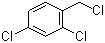 |
| Molecular Formula | C7H5Cl3 |
| Molecular Weight | 195.47 |
| CAS Registry Number | 94-99-5 |
| EC Number | 202-381-0 |
| SMILES | C1=CC(=C(C=C1Cl)Cl)CCl |
| Density | 1.4±0.1 g/cm3 Calc.*, 1.407 g/mL (Expl.) |
|---|---|
| Melting point | -2.6 °C (Expl.) |
| Boiling point | 248.3±25.0 °C 760 mmHg (Calc.)*, 248 °C (Expl.) |
| Flash point | 158.0±18.8 °C (Calc.)*, 113 °C (Expl.) |
| Index of refraction | 1.563 (Calc.)*, 1.576 (Expl.) |
| Melting point | -2.7 °C |
| Boiling point | 248 °C |
| Refractive index | 1.575-1.577 |
| Flash point | 190 °C |
| * | Calculated using Advanced Chemistry Development (ACD/Labs) Software. |
| Hazard Symbols |    GHS05;GHS07;GHS09 Danger Details GHS05;GHS07;GHS09 Danger Details | ||||||||||||||||||||||||||||||||||||||||||||||||||||||||||||||||
|---|---|---|---|---|---|---|---|---|---|---|---|---|---|---|---|---|---|---|---|---|---|---|---|---|---|---|---|---|---|---|---|---|---|---|---|---|---|---|---|---|---|---|---|---|---|---|---|---|---|---|---|---|---|---|---|---|---|---|---|---|---|---|---|---|---|
| Risk Statements | H302-H314-H315-H319-H332-H335-H400-H410-H411 Details | ||||||||||||||||||||||||||||||||||||||||||||||||||||||||||||||||
| Safety Statements | P260-P261-P264-P264+P265-P270-P271-P273-P280-P301+P317-P301+P330+P331-P302+P352-P302+P361+P354-P304+P340-P305+P351+P338-P305+P354+P338-P316-P317-P319-P321-P330-P332+P317-P337+P317-P362+P364-P363-P391-P403+P233-P405-P501 Details | ||||||||||||||||||||||||||||||||||||||||||||||||||||||||||||||||
| Hazard Classification | |||||||||||||||||||||||||||||||||||||||||||||||||||||||||||||||||
| |||||||||||||||||||||||||||||||||||||||||||||||||||||||||||||||||
| SDS | Available | ||||||||||||||||||||||||||||||||||||||||||||||||||||||||||||||||
 chemBlink Chemical Story
|
2,4-Dichlorobenzyl chloride is an organic compound with the molecular formula C7H5Cl2Cl. It consists of a benzene ring (C6H5) with two chlorine atoms attached at the 2 and 4 positions on the ring, and a chloromethyl group (-CH2Cl) attached to the benzene ring at the 1 position. This structure makes it a halogenated aromatic compound that is primarily used in organic synthesis. The synthesis of 2,4-dichlorobenzyl chloride typically involves the chloromethylation of 2,4-dichlorotoluene, using chloromethylating agents such as formaldehyde and hydrogen chloride (HCl). Under appropriate reaction conditions, the chloromethyl group (-CH2Cl) is introduced into the aromatic ring at the 1-position, leading to the formation of the desired product. Due to the presence of both chlorine atoms and the chloromethyl group, 2,4-dichlorobenzyl chloride is highly reactive and can undergo various chemical reactions. The chloromethyl group is an electrophilic center that can participate in nucleophilic substitution reactions. This reactivity makes 2,4-dichlorobenzyl chloride a useful intermediate for the synthesis of a wide range of organic compounds. The chloromethyl group can be replaced by other functional groups, such as amines, alcohols, or thiols, leading to the formation of derivatives with diverse chemical properties. One of the primary applications of 2,4-dichlorobenzyl chloride is in the preparation of various pharmaceuticals and agrochemicals. The reactivity of the chloromethyl group allows it to be used as a precursor for the introduction of biologically active substituents, which can enhance the pharmacological properties of the resulting compounds. For example, derivatives of 2,4-dichlorobenzyl chloride may have antimicrobial, anti-inflammatory, or anticancer properties, making them useful in drug discovery and development. In addition to its use in pharmaceuticals, 2,4-dichlorobenzyl chloride is employed in materials science for the preparation of functionalized polymers. The chloromethyl group can act as a cross-linking agent, allowing for the formation of networked polymer structures. These polymers may have improved mechanical, thermal, or chemical properties, making them useful in coatings, adhesives, and other applications where durable materials are required. 2,4-Dichlorobenzyl chloride can also be used in the synthesis of fluorescent compounds. The presence of the halogen atoms and the chloromethyl group can influence the electronic properties of the molecule, making it suitable for applications in organic electronics or fluorescence-based sensing. The compound can be further modified to create new molecules with specific optical properties, such as those used in dye-sensitized solar cells or light-emitting devices. While 2,4-dichlorobenzyl chloride has many applications in synthetic chemistry, it must be handled with caution. The chloromethyl group is reactive and can cause irritation or burns upon contact with the skin, eyes, or mucous membranes. It may also be toxic if inhaled or ingested. As such, it is important to follow proper safety protocols when working with this compound, including wearing protective equipment such as gloves, goggles, and lab coats, as well as ensuring adequate ventilation in the working environment. In summary, 2,4-dichlorobenzyl chloride is a versatile and reactive compound used primarily as an intermediate in organic synthesis. Its reactivity, particularly due to the chloromethyl group, makes it a valuable building block for the development of pharmaceuticals, agrochemicals, polymers, and fluorescent materials. However, as with many reactive chemicals, it must be handled with care to avoid exposure to its potentially harmful effects. References 2008. Distributed Drug Discovery, Part 2: Global Rehearsal of Alkylating Agents for the Synthesis of Resin-Bound Unnatural Amino Acids and Virtual D3 Catalog Construction. Journal of Combinatorial Chemistry, 11(1). DOI: 10.1021/cc800184v 2009. 2,4-Dichloro-1-[1-(2,4-dichloro-benz-yl-oxy)eth-yl]benzene. Acta Crystallographica. Section E, Structure Reports Online, 66(Pt 1). DOI: 10.1107/s1600536809053422 2013. Synthesis, biological screening and ADME prediction of benzylindole derivatives as novel anti-HIV-1, anti-fungal and anti-bacterial agents. Medicinal Chemistry Research, 22(6). DOI: 10.1007/s00044-012-0463-6 |
| Market Analysis Reports |