
Online Database of Chemicals from Around the World
| CAS: 95810-54-1 Product: Butonitazene No suppliers available. |
| Classification | Pharmaceutical intermediate >> Heterocyclic compound intermediate >> Pyrimidine compound >> Amine |
|---|---|
| Name | Butonitazene |
| Synonyms | 2-[2-[(4-butoxyphenyl)methyl]-5-nitrobenzimidazol-1-yl]-N,N-diethylethanamine |
| Molecular Structure | 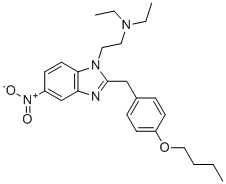 |
| Molecular Formula | C24H32N4O3 |
| Molecular Weight | 424.54 |
| CAS Registry Number | 95810-54-1 |
| SMILES | CCCCOC1=CC=C(C=C1)CC2=NC3=C(N2CCN(CC)CC)C=CC(=C3)[N+](=O)[O-] |
| Density | 1.2±0.1 g/cm3, Calc.* |
|---|---|
| Index of Refraction | 1.582, Calc.* |
| Boiling Point | 598.8±45.0 °C (760 mmHg), Calc.* |
| Flash Point | 315.9±28.7 °C, Calc.* |
| * | Calculated using Advanced Chemistry Development (ACD/Labs) Software. |
| SDS | Available |
|---|---|
 chemBlink Chemical Story
|
The chemical substance butonitazene is a synthetic opioid of the benzimidazole class, first synthesized during the late 1950s as part of analgesic research by Chemical Industries Basel (CIBA). It belongs to a group of 2-benzylbenzimidazole derivatives that were developed in a search for potent opioid analgesics. The synthesis involved modification of the benzimidazole core to incorporate various substituted benzyl and aminoethyl side chains, aiming to improve receptor affinity and analgesic potency. Butonitazene, chemically designated as 2-[(4-butoxyphenyl)methyl]-5-nitro-1-(2-pyrrolidin-1-ylethyl)benzimidazole, was one of several analogues that demonstrated high activity at the μ-opioid receptor. Although its analgesic potency was notable, its development for medical use was discontinued because of its high risk of dependency and lack of therapeutic advantages over existing opioids. After its initial synthesis, butonitazene remained largely a laboratory compound without industrial or clinical application. Its pharmacological profile is characterized by potent opioid receptor agonism, producing strong analgesic and sedative effects similar to those of etonitazene and isotonitazene. Comparative assays have shown that the potency of butonitazene can exceed that of morphine by several orders of magnitude. Despite its potential as an analgesic, it was never approved for therapeutic use in any country, and no medical formulations containing butonitazene were developed. In later years, renewed interest in benzimidazole opioids emerged because of their appearance in forensic toxicology. Analytical detection of butonitazene in biological samples has been reported in several toxicological investigations. Forensic laboratories identified butonitazene in samples linked to overdose fatalities and seizures of illicit drugs. In these cases, the compound was found either as a pure substance or in combination with other opioids such as fentanyl analogues. The detection of butonitazene in human biological specimens confirmed that it is active in vivo and that it contributes to opioid intoxication. The pharmacological manifestations include respiratory depression, sedation, and miosis, which are reversible with naloxone administration. Experimental studies of butonitazene metabolism have shown that the compound undergoes extensive biotransformation in human liver microsomes. Enzymatic assays demonstrated high intrinsic clearance values, indicating that it is rapidly metabolized. Cytochrome P450 isoforms such as CYP2D6, CYP2B6, and CYP2C8 have been implicated in the oxidative metabolism of butonitazene, leading to multiple hydroxylated and dealkylated metabolites. These metabolic pathways are consistent with those of other nitazene analogues and suggest that the parent compound may have a relatively short biological half-life despite its strong receptor affinity. Because of its high potency and the narrow margin between effective and toxic doses, butonitazene poses significant health risks when used outside controlled laboratory settings. Regulatory authorities have evaluated the available pharmacological and toxicological data and have classified butonitazene as a Schedule I controlled substance, indicating that it has no accepted medical use and a high potential for abuse. Its inclusion in this schedule aligns with other benzimidazole opioids that have been detected in the illicit drug supply. Although butonitazene was initially developed within the framework of legitimate pharmaceutical research, its rediscovery in modern illicit markets underscores the continuing public health challenge posed by synthetic opioids. The compound is now of interest primarily to forensic and analytical scientists who study its metabolism, toxicity, and occurrence in drug seizures. Research continues to refine analytical methods for its identification, including the use of ultra-high-performance liquid chromatography coupled with tandem mass spectrometry. These methods facilitate monitoring of butonitazene and related compounds in toxicological and law-enforcement contexts. Beyond this forensic application, there are no industrial or therapeutic uses of butonitazene known to date. |
| Market Analysis Reports |