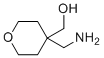
The chemical substance (4-(aminomethyl)tetrahydro-2H-pyran-4-yl)methanol is a functionalized tetrahydropyran derivative, notable for its role as a versatile intermediate in organic synthesis, particularly in pharmaceutical and medicinal chemistry. Its discovery and applications are well-established in the literature, rooted in the development of heterocyclic chemistry and the synthesis of amino alcohol derivatives.
The origins of this compound are tied to the broader study of tetrahydropyran derivatives, which have been explored since the early 20th century for their presence in natural products and utility as synthetic scaffolds. Tetrahydropyran, a six-membered oxygen-containing heterocycle, is valued for its structural similarity to sugars and its stability in synthetic transformations. The specific functionalization of (4-(aminomethyl)tetrahydro-2H-pyran-4-yl)methanol, incorporating both an aminomethyl and a hydroxymethyl group at the 4-position, emerged with advancements in heterocyclic synthesis during the late 20th century. These advancements included improved methods for introducing amino and alcohol functionalities, driven by the pharmaceutical industry’s need for polar, multifunctional molecules to serve as drug precursors. Techniques such as reductive amination and selective hydroxymethylation, refined in the 1970s and 1980s, enabled the precise construction of such compounds.
Synthetically, (4-(aminomethyl)tetrahydro-2H-pyran-4-yl)methanol is typically prepared from tetrahydro-2H-pyran-4-one or a related precursor. One common route involves the introduction of a nitrile or protected amine group at the 4-position via nucleophilic addition or substitution, followed by reduction to form the aminomethyl group. The hydroxymethyl group is often introduced through a formylation reaction, such as a crossed Cannizzaro reaction, or by reduction of a carboxylic acid or ester derivative. For example, starting with tetrahydro-2H-pyran-4-carbonitrile, reduction with lithium aluminum hydride can yield the aminomethyl group, while subsequent hydroxymethylation with formaldehyde under basic conditions affords the final compound. These steps rely on well-documented organic transformations, ensuring regioselectivity and high yields.
The primary application of (4-(aminomethyl)tetrahydro-2H-pyran-4-yl)methanol is as a synthetic intermediate in pharmaceutical chemistry. The tetrahydropyran ring provides a stable, polar scaffold that mimics carbohydrate-like structures, making it valuable in drug design. The aminomethyl group serves as a handle for forming amides, amines, or heterocycles, while the hydroxymethyl group enables further functionalization or acts as a hydrogen-bonding moiety in biological interactions. This compound is frequently used in the synthesis of enzyme inhibitors, receptor agonists, or other bioactive molecules where the polar functionalities enhance solubility and binding to target proteins. Its dual functional groups make it particularly suited for constructing complex molecules with specific pharmacokinetic properties.
Beyond pharmaceuticals, the compound is employed in academic research to study heterocyclic chemistry and the reactivity of amino alcohols. Its tetrahydropyran core is a model system for exploring stereoselective reactions and conformational analysis, while the amino and hydroxyl groups allow investigations into hydrogen-bonding effects and nucleophilic reactivity. The compound also finds use in the synthesis of specialty chemicals, such as ligands for catalysis or intermediates for agrochemicals, where its polar nature and heterocyclic structure are advantageous.
The significance of (4-(aminomethyl)tetrahydro-2H-pyran-4-yl)methanol lies in its role as a multifunctional building block that bridges heterocyclic chemistry with practical applications. Its development reflects progress in synthetic methodologies for oxygen-containing heterocycles and polar functional groups. By enabling the efficient synthesis of biologically relevant molecules, it has become a valuable tool in advancing pharmaceutical research and chemical innovation.
|





 GHS05;GHS07 Danger Details
 chemBlink Chemical Story