
Online Database of Chemicals from Around the World
| Changzhou Lanming Science and Technology Co., Ltd. | China | |||
|---|---|---|---|---|
 | www.lmkjcz.com | |||
 | +86 (519) 8881-6918 +86 13906110072 +86 13915000734 | |||
 | +86 (519) 8825-5676 | |||
 | lmkj@lmkjcz.com | |||
 | QQ Chat | |||
| Chemical manufacturer | ||||
| chemBlink Standard supplier since 2007 | ||||
| Simagchem Corporation | China | |||
|---|---|---|---|---|
| www.simagchem.com | |||
| +86 13806087780 | |||
| +86 (592) 268-0237 | |||
| sale@simagchem.com | |||
| Chemical manufacturer since 2002 | ||||
| chemBlink Standard supplier since 2008 | ||||
| Hefei TNJ Chemical Industry Co., Ltd. | China | |||
|---|---|---|---|---|
| www.tnjchem.com | |||
| +86 (551) 6541-8684 | |||
| +86 (551) 6541-8697 | |||
| sales@tnjchem.com | |||
| Chemical manufacturer since 2001 | ||||
| chemBlink Standard supplier since 2010 | ||||
| BOC Sciences | USA | |||
|---|---|---|---|---|
| www.bocsci.com | |||
| +1 (631) 485-4226 | |||
| +1 (631) 614-7828 | |||
| info@bocsci.com | |||
| Chemical manufacturer | ||||
| chemBlink Standard supplier since 2010 | ||||
| Hangzhou Leap Chem Co., Ltd. | China | |||
|---|---|---|---|---|
| www.leapchem.com | |||
| +86 (571) 8771-1850 | |||
| market19@leapchem.com | |||
| QQ Chat | |||
| Chemical manufacturer since 2006 | ||||
| chemBlink Standard supplier since 2015 | ||||
| Coresyn Pharmatech Co., Ltd. | China | |||
|---|---|---|---|---|
| www.coresyn.com | |||
| +86 (571) 8662-6709 | |||
| sales@coresyn.com | |||
| Chemical manufacturer | ||||
| chemBlink Standard supplier since 2016 | ||||
| Turtle Pharma Private Limited | India | |||
|---|---|---|---|---|
| www.turtlepharma.com | |||
| +91 9850998504 | |||
| info@turtlepharma.com | |||
| Chemical manufacturer since 2015 | ||||
| chemBlink Standard supplier since 2024 | ||||
| Kemprotec Limited | UK | |||
|---|---|---|---|---|
| www.kemprotec.com | |||
| +44 (1642) 591-764 | |||
| +44 (1845) 550-001 | |||
| sales@kemprotec.co.uk | |||
| Chemical distributor since 1998 | ||||
| LKT Laboratories, Inc. | USA | |||
|---|---|---|---|---|
| www.lktlabs.com | |||
| +1 (888) 558-5227 | |||
| +1 (651) 644-8357 | |||
| peacerli@mbolin-lktlabs.com | |||
| Chemical manufacturer | ||||
| Classification | API >> Synthetic anti-infective drugs >> Quinolone |
|---|---|
| Name | Lomefloxacin hydrochloride |
| Synonyms | 1-Ethyl-6,8-difluoro-1,4-dihydro-7-(3-methyl-1-piperazinyl)-4-oxo-3-quinolinecarboxylic acid hydrochloride |
| Molecular Structure | 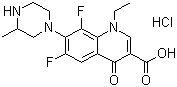 |
| Molecular Formula | C17H19F2N3O3.HCl |
| Molecular Weight | 387.81 |
| CAS Registry Number | 98079-52-8 |
| EC Number | 627-337-1 |
| SMILES | CCN1C=C(C(=O)C2=CC(=C(C(=C21)F)N3CCNC(C3)C)F)C(=O)O.Cl |
| Solubility | 1 mg/mL (DMSO), 6 mg/mL (water) |
|---|---|
| Hazard Symbols |  GHS07 Warning Details GHS07 Warning Details | ||||||||||||
|---|---|---|---|---|---|---|---|---|---|---|---|---|---|
| Risk Statements | H302 Details | ||||||||||||
| Safety Statements | P264-P270-P301+P317-P330-P501 Details | ||||||||||||
| Hazard Classification | |||||||||||||
| |||||||||||||
| SDS | Available | ||||||||||||
 chemBlink Chemical Story
|
Lomefloxacin hydrochloride is a member of the fluoroquinolone class of antibiotics, developed for the treatment of bacterial infections. It was introduced in the late 1980s as a more potent alternative to earlier fluoroquinolones, offering significant improvements in antibacterial efficacy and pharmacokinetics. The discovery of lomefloxacin emerged from the ongoing search for new and more effective antibiotics to combat a growing range of bacterial infections. The fluoroquinolone class, known for its broad-spectrum activity, already included ciprofloxacin and norfloxacin, which demonstrated effectiveness against various Gram-negative and Gram-positive bacteria. Lomefloxacin was designed to enhance these properties and provide better clinical outcomes, particularly for infections resistant to other antibiotics. Lomefloxacin hydrochloride functions by inhibiting bacterial DNA gyrase and topoisomerase IV, key enzymes involved in DNA replication and repair. By interfering with these processes, lomefloxacin disrupts bacterial cell division, leading to the death of the bacteria. This mechanism of action is similar to other fluoroquinolones but with optimized activity against certain pathogens. The primary applications of lomefloxacin hydrochloride include the treatment of respiratory tract infections, urinary tract infections, and skin infections. Its broad-spectrum activity makes it suitable for managing infections caused by a variety of bacteria, including those resistant to other antibiotics. Lomefloxacin is typically administered orally, with good absorption and distribution throughout the body, which allows for effective treatment of systemic infections. One of the key advantages of lomefloxacin hydrochloride is its improved pharmacokinetic profile compared to some earlier fluoroquinolones. It achieves high plasma concentrations and is well-absorbed from the gastrointestinal tract, ensuring effective treatment of infections. Additionally, lomefloxacin has a relatively long half-life, allowing for once-daily dosing in many cases, which enhances patient compliance. Despite its benefits, the use of lomefloxacin hydrochloride is not without concerns. As with other antibiotics, there is a risk of developing antibiotic resistance, particularly if the drug is used inappropriately or overused. Resistance mechanisms include mutations in the target enzymes or increased efflux of the drug out of bacterial cells. Therefore, it is crucial to use lomefloxacin judiciously and in accordance with clinical guidelines to minimize the risk of resistance. Side effects of lomefloxacin hydrochloride are generally mild but can include gastrointestinal disturbances, such as nausea and diarrhea, as well as potential central nervous system effects, such as dizziness or headache. Patients should be monitored for any adverse reactions, and the drug should be used with caution in individuals with certain medical conditions or those taking other medications that may interact with lomefloxacin. In summary, lomefloxacin hydrochloride represents a valuable advancement in the fluoroquinolone class of antibiotics, offering enhanced efficacy and a favorable pharmacokinetic profile. Its ability to treat a wide range of bacterial infections makes it an important tool in modern antibiotic therapy. However, its use must be managed carefully to ensure its effectiveness and to prevent the emergence of resistance. References 2023. Determination of elemental impurities in lomefloxacin hydrochloride ear drops by inductively coupled plasma‐mass spectrometry using oxygen reaction mode and study of their catalytic effect on photodegradation reaction. Rapid communications in mass spectrometry : RCM, 37(3). DOI: 10.1002/rcm.9468 2022. Photocatalytic degradation of lomefloxacin antibiotics using hydrothermally synthesized magnesium titanate under visible light-driven energy sources. Environmental science and pollution research international, 29(29). DOI: 10.1007/s11356-022-20540-3 2022. Changes in the Oxidation-Reduction State of Human Dermal Fibroblasts as an Effect of Lomefloxacin Phototoxic Action. Cells, 11(12). DOI: 10.3390/cells11121971 |
| Market Analysis Reports |