
Online Database of Chemicals from Around the World
| Changzhou Dongchen Pharmtech Co., Ltd. | China | |||
|---|---|---|---|---|
 | www.dcpharmtech.com | |||
 | +86 (519) 8899-5800 | |||
 | +86 (519) 8899-5808 | |||
 | gjf@dcpharmtech.com jeffrey_gjf@hotmail.com | |||
 | QQ Chat | |||
| Chemical manufacturer since 2012 | ||||
| chemBlink Standard supplier since 2013 | ||||
| Pure Chemistry Scientific Inc | USA | |||
|---|---|---|---|---|
| www.purechems.com | |||
| +1 (888) 588-9418 | |||
| +1 (617) 206-9595 | |||
| sales@purechems.com | |||
| Chemical manufacturer since 2004 | ||||
| chemBlink Standard supplier since 2014 | ||||
| Shanghai Edu Chemical Technology Co., Ltd. | China | |||
|---|---|---|---|---|
| www.chemido.com | |||
| +86 19301251526 | |||
| sales1@chemido.com | |||
| QQ Chat | |||
| Chemical manufacturer since 2011 | ||||
| chemBlink Standard supplier since 2025 | ||||
| BioBlocks Inc. | USA | |||
|---|---|---|---|---|
| www.bioblocks.com | |||
| +1 (858) 558-5900 | |||
| +1 (858) 558-5911 | |||
| sales@bioblocks.com | |||
| Chemical manufacturer | ||||
| Activate Scientific GmbH | Germany | |||
|---|---|---|---|---|
| www.activate-scientific.com | |||
| +49 (8051) 965-1660 | |||
| +49 (8051) 965-1661 | |||
| rschmitt@activate-scientific.com | |||
| Chemical manufacturer | ||||
| W & J PharmaChem, Inc. | USA | |||
|---|---|---|---|---|
| www.wjpharmachem.com | |||
| +1 (301) 880-0624 | |||
| +1 (301) 434-9366 | |||
| info@wjpharmachem.com | |||
| Chemical manufacturer | ||||
| Ramidus AB | Sweden | |||
|---|---|---|---|---|
| www.ramidus.se | |||
| +46 (46) 286-2850 | |||
| +46 (46) 286-2851 | |||
| info@ramidus.se | |||
| Chemical manufacturer | ||||
| Classification | Pharmaceutical intermediate >> Heterocyclic compound intermediate >> Quinoline compound |
|---|---|
| Name | 6-Bromo-4-hydroxyquinoline-3-carboxylic acid |
| Molecular Structure | 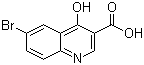 |
| Molecular Formula | C10H6BrNO3 |
| Molecular Weight | 268.06 |
| CAS Registry Number | 98948-95-9 |
| EC Number | 804-515-9 |
| SMILES | C1=CC2=C(C=C1Br)C(=O)C(=CN2)C(=O)O |
| Density | 1.9±0.1 g/cm3 Calc.* |
|---|---|
| Boiling point | 436.9±45.0 °C 760 mmHg (Calc.)* |
| Flash point | 218.0±28.7 °C (Calc.)* |
| Index of refraction | 1.751 (Calc.)* |
| * | Calculated using Advanced Chemistry Development (ACD/Labs) Software. |
| Hazard Symbols |  GHS07 Warning Details GHS07 Warning Details | ||||||||||||||||||||||||
|---|---|---|---|---|---|---|---|---|---|---|---|---|---|---|---|---|---|---|---|---|---|---|---|---|---|
| Risk Statements | H319 Details | ||||||||||||||||||||||||
| Safety Statements | P264+P265-P280-P305+P351+P338-P337+P317 Details | ||||||||||||||||||||||||
| Hazard Classification | |||||||||||||||||||||||||
| |||||||||||||||||||||||||
| SDS | Available | ||||||||||||||||||||||||
 chemBlink Chemical Story
|
6-Bromo-4-hydroxyquinoline-3-carboxylic acid is a halogenated quinoline derivative featuring a bromine atom at the sixth position, a hydroxy group at the fourth position, and a carboxylic acid group at the third position of the quinoline ring. The quinoline scaffold is a bicyclic heteroaromatic system known for its biological and chemical versatility, and substitution with halogens, hydroxyl, and carboxyl groups modulates both electronic properties and reactivity. The combination of these functional groups enables selective chemical transformations and facilitates interactions with biological targets, making the compound a valuable intermediate in pharmaceutical and synthetic chemistry. The synthesis of 6-bromo-4-hydroxyquinoline-3-carboxylic acid typically begins with appropriately substituted aniline or quinoline precursors, which are functionalized via halogenation, hydroxylation, and carboxylation reactions. Bromination at the 6-position is usually achieved under controlled conditions to avoid polyhalogenation, while the hydroxy and carboxylic acid groups are introduced through oxidation or condensation strategies. Purification is commonly accomplished by recrystallization or chromatography, yielding a crystalline solid with defined chemical composition and functional integrity. In organic synthesis, 6-bromo-4-hydroxyquinoline-3-carboxylic acid serves as a versatile building block for the preparation of substituted quinoline derivatives. The bromine atom at the 6-position enables palladium-catalyzed cross-coupling reactions, such as Suzuki or Buchwald–Hartwig couplings, to introduce aryl, heteroaryl, or alkyl groups. The hydroxy group allows for derivatization via etherification, esterification, or acylation, while the carboxylic acid can be activated for amide bond formation or esterification. These multiple reactive sites make the compound suitable for constructing complex molecular architectures with tunable chemical and physical properties. In medicinal chemistry, derivatives of 6-bromo-4-hydroxyquinoline-3-carboxylic acid have been explored as scaffolds for bioactive compounds, including antimicrobial, anticancer, and enzyme inhibitory agents. The planar quinoline core allows π–π stacking interactions and hydrogen bonding with protein targets, while substitution at the 4, 3, and 6 positions modulates solubility, binding affinity, and metabolic stability. The compound’s versatility facilitates systematic modification of the scaffold to optimize pharmacological activity and specificity. The compound is also utilized in chemical research for methodology development and materials chemistry. The brominated position and reactive hydroxy and carboxylic acid groups allow exploration of selective functionalization techniques, cross-coupling reactions, and heterocycle derivatization strategies. In materials science, quinoline derivatives are studied for their optical, electronic, and coordination properties, and 6-bromo-4-hydroxyquinoline-3-carboxylic acid can serve as a precursor for such functional materials. Physically, 6-bromo-4-hydroxyquinoline-3-carboxylic acid is a stable solid under ambient conditions with moderate solubility in polar organic solvents such as dimethylformamide, dimethyl sulfoxide, and ethanol. It is generally stable to light and air but should be protected from strong oxidizing or reducing agents to maintain functional group integrity. The combination of stability and reactivity makes it suitable for multistep synthesis and derivatization in both laboratory and industrial settings. Overall, 6-bromo-4-hydroxyquinoline-3-carboxylic acid is a chemically versatile halogenated quinoline derivative. Its bromine, hydroxy, and carboxylic acid functional groups provide multiple avenues for selective transformations, enabling the synthesis of biologically active compounds, complex heterocyclic molecules, and functional materials. Its structural features and reactivity make it a key intermediate in synthetic and medicinal chemistry. References 2022. Discovery of small molecule inhibitors of Plasmodium falciparum apicoplast DNA polymerase. Journal of Enzyme Inhibition and Medicinal Chemistry, 37(1). DOI: 10.1080/14756366.2022.2070909 2014. A High-Throughput Assay to Identify Inhibitors of the Apicoplast DNA Polymerase from Plasmodium falciparum. Journal of Biomolecular Screening, 19(5). DOI: 10.1177/1087057114528738 2006. Evaluation of 3-Carboxy-4(1H)-quinolones as Inhibitors of Human Protein Kinase CK2. Journal of Medicinal Chemistry, 49(22). DOI: 10.1021/jm050048t |
| Market Analysis Reports |