
Online Database of Chemicals from Around the World
| Jiangsu Evergreen New Material Technology Incorporated | China | |||
|---|---|---|---|---|
 | www.cqs-hm.com | |||
 | +86 (025) 8491-1160 | |||
 | flora.wang@cqsgfz.cn | |||
 | QQ Chat | |||
 | Skype Chat | |||
 | WeChat: 13605178468 | |||
 | WhatsApp:+8613605178468 | |||
| Chemical manufacturer since 2010 | ||||
| chemBlink Standard supplier since 2024 | ||||
| Classification | Chemical reagent >> Organic reagent >> Aromatic hydrocarbon reagent |
|---|---|
| Name | 1,3-Diisopropylbenzene |
| Synonyms | 3-Isopropylcumene |
| Molecular Structure | 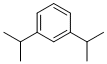 |
| Molecular Formula | C12H18 |
| Molecular Weight | 162.27 |
| CAS Registry Number | 99-62-7 |
| EC Number | 202-773-1 |
| SMILES | CC(C)C1=CC(=CC=C1)C(C)C |
| Solubility | 4.325 mg/L (25 °C water) |
|---|---|
| Density | 0.9±0.1 g/cm3, Calc.*, 0.856 g/mL |
| Index of Refraction | 1.488, Calc.*, 1.489 |
| Melting point | -63.1 °C |
| Boiling Point | 203.2±0.0 °C (760 mmHg), Calc.*, 206.62 °C |
| Flash Point | 76.7±0.0 °C, Calc.*, 76 °C |
| * | Calculated using Advanced Chemistry Development (ACD/Labs) Software. |
| Hazard Symbols |    GHS07;GHS08;GHS09 Danger Details GHS07;GHS08;GHS09 Danger Details | ||||||||||||||||||||||||||||||||
|---|---|---|---|---|---|---|---|---|---|---|---|---|---|---|---|---|---|---|---|---|---|---|---|---|---|---|---|---|---|---|---|---|---|
| Risk Statements | H304-H335-H336-H361-H400-H410 Details | ||||||||||||||||||||||||||||||||
| Safety Statements | P203-P261-P271-P273-P280-P301+P316-P304+P340-P318-P319-P331-P391-P403+P233-P405-P501 Details | ||||||||||||||||||||||||||||||||
| Hazard Classification | |||||||||||||||||||||||||||||||||
| |||||||||||||||||||||||||||||||||
| SDS | Available | ||||||||||||||||||||||||||||||||
 chemBlink Chemical Story
|
1,3-Diisopropylbenzene, also known as meta-diisopropylbenzene, is an aromatic hydrocarbon with the chemical formula C12H18. It consists of a benzene ring attached to two isopropyl groups (–CH2–CH3) at the 1 and 3 positions of the benzene ring. This compound is one of the isomers of diisopropylbenzene, with the other isomers being 1,2-diisopropylbenzene and 1,4-diisopropylbenzene. 1,3-Diisopropylbenzene is produced through the alkylation of benzene with isopropyl alcohol or isopropene in the presence of an acid catalyst. The compound is typically used as an intermediate in the synthesis of other chemicals or as a solvent in certain applications. It is also known to be used in the production of high-performance polymers and resins due to its chemical stability and solvent properties. One notable application of 1,3-diisopropylbenzene is in the production of phenol through the cumene process, although it is less commonly used than other alkylated aromatics like cumene itself. In this process, 1,3-diisopropylbenzene is oxidized to produce phenol, a key industrial chemical used in the manufacture of plastics, resins, and pharmaceuticals. Due to its chemical structure, 1,3-diisopropylbenzene is also used in the manufacture of certain types of lubricants, surfactants, and as a starting material for the production of alkylated aromatic compounds. Its relatively high boiling point and low vapor pressure make it a suitable solvent in various applications, particularly where stable, non-volatile solvents are required. In addition to its industrial uses, 1,3-diisopropylbenzene has been studied in the context of its environmental and toxicological properties. However, there is limited data on its specific toxicity, though it is considered to share similar properties with other alkylated benzene derivatives, which can exhibit toxicity if handled improperly or in large quantities. In conclusion, 1,3-diisopropylbenzene is an important industrial chemical used in the production of phenol, lubricants, and alkylated aromatic compounds. Its stability, solvent properties, and use as an intermediate in chemical synthesis make it a valuable component in several industrial processes. References 2024. Alkylation of azoles with alkenes catalyzed by the NiCl2Py2/IMes • HCl/ButONa system. Russian Chemical Bulletin, 73(9). DOI: 10.1007/s11172-024-4380-x 2024. Nano-liquid Metal Manufacture. Handbook of Liquid Metals, 28. DOI: 10.1007/978-981-97-1614-2_28 2023. Non-targeted metabolomics analysis of metabolite changes in two quinoa genotypes under drought stress. BMC Plant Biology, 23(10). DOI: 10.1186/s12870-023-04467-6 |
| Market Analysis Reports |