Online Database of Chemicals from Around the World

2-Propylpentanoic acid
[CAS# 99-66-1]

List of Suppliers
Yancheng Langde Chemical & Pharmaceutical Co., Ltd. China Inquire
www.langdechem.com
+86 (515) 8835-9955
+86 13705103058
+86 (515) 8835-7955
langdechem@163.com
QQ Chat
Chemical manufacturer since 2006
chemBlink Standard supplier since 2006
Hefei TNJ Chemical Industry Co., Ltd. China Inquire
www.tnjchem.com
+86 (551) 6541-8684
+86 (551) 6541-8697
sales@tnjchem.com
Chemical manufacturer since 2001
chemBlink Standard supplier since 2010
Apexbio Technology LLC USA Inquire
www.apexbt.com
+1 (832) 696-8203
+1 (855) 527-3928
info@apexbt.com
Chemical manufacturer since 2012
chemBlink Standard supplier since 2013
Liyang Yongan Fine Chemical Co., Ltd. China Inquire
www.winan.cn
+86 (519) 8762-7222
dl419512@163.com
Chemical manufacturer since 1997
chemBlink Standard supplier since 2014
Medilink Pharmachem India Inquire
www.medilinkpharma.com
+91 (79) 3007-0133
+91 (79) 4007-4175
exports@medilinkpharma.com
Chemical distributor since 1996
chemBlink Standard supplier since 2014
Hangzhou Leap Chem Co., Ltd. China Inquire
www.leapchem.com
+86 (571) 8771-1850
market19@leapchem.com
QQ Chat
Chemical manufacturer since 2006
chemBlink Standard supplier since 2015
Hebei Chenguang Tianrun Pharmaceutical Co., Ltd. China Inquire
www.cgtrzy.com
+86 17333956889
hbcgtr@126.com
QQ Chat
WeChat: Hebei Chenguang Tianrun Pharma Co., Ltd.
Chemical manufacturer since 2019
chemBlink Standard supplier since 2025
Katwijk Chemie B.V. Netherlands Inquire
www.katwijk-chemie.nl
+31 (71) 405-6789
+31 (71) 405-6700
sales@katwijk-chemie.nl
Chemical manufacturer since 1914

Identification
ClassificationAPI >> Nervous system medication >> Antiepileptic and anticonvulsant
Name2-Propylpentanoic acid
SynonymsDipropylacetic acid; Valproic acid
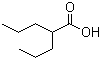
Molecular StructureCAS # 99-66-1, 2-Propylpentanoic acid
Molecular FormulaC8H16O2
Molecular Weight144.21
CAS Registry Number99-66-1
EC Number202-777-3
SMILESCCCC(CCC)C(=O)O
Properties
Solubility10 mM (water) (Expl.)
Density0.9±0.1 g/cm3, Calc.*
Index of Refraction1.435, Calc.*
Boiling Point220.0 °C (760 mmHg), Calc.*, 220 °C (Expl.)
Flash Point111.1 °C, Calc.*, 126 °C (Expl.)
*Calculated using Advanced Chemistry Development (ACD/Labs) Software.
Safety Data
Hazard Symbolssymbol symbol symbol   GHS05;GHS07;GHS08 Danger  Details
Risk StatementsH302-H315-H318-H319-H335-H360  Details
Safety StatementsP203-P261-P264-P264+P265-P270-P271-P280-P301+P317-P302+P352-P304+P340-P305+P351+P338-P305+P354+P338-P317-P318-P319-P321-P330-P332+P317-P337+P317-P362+P364-P403+P233-P405-P501  Details
Hazard Classification
up    Details
HazardClassCategory CodeHazard Statement
Acute toxicityAcute Tox.4H302
Skin irritationSkin Irrit.2H315
Eye irritationEye Irrit.2H319
Reproductive toxicityRepr.1AH360
Specific target organ toxicity - single exposureSTOT SE3H335
Serious eye damageEye Dam.1H318
Reproductive toxicityRepr.1BH360
Reproductive toxicityRepr.1AH360D
Acute toxicityAcute Tox.4H332
Acute toxicityAcute Tox.4H312
Skin corrosionSkin Corr.1BH314
SDSAvailable
up Discovery and Applications
2-Propylpentanoic acid, commonly known as valproic acid, is a carboxylic acid derivative that was first synthesized in the late 19th century. Initially, it was used as an organic solvent due to its lipophilic properties. However, its pharmacological potential was discovered in the 1960s when researchers observed its anticonvulsant activity. Since then, valproic acid has been widely used in medicine, primarily for the treatment of epilepsy and other neurological disorders.

Valproic acid acts by increasing the availability of gamma-aminobutyric acid (GABA), an inhibitory neurotransmitter in the central nervous system. This effect helps to stabilize neuronal activity, making it effective in controlling seizures. In addition to its role as an anticonvulsant, valproic acid has mood-stabilizing properties and is commonly prescribed for bipolar disorder. It is also used as a preventive treatment for migraine headaches.

Valproic acid is available in various formulations, including sodium valproate and divalproex sodium, which differ in their pharmacokinetic profiles but share the same therapeutic effects. The drug is well absorbed following oral administration, with metabolism occurring primarily in the liver through glucuronidation and mitochondrial β-oxidation. Due to its hepatic metabolism, interactions with other drugs that affect liver enzymes can influence its plasma levels and efficacy.

In clinical use, valproic acid is generally well tolerated, though it has known adverse effects, including gastrointestinal disturbances, weight gain, tremors, and hepatotoxicity in rare cases. Its use during pregnancy is associated with an increased risk of teratogenic effects, particularly neural tube defects, which has led to strict guidelines regarding its administration in women of childbearing potential.

Beyond its established applications in neurology and psychiatry, valproic acid has been investigated for its potential effects in other medical conditions, including neurodegenerative diseases and certain types of cancer. However, its primary role remains in the management of epilepsy and bipolar disorder, where it continues to be a key therapeutic agent.

References

2025. DNA methylation profiles of transgenerational rat hyperactivity primed by silver nanoparticles: Comparison with valproate model rats of autism. Behavioural Brain Research, 477.
DOI: 10.1016/j.bbr.2024.115293

2025. Valproic acid-induced oxidative stress: Systematic review, meta-analysis and network pharmacology highlights disruption in antioxidant pathways in rodents. Toxicology and Applied Pharmacology, 484.
DOI: 10.1016/j.taap.2024.117160

2024. Glutamic Acid Decarboxylase 65 Antibody-associated Epilepsy and Diplopia: Two Case Reports with Literature Review. Cerebellum (London, England), 23(6).
DOI: 10.1007/s12311-024-01768-w
Market Analysis Reports
List of Reports Available for 2-Propylpentanoic acid
Related Products
Propyl Paraben ...  n-Propyl Pelarg...  Propyl pentacon...  (2E)-2-Propylpe...  (E/Z)-2-Propyl-...  2-Propylpentana...  N-Propyl-3-pent...  3-n-Propyl-2,4-...  2-Propylpentane...  2-Propylpentano...  2-Propyl-Pentan...  2-Propylpentano...  2-Propyl-1-pent...  N-(2-Propylpent...  2-Propylpent-4-...  4-Propyl-4-Pent...  2-Propyl-4-Pent...  (E)-2-Propylpen...  2-Propyl-3-pent...  2-(2-Propylpent...