Because some particles are simply too small to settle.
Clay, organic matter, and other microscopic particles can remain suspended in water because they carry electrical charges that keep them apart. Instead of sinking, they continually repel one another and float almost indefinitely.
Water treatment plants solve this problem with a clever piece of chemistry called coagulation.
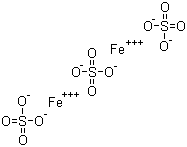
Ferric sulfate is one of the chemicals used for this job.
When added to water under suitable conditions, ferric ions form tiny iron hydroxide particles. These help neutralize electrical charges and sweep suspended material into increasingly larger clusters called flocs.

Global Chemical Database