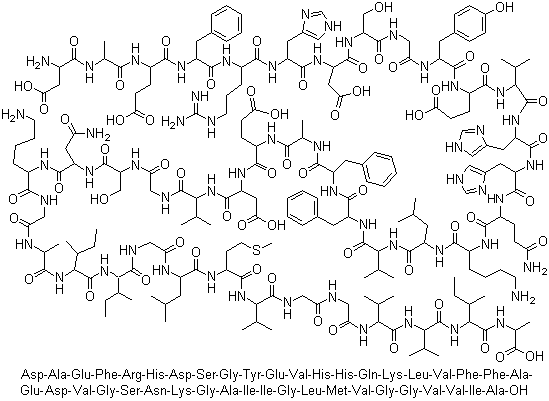
beta-Amyloid (1-42) human
CAS 107761-42-2
Aβ42 is only 42 amino acids long, but its unusual tendency to aggregate made it one of the defining molecules of Alzheimer's research.
beta-Amyloid (1-42) human (CAS 107761-42-2) shows how molecular structure determines chemical role. Human beta-amyloid (1-42), often written Aβ42, is a 42-amino-acid peptide and one of the most intensively studied molecules in Alzheimer's disease research. It is generated by proteolytic processing of amyloid precursor protein (APP). Compared with shorter Aβ species, the 42-residue peptide has a strong tendency to self-associate and form beta-sheet-rich oligomers and fibrils. Early 1990s studies using synthetic amyloid peptides demonstrated the importance of sequence length and secondary structure for filament formation, helping establish aggregation as a central experimental problem in Alzheimer's research. CAS 107761-42-2 is widely used for synthetic human Aβ(1-42) research material; commercial preparations list a molecular weight near 4514 Da. The peptide is a research reagent and disease-associated biomolecule, not an.
Published:
2026-10-01